MOSCOW: A group of weary-looking Indian men carrying sports bags queued at passport control at a busy Moscow airport one recent evening after flying over 2,700 miles — and via Uzbekistan — to get work.
“I have a contract for one year. In the rubbish disposal business. The money is good,” said Ajit, one of the men, speaking in English.
Faced with what the authorities say is an immediate shortage of at least 2.3 million workers, a shortfall exacerbated by the strain of Russia’s war in Ukraine and one that Russia’s traditional source of foreign labor — Central Asians — is not able to fill, Moscow is turning to a new supplier: India.
Indian influx helps Russia make up labor shortfall
In 2021, a year before Russia sent its troops into Ukraine, some 5,000 work permits were approved for Indian nationals. Last year, almost 72,000 permits were okayed for Indians — nearly a third of the total annual quota for migrant workers on visas.
“Currently, expatriate employees from India are the most popular,” said Alexei Filipenkov, director of a company that brings in Indian workers.
He said workers from ex-Soviet Central Asia, who do not need visas, had stopped coming in sufficient numbers. Official figures show they still made up the majority of some 2.3 million legal foreign workers not requiring a visa last year, however.
But a weaker ruble, tougher migration laws, and increasingly sharp anti-immigrant rhetoric from Russian politicians have eroded their numbers and encouraged Moscow to boost visa quotas for workers from elsewhere.
The choice of India for unskilled labor reflects strong defense and economic ties between Moscow and New Delhi.
India has been buying discounted Russian oil that Moscow — due to Western sanctions — cannot easily sell elsewhere, although that may now be in question.
President Vladimir Putin and Indian Prime Minister Narendra Modi signed a deal in December to make it easier for Indians to work in Russia. Denis Manturov, Russia’s first deputy prime minister, said at the time that Russia could accept an “unlimited number” of Indian workers.
At least 800,000 people were needed in manufacturing, and another 1.5 million in the service and construction sectors, he said.
Indians working in Russian factories and farms
Brera Intex, a Moscow textiles company, has hired around 10 workers from South Asia, including Indians, to make curtains and bed linen.
Sat at a sewing machine, 23-year-old Gaurav from India said he had been working in Russia for three months.
“I was told to come (over) to this side, that the work and money are good,” he said. “Russian life is very good.”
Married with two children, he said he spoke to his family back in India by phone every day and told them he missed them.
Olga Lugovskaya, the company’s owner, said the workers — with the help of samples and supervision — had picked up the work in time and were highly motivated.
“Some of the guys who came in didn’t even know how to switch on a sewing machine,” she said. “(But) after two or three months, you could already trust them to sew a proper finished item.”
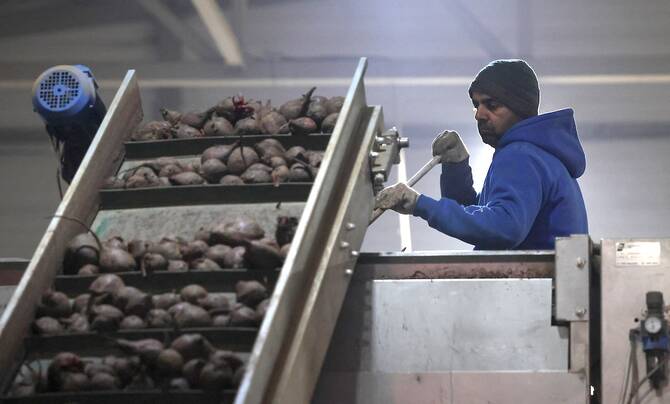
Outside Moscow, the Sergiyevsky farm relies on Indian workers too, using them to process and pack vegetables for an average salary of about 50,000 rubles ($660) per month, a salary for which the farm says locals will not work.
“I have been working here, at Sergiyevsky, for one year,” said Sahil, 23, who said he was from India’s Punjab region.
“In India there is little money, but here there is a lot of money. The work is here.”
US pressure on India to halt its purchases of Russian oil — something President Donald Trump has linked to a trade deal between the United States and India announced this month — could yet dampen Moscow’s appetite for Indian workers.
But for now it’s unclear how New Delhi will recalibrate its oil purchases, and Moscow has played down any suggestion of tensions.


![]()

Russia, facing labor crunch worsened by war, pivots to India for workers
Short Url
https://arab.news/6z8ay
Russia, facing labor crunch worsened by war, pivots to India for workers
- Migrant labor crucial to Russia’s war economy
- Russia is employing fewer workers from Central Asia


Latest updates


Recommended


© 2026 SAUDI RESEARCH & PUBLISHING COMPANY, All Rights Reserved And subject to Terms of Use Agreement.