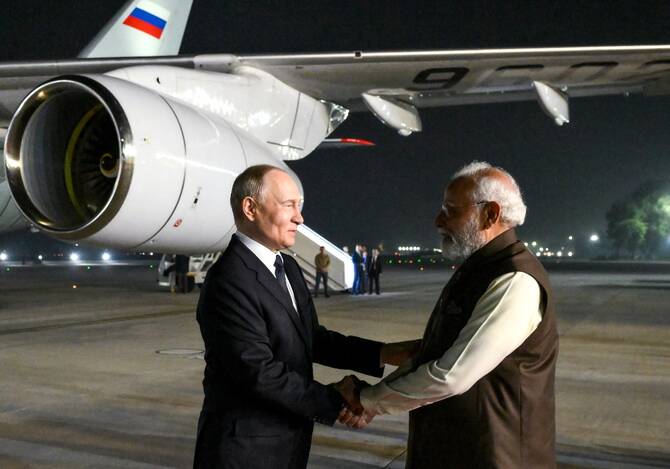

NEW DELHI: Indian Prime Minister Narendra Modi and Russian President Vladimir Putin agreed to scale up and diversify economic cooperation during talks in New Delhi on Friday, showcasing deepening ties despite pressure from US President Donald Trump.
Putin was on a two-day visit to India to co-chair with Modi the 23rd India-Russia Annual Summit, a key platform of their 25-year-Special and Privileged Strategic Partnership.
The trip takes place amid Washington’s intensifying pressure on Russia to end the war in Ukraine and tense relations between the US and India, after Trump imposed hefty tariffs on Delhi and threatened sanctions over its historic ties with Moscow and its imports of Russian oil.
In a joint press briefing following the Friday summit, Modi said India’s ties with Russia “have always stood the test of time” and had remained a “guiding star” for the past eight decades.
“Today, we discussed all aspects of cooperation to further strengthen this foundation. Taking economic cooperation to new heights is our shared priority,” he said.
“To realize this, today we have agreed on an Economic Cooperation Program until 2030. This will make our trade and investment diversified, balanced and sustainable, and will also add new dimensions to areas of cooperation.”
Defense has traditionally been the main pillar of India-Russia ties, as Moscow is India’s largest defense supplier, accounting for an estimated 36 percent of arms imports and more than half of its military hardware.
But bilateral trade has been on the rise for the past two years, reaching $68.7 billion in 2024-25 fiscal year and dominated by Indian imports of Russian goods, particularly crude oil and petroleum products, government data showed.
The two countries are now working to reach $100 billion by 2030 and to conclude a free trade agreement with the Eurasian Economic Union, as their leaders also agreed on Friday to strengthen collaboration across other areas, especially energy and connectivity.
“Both the countries are trying to convey a message to the West, that they’ll not come under Western pressure,” said Prof Rajan Kumar of the School of International Studies at the Jawaharlal Nehru University.
“India believes in the strategic economy, policy of multi-alignment. It will not come under any pressure from the West. So Putin’s visit is very important, India-Russia friendship is very important from that perspective.”
For Russia, the visit was intended to show “the world that it remains a global power,” Prof. Harsh V. Pant, vice president of the Observer Research Foundation, told Arab News.
“It remains a power that has friends, that it is not as isolated as what the West might be trying to project Russia,” he said.
“For India, this is a case of projecting its own sense of strategic autonomy in deciding how it wants to engage Russia, that despite American pressure, it has no intention of abandoning Russia, and it will continue to invest in its relationship with Russia.”
India and Russia signed 16 agreements and memoranda of understanding on Friday, including one on labor mobility that would facilitate the movement of skilled and semi-skilled workers to and from the two countries.
The Indian government also announced the launch of a free 30-day e-tourist visa for Russian nationals.
“We are undoubtedly satisfied with the results of the negotiation we just had,” Putin said during the joint press briefing.
“I can express my confidence that the current visit and the agreements will help the further deepening of the Russian-Indian strategic partnership for the benefit of our countries and the people, the peoples of India and Russia.”