

Sahara celebrates desert cultures at Chad festival

1 / 4
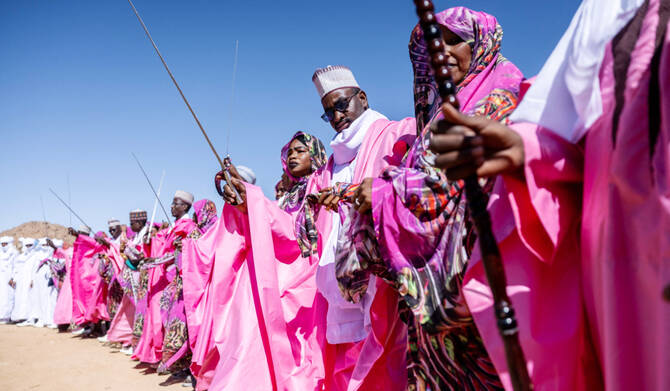
Chadian dancers perform at the International Festival of Saharan Cultures in Amdjarass, Ennedi-Est, Chad, on February 7, 2026. (AFP)
2 / 4
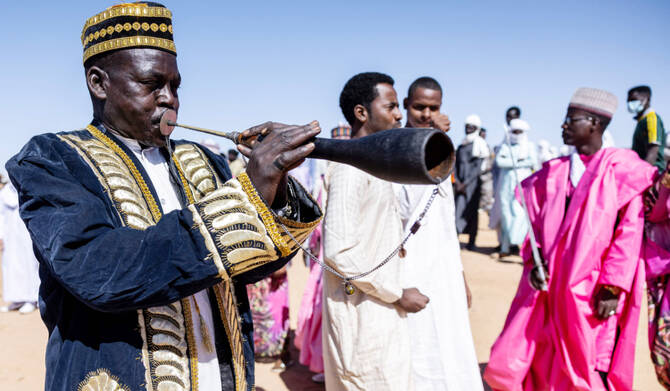
A chadian musician performs at the International Festival of Saharan Cultures in Amdjarass, Ennedi-Est, Chad, on February 7, 2026. (AFP)
3 / 4
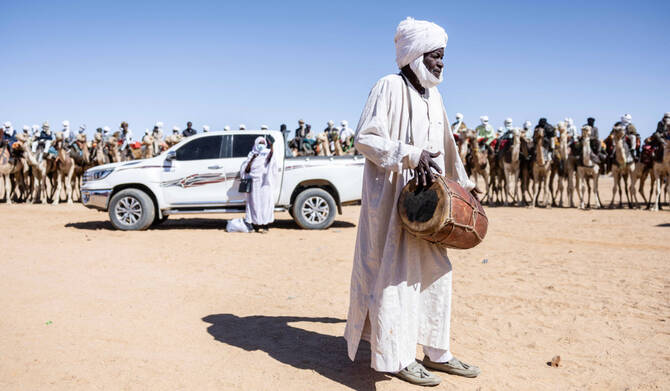
A chadian musician performs at the International Festival of Saharan Cultures in Amdjarass, Ennedi-Est, Chad, on February 7, 2026. (AFP)
4 / 4
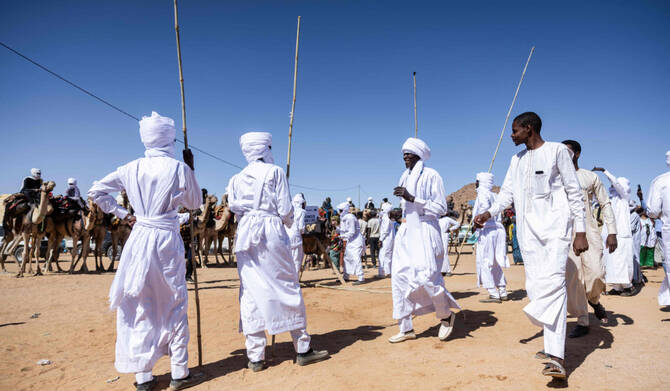
Chadian dancers perform at the International Festival of Saharan Cultures in Amdjarass, Ennedi-Est, Chad, on February 7, 2026. (AFP)
Short Url
Updated 10 February 2026
Follow

Sahara celebrates desert cultures at Chad festival

  • Amdjarass, which is home to several nomadic peoples, is located in far northeast of Chad, a vast, sparsely populated region renowned for its dramatic rock formations and desert landscapes

AMDJARASS, Chad: In the heart of the Sahara, where the routes to Sudan and Libya cross, the Chadian city of Amdjarass has been transformed this week into an open-air celebration of desert culture.
Until Friday, Amdjarass hosts dance troupes, musicians, traditional storytellers, craftspeople, cooks and nomadic camel drivers from across the vast region.
Niger, the guest of honor at the sixth Amdjarass International Festival of Saharan Cultures (FICSA), hailed the event as a way to foster peace in a region beset by conflict and climate change.
“In a world rife with tensions, crises and misunderstandings, culture remains a space for encounter and dialogue, enabling us to understand and respect each other and build together,” Niger’s crafts and tourism minister Aghaichata Guichene Atta told the opening ceremony on Saturday.
“Our countries have everything to gain by joining forces to make culture a tool for peace, development and employment,” she said, to cheers from the crowd.
Atta highlighted the role of Saharan women in keeping desert cultures alive down the centuries.
In a shapeshifting region where traditions are seldom archived on paper, the women “carry the living memory of Saharan societies through their songs, their stories, their hands that weave, shape, cook and educate.”
Amdjarass, which is home to several nomadic peoples, is located in far northeast of Chad, a vast, sparsely populated region renowned for its dramatic rock formations and desert landscapes.
The once dusty village, now a grid-shaped city, derives its name from “djarass,” the Arabic word for bell, in reference to a strange white rock that rings in the wind and was once used to warn locals of raids by rival tribes.

- Spark interest in the desert -

Local Issak Bassam, 27, said he was delighted the festival had returned to his hometown after a break of seven years due to the covid pandemic, the change of president in 2021 and organizational problems.
“I haven’t got the money to travel so this festival is a way for me to meet people from different horizons and celebrate Saharan culture in all its diversity,” he told AFP.
Amdjarass was the stronghold of late president Idriss Deby Itno, who hailed from the area and ruled Chad for 30 years until he was killed during clashes with rebels and his son was handed the reins of power.
For current Prime Minister Allah Maye Halina and festival founder Issouf Elli Moussami, FICSA is not just an excuse for a week-long outdoor party.
It is also a lever for encouraging tourism into an area far off the beaten track.
Guitarist Omar “Bombino” Moctar from Niger, who played his blend of Tuareg blues-rock to a crowd gathered under the desert stars, said he hoped the festival would spark the world’s interest in a region about which it knows little.
“Through my music, I want to share happiness with all the peoples of the desert, bring them together and explain to the whole world the dangers we face,” he said.


Who is Iran’s new supreme leader, Mojtaba Khamenei?

Updated 4 sec ago
Follow

Who is Iran’s new supreme leader, Mojtaba Khamenei?

  • A shiite cleric and longtime political insider, Mojtaba became Iran’s third supreme leader on Sunday, ascending to Iran’s top position following the assassination of his father

DUBAI: Mojtaba Hosseini Khamenei, a Shiite cleric and longtime political insider, became Iran’s third supreme leader on Sunday, ascending to Iran’s top position following the assassination of his father, Ayatollah Ali Khamenei. 
His elevation to the country’s highest political and religious office marked a historic moment for the Islamic Republic, placing a member of the ruling family directly at the helm of the state. 
It’s a move that some thought would be too reminiscent of a monarchy to take place. The Islamic Republic was founded in 1979 after the monarchy was overthrown and its ideology is based on the principle that the supreme leader should be chosen for his religious standing and proven leadership, not through hereditary succession.
According to the BBC, one member of Iran's Assembly of Experts - the clerical body that selects the supreme leader - said two years ago that Ali Khamenei opposed the idea of his son being a candidate for future leadership. But he had never publicly addressed such speculation.
For years, Mojtaba had been viewed as one of the most influential figures within Iran’s political establishment, operating largely behind the scenes while maintaining close ties with powerful security institutions, particularly the Islamic Revolutionary Guard Corps (IRGC).
US diplomatic cables, which were published by WikiLeaks in the late 2000s, described him as "the power behind the robes" who was widely regarded as a "capable and forceful" figure within the regime, according to news agency AP.
Early Life
Born on Sept. 8, 1969, in the northeastern city of Mashhad, Mojtaba Khamenei grew up during a turbulent period in Iranian history. His father emerged as a key figure in the 1979 Iranian Revolution that overthrew Shah Mohammad Reza Pahlavi and established the Islamic Republic. 
As a child, Mojtaba witnessed the transformation of Iran’s political system and the rapid rise of his father within the revolutionary leadership. The Khamenei family traces its lineage to Husayn ibn Ali, the grandson of the Prophet Muhammad, a heritage that carries significant prestige within the Shiite clerical establishment.
Mojtaba received his early education in the northwestern Iranian cities of Sardasht and Mahabad before graduating from Alavi High School in Tehran. After completing his schooling, he pursued Islamic theology, studying under several prominent clerics including his father and Ayatollah Mahmoud Hashemi Shahroudi. 
His religious studies later continued in the seminary city of Qom, one of the most important centers of Shiite scholarship, where he eventually became a teacher at the Qom Seminary.
Before fully dedicating himself to clerical life, Mojtaba joined the IRGC in the late 1980s during the final years of the Iran–Iraq War. As a young member of the IRGC’s Habib bin Muzahir Battalion, he reportedly participated in several military operations during the conflict.
Mojtaba married Zahra Haddad-Adel, the daughter of conservative politician Gholam-Ali Haddad-Adel, in 1999. The couple have three children.
According to Iranian government statements in 2026, several members of his family, including his wife, parents and one of his sons, were killed during US-Israeli strikes amid regional tensions.
Political positions
By the late 1990s and early 2000s, Mojtaba had emerged as an important figure within the inner circle of the Supreme Leader’s office. His influence became particularly visible during Iran’s 2009 presidential election crisis – where according to multiple reports including by the BBC and New York Times, Mojtaba had helped orchestrate the controversial reelection of President Mahmoud Ahmadinejad and supported the crackdown on the mass protests that followed.
Critics alleged he had close ties to the Basij paramilitary force, which was deployed to suppress demonstrations during what became known as the Green Movement. Mostafa Tajzadeh, the then-deputy interior minister, described the result as an "electoral coup". He was imprisoned for seven years, which he attributed to "the direct wish of Mojtaba Khamenei".
Two reformist candidates, Mir-Hossein Mousavi and Mehdi Karoubi, were put under house arrest after the 2009 election. In February 2012, Mojtaba met and urged Mousavi to give up his protest, Iranian sources told BBC Persian.
Although Mojtaba rarely appeared in public and seldom delivered speeches, his perceived influence within the security establishment made him a central figure in Iran’s internal power structure.
In 2019, the United States imposed sanctions on Mojtaba, accusing him of acting on behalf of the supreme leader and maintaining close connections with Iran’s security apparatus and regional proxy networks. 
Politically, Mojtaba is widely viewed as aligned with the ultraconservative wing of Iran. Patrick Clawson from The Washington institute said in a piece last week that Mojtabi would likely embrace a strategy of “defiant consolidation” that would rely on the IRGC to emphasize strategic depth through coercive power. 
Moreover, Clawson said that Mojtaba could take a more hardline position towards the United States as a consequence of violent circumstances surrounding his succession – which has included the killing of many of his family members. 
“He may take a deep existential view of foreign security threats, place even stronger emphasis on state power and resilience, and show even less inclination than his father to compromise with the United States,” he said. 
“Particularly in the immediate term, he may be driven by raw, vengeful feelings that reinforce the Islamic Republic’s ideology of existential confrontation with America and Israel.” 
Clerical criticism 
Mojtaba is a mid-ranking cleric, which could pose an obstacle to his acceptance as the new supreme leader. 
According to the BBC, before he was selected, some media outlets and officials close to centres of power in Iran began referring to Mojtaba Khamenei as "Ayatollah", a senior clerical title. The shift appeared to some observers as an attempt to elevate his religious standing and present him as a credible leader.
In the Iranian system, holding the rank of "Ayatollah" is considered one of the requirements and prerequisites for a future leader. His father, Ali Khamenei, was quickly promoted to "Ayatollah" after he became Iran's second supreme leader in 1989.
Wealth 
A year-long investigation by Bloomberg, reported in January 2026 that Mojtabi is linked to an offshore financial network used to hold and move assets outside Iran. 
The reported holdings included high-value real estate in London and Dubai, as well as interests connected to shipping, banking relationships, and hospitality assets in Europe. 
According to the investigation, the assets were generally not held in Khamenei's name but structured through intermediaries, including those controlled by prominent business man Ali Ansari, and layered corporate entities across multiple jurisdictions. Some of these assets have since been sold or restructured amid increased scrutiny.