

Boeing has 400 defense platforms in Saudi Arabia

According to Al-Jomai, Boeing’s relationship with Saudi Arabia spans more than 81 years. AL-EQTISADIAH
Short Url
Updated 11 February 2026
Follow

Boeing has 400 defense platforms in Saudi Arabia

RIYADH: Boeing Saudi Arabia President Asaad Al-Jomoai said the company has more than 400 defense platforms in Saudi Arabia and works closely with local manufacturers such as Saudi Arabian Military Industries, or SAMI, which is leading the Kingdom’s defense localization mission. 

He added: “The partnership is also active through academic and technical cooperation as Boeing is a founding partner of Al-Faisal University and has partnerships with King Abdullah University of Science and Technology, or KAUST, and King Abdulaziz City for Science and Technology.” 

Localization of industry is a key objective for companies operating in Saudi Arabia, Al-Jomoai said, adding that partnerships with firms such as SAMI support the Kingdom’s goal of localizing more than 50 percent of military spending by 2030. Boeing considers itself a central partner in localization and technology transfer. 

According to Al-Jomoai, Boeing’s relationship with Saudi Arabia spans more than 81 years. The company currently employs more than 90 people at its Saudi headquarters and has delivered more than 170 commercial aircraft in recent years. 

Defense contracts dominate operations 

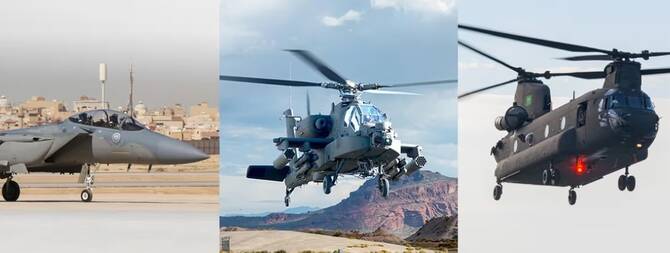
Boeing’s existing contracts include maintenance and technical support for advanced defense systems, most notably F-15 fighter jets, with Saudi Arabia the largest operator of the aircraft outside the US. 

He added that these contracts also cover Apache attack helicopters and AH-6i aircraft, known as the “Little Bird.” 

Al-Jomoai said that although support agreements cover both commercial and defense sectors, defense operations currently dominate in Saudi Arabia due to the expansion in military spending. He added that long global delivery cycles for commercial aircraft have shifted technical support efforts toward servicing defense fleets already operating in the Kingdom. 

According to Boeing’s website, Boeing Defense, Space & Security’s relationship with the Royal Saudi Air Force began in 1978 when Saudi Arabia selected its first fleet of F-15C/D aircraft, forming the backbone of the Kingdom’s air defense. 

The fleet expanded significantly in December 2011 when Saudi Arabia and the US signed a military sales agreement — the largest in US history at the time — covering F-15SA fighter jets, AH-64E Apache attack helicopters and AH-6 light armed reconnaissance helicopters. 


PIF’s Humain invests $3bn in Elon Musk’s xAI prior to SpaceX acquisition

Updated 18 February 2026
Follow

PIF’s Humain invests $3bn in Elon Musk’s xAI prior to SpaceX acquisition

JEDDAH: Humain, an artificial intelligence company owned by Saudi Arabia’s Public Investment Fund, invested $3 billion in Elon Musk’s xAI shortly before the startup was acquired by SpaceX.

As part of xAI’s Series E round, Humain acquired a significant minority stake in the company, which was subsequently converted into shares of SpaceX, according to a press release.

The transaction reflects PIF’s broader push to position Saudi Arabia as a central hub in the global AI ecosystem, as part of its Vision 2030 diversification strategy.

Through Humain, the fund is seeking to combine capital deployment with infrastructure buildout, partnerships with leading technology firms, and domestic capacity development to reduce reliance on oil revenues and expand into advanced industries.

The $3 billion commitment offers potential for long-term capital gains while reinforcing the company’s role as a strategic, scaled investor in transformative technologies.

CEO Tareq Amin said: “This investment reflects Humain’s conviction in transformational AI and our ability to deploy meaningful capital behind exceptional opportunities where long-term vision, technical excellence, and execution converge, xAI’s trajectory, further strengthened by its acquisition by SpaceX, one of the largest technology mergers on record, represents the kind of high-impact platform we seek to support with significant capital.” 

The deal builds on a large-scale collaboration announced in November at the US-Saudi Investment Forum, where Humain and xAI committed to developing over 500 megawatts of next-generation AI data center and computing infrastructure, alongside deploying xAI’s “Grok” models in the Kingdom.

In a post on his X handle, Amin said: “I’m proud to share that Humain has invested $3 billion into xAI’s Series E round, just prior to its historic acquisition by SpaceX. Through this transaction, Humain became a significant minority shareholder in xAI.”

He added: “The investment builds on our previously announced 500MW AI infrastructure partnership with xAI in Saudi Arabia, reinforcing Humain’s role as both a strategic development partner and a scaled global investor in frontier AI.”

He noted that xAI’s trajectory, further strengthened by SpaceX’s acquisition, exemplifies the high-impact platforms Humain aims to support through strategic investments.

Earlier in February, SpaceX completed the acquisition of xAI, reflecting Elon Musk’s strategy to integrate AI with space exploration.

The combined entity, valued at $1.25 trillion, aims to build a vertically integrated innovation ecosystem spanning AI, space launch technology, and satellite internet, as well as direct-to-device communications and real-time information platforms, according to Bloomberg.

Humain, founded in August, consolidates Saudi Arabia’s AI initiatives under a single entity. From the outset, its vision has extended beyond domestic markets, participating across the global AI value chain from infrastructure to applications.

The company represents a strategic initiative by PIF to diversify the Kingdom’s economy and reduce oil dependence by investing in knowledge-based and advanced technologies.