

Boeing cleared to increase 737 Max production nearly two years after door plug flew off plane

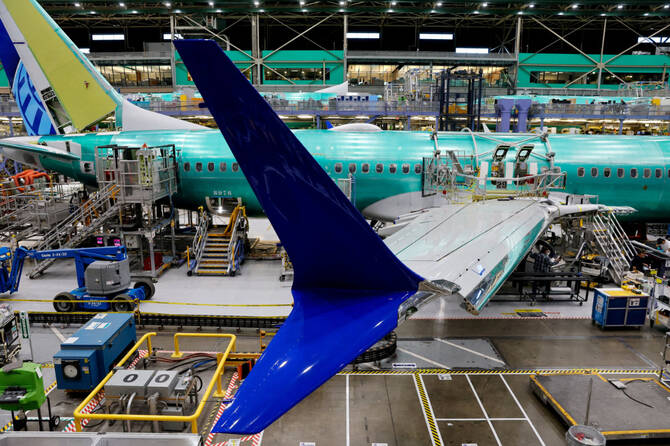
A Boeing 737 MAX aircraft is assembled at the company's plant in Renton, Washington, on June 25, 2024.(Pool via REUTERS/File Photo)
Short Url
Updated 18 October 2025
Follow

Boeing cleared to increase 737 Max production nearly two years after door plug flew off plane

  • Just last month, the FAA also restored Boeing’s ability to perform final safety inspections on 737 Max jetliners and certify them for flight
  • Boeing hadn’t been allowed to do that for more than six years, after two crashes of the then-new model killed 346 people


WASHINGTON: The US Federal Aviation Administration said Friday it will allow Boeing to produce more 737 Max airplanes by increasing the monthly limit that it imposed after a door plug blew off an Alaska Airlines jet that the company built.
Boeing can now produce 42 Max jets per month, up from 38, after safety inspectors conducted extensive reviews of the aerospace company’s manufacturing lines to ensure an increase in production can be done safely, the FAA said.
The agency had set a cap on production shortly after the terrifying January 2024 incident involving the Alaska Airlines 737 Max jet. In practice, though, the production rate fell well below the ceiling last year as the company contended with investigations and a machinists’ strike that idled factories for almost eight weeks. But Boeing said over the summer that it had reached the monthly cap in the second quarter and would eventually seek the FAA’s permission to start producing more of the planes.
A spokesperson for Boeing said Friday that the company followed a “disciplined process” to make sure it was ready to safely increase production, using safety guidelines and performance goals that it set with the FAA.
“We appreciate the work by our team, our suppliers and the FAA to ensure we are prepared to increase production with safety and quality at the forefront,” Boeing said in a statement.
The FAA also said Friday this won’t change the way it oversees Boeing production processes and its efforts to strengthen the company’s safety culture, adding that FAA inspectors at Boeing plants have continued to work through the federal government shutdown that began Oct. 1.
Just last month, the FAA also restored Boeing’s ability to perform final safety inspections on 737 Max jetliners and certify them for flight. Boeing hadn’t been allowed to do that for more than six years, after two crashes of the then-new model killed 346 people. The FAA took full control over 737 Max approvals in 2019, after the second of the two crashes that were later blamed on a new software system Boeing developed for the aircraft.
Earlier this year, Boeing CEO Kelly Ortberg faced questions from a Senate committee about the production rate of the 737 Max, with lawmakers seeking reassurance from Ortberg that the company was prioritizing quality and safety over meeting production targets for profit.
“Just to be very clear, we won’t ramp up production if the performance isn’t indicating a stable production system,” Ortberg said at the April hearing. “We will continue to work on getting to a stable system.”
The incident involving the Alaska Airlines flight that prompted the production cap on Max jets was among a series of alleged safety violations by Boeing between September 2023 and February 2024 that led to the FAA seeking $3.1 million in fines from the company.


Tarique Rahman-led BNP set to form Bangladesh’s next government after major election win

Updated 13 February 2026
Follow

Tarique Rahman-led BNP set to form Bangladesh’s next government after major election win

  • Jamaat-e-Islami, banned during Hasina’s government, won 68 seats
  • Majority of Bangladeshis endorsed sweeping reforms in national referendum

DHAKA: The Bangladesh Nationalist Party, led by Tarique Rahman, is set to form the country’s next government after securing a more than two-thirds majority in the first elections since a student-led uprising in 2024 ousted ex-prime minister, Sheikh Hasina.

The BNP has won at least 209 seats out of the 299 contested, according to the latest election results released by the Election Commission on Friday, paving the way for Rahman to become the country’s next prime minister.

Jamaat-e-Islami, banned during Hasina’s 15 years in power, has registered its best performance yet, winning at least 68 seats and emerging as the main opposition party.

The National Citizen Party, which was born out of the 2024 protests, was in third place with six seats, including for its leader Nahid Islam, while Hasina’s Awami League was barred from participating in the elections.

The majority of Bangladeshis also reportedly voted “yes” in a national referendum on the “July National Charter” that was held alongside the general vote on Thursday.

Named after the month when the uprising that toppled Hasina began, the charter is aimed at achieving sweeping democratic reforms to prevent authoritarian administrations, including term limits for premiers, stronger presidential powers and greater judicial independence, while also proposing increased representation of women in parliament.

The BNP-led government is likely to follow the commitments made under the charter, said Prof. A.S.M. Amanullah, vice chancellor of the National University in Dhaka, adding that the implementation of the July charter was also included in the party’s election manifesto that covers reform of the state and rebuilding of the economy.

“Mr. Tarique Rahman is a highly trained politician, highly sensitive politician, and he takes decisions based on facts. I believe he prepared himself to run this country locally and play a role internationally,” Amanullah told Arab News.

Rahman is the son of former Prime Minister Khaleda Zia and former President Ziaur Rahman. He returned to Bangladesh late last year after nearly two decades of self-imposed exile in the UK, and assumed BNP’s leadership days later, following his mother’s death from a prolonged illness.

In an interview with Arab News earlier this week, the 60-year-old pledged to pursue accountability for the former leadership and meet the political and economic expectations of the youth movement that brought about the change.

The new government is likely to be a mix of young and old politicians, Amanullah said, with Jemaat-e-Islami set to balance out the BNP’s rule.

“This is a very good size of opposition to press the issues or to challenge the government on different issues, different policies and decisions of the government. I’m hopeful about Jemaat,” he said.

“The way the people voted for these major two parties, the BNP and Jemaat, I think if they could work jointly, Bangladesh should see a stable political situation in the near future.”

Mohiuddin Ahmad, a political analyst and researcher, described Jemaat-e-Islami as “the most organized party” in Bangladesh and that it would therefore play an “instrumental” role as the opposition party.

Voter turnout averaged 59.44 percent, the EC said, with many Bangladeshis considering this week’s vote as their first “free and fair” election after more than 17 years.

“Such a result of an election we haven’t actually experienced before,” Muhiuddin Iqbal, a history student at Dhaka University, told Arab News.

“The festive feeling has not gone yet, so we’re very much excited about it and hopeful for the future.”