

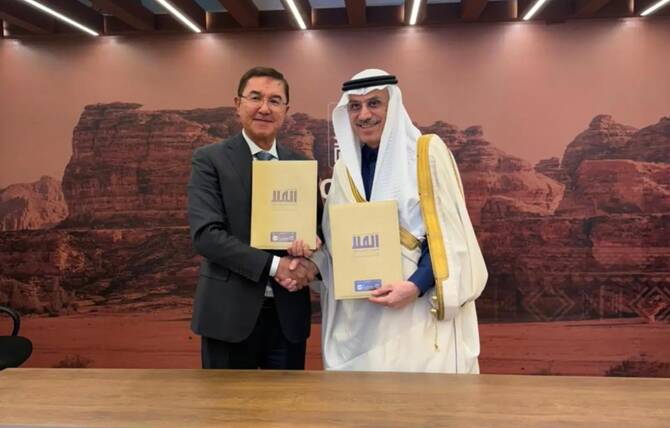
IsDB, Uzbekistan sign financing agreements in AlUla for transport, education sectors 

Islamic Development Bank Group President Muhammad Al-Jasser and Uzbekistan’s Deputy Prime Minister and Minister of Economy and Finance Jamshid Kuchkarov signed financing agreements to support key infrastructure and social development projects. SPA
Short Url
Updated 09 February 2026
Follow

IsDB, Uzbekistan sign financing agreements in AlUla for transport, education sectors 

ALULA: Islamic Development Bank Group President Muhammad Al-Jasser and Uzbekistan’s Deputy Prime Minister and Minister of Economy and Finance Jamshid Kuchkarov signed financing agreements to support key infrastructure and social development projects on the sidelines of the Second AlUla Conference on Emerging Market Economies. 

The two sides also held talks to expand cooperation between the IsDB and Uzbekistan, focusing on accelerating high-impact initiatives aligned with Uzbekistan's national development priorities. 

The first agreement covers a $70 million phase of the IsDB’s total $192 million commitment to rehabilitate the 4R40 Dashtabad–Zaamin–Bakhmal–Galyaaral road. 

The financing will support the reconstruction of 143 km of the regional highway and the rehabilitation of 30 km of local and rural roads in Jizzakh Region. 

The project aims to ease traffic congestion, improve road safety for more than 200,000 people, enhance access to markets and social services, and boost economic and tourism potential. 

The second agreement formalizes a $94.06 million phase of the IsDB’s total contribution of $160.25 million to the SmartEd project. 

The initiative includes the construction and equipping of 58 new educational institutions and the addition of 2,431 classrooms to existing schools across Uzbekistan. 

It seeks to establish a comprehensive competency-based education system benefiting approximately 72,930 students annually, while providing specialized training for more than 36,115 teachers and administrative staff. 

Al-Jasser reaffirmed the IsDB's commitment to supporting Uzbekistan’s development through results-focused cooperation, according to a statement.   

Kuchkarov welcomed the continued partnership, highlighting the importance of sustained investment in connectivity and human capital to ensure long-term, resilient growth, the IsDB release added. 

In December, the IsDB approved a new package of projects totaling approximately $1.36 billion to support 12 member countries, including Uzbekistan. 

The Islamic development finance institution allocated a total financing of $110 million for photovoltaic solar and battery storage projects at the Samarkand I and Samarkand II facilities, enhancing the capacities of the national grid. 


Free trade negotiations between GCC, India mark new phase of partnership, says sec-gen

Updated 24 February 2026
Follow

Free trade negotiations between GCC, India mark new phase of partnership, says sec-gen

RIYADH: The Gulf Cooperation Council’s secretary-general affirmed that the negotiations for a free trade agreement between the GCC and India, and the signing of the joint statement, represents a new phase of strategic partnership.

Jasem Mohamed Al-Budaiwi said that this contributes to enhancing close cooperation and strengthening economic and trade ties, according to the Saudi Press Agency.

This came during the signing ceremony of the joint statement on launching the free trade agreement negotiations between the Al-Budaiwi and India’s Minister of Commerce and Industry, Piyush Goyal, which took place in New Delhi, on Tuesday.

During the signing ceremony, Al-Budaiwi said that the Terms of Reference, signed on Feb. 5, provide a comprehensive and clear framework for these negotiations. The two nations agreed to discuss enhancing cooperation in vital strategic areas, including trade in goods, customs procedures, and services.

Additionally, the framework covers Sanitary and Phytosanitary measures, intellectual property rights, cooperation on Micro, Small, and Medium Enterprises, along with other topics of mutual interest. This reflects the comprehensive nature of the agreement and its ability to keep pace with the future economy.

Al-Budaiwi expressed hope that these negotiations would lead to a comprehensive and ambitious free trade agreement that works to remove customs and non-customs barriers, enhance the flow of quality investments in both directions, and achieve further liberalization in trade and investment cooperation between the GCC and India for mutual benefit. 

This would provide a stimulating economic environment and an investment climate that opens broad horizons for the business sector, supports supply chains, and accelerates the pace of economic growth in line with the ambitious developmental visions of the GCC states. 

The top official affirmed the full readiness of the General Secretariat to host the first round of negotiations at its headquarters in Riyadh during the second half of this year.

The two sides held a meeting during which they reviewed the existing cooperation relations between the GCC and India and discussed ways to develop and elevate them to broader horizons, serving mutual interests and enhancing opportunities for strategic partnership between the two sides, particularly in the economic, investment, and trade fields.

They praised the role undertaken by the negotiating teams from both sides, appreciating the efforts contributing to reaching a comprehensive agreement that enhances economic integration and supports the smooth flow of trade between the two nations.