
JEDDAH: Saudi Arabia’s Islamic Development Bank has approved a new package of projects with a total value of approximately $1.37 billion, allocated to support 12 member countries.
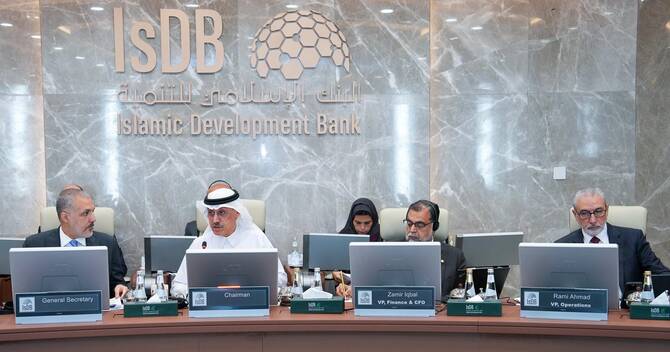
The approval was made by the board of executive directors of the bank, during its 363rd meeting chaired by its President Muhammad Al-Jasser.
The session approved 14 financing operations to support development projects covering renewable energy, cross-border energy networks, major transport corridors, water and food security, alongside education and health services.
This contributes to enhancing economic resilience, improving access to basic services, and supporting progress toward achieving the Sustainable Development Goals.
The approvals included financing of €306.89 million ($360 million) for the expansion and development project of the Godomey–Ouedo–Hillacondji road in Benin, to enhance a strategic segment of the Abidjan–Lagos Corridor.
Cote d’Ivoire received €200 million in financing to develop the Taferi–Ferkessedougou section of the A3 highway, boosting trade and mobility between central and northern regions and neighboring landlocked countries.
Funding of $180.72 million was also approved for the King Faisal Road development project in Manama, Bahrain, aiming to alleviate traffic congestion and improve urban transport mobility.
Lebanon benefited from $13.50 million in financing to establish the Bqarqacha bypass and develop the Bqarqacha–Bcharre road, to improve traffic safety and accessibility for local communities.
In the energy sector, Uzbekistan will receive total financing of $110 million for utility-scale photovoltaic solar and battery storage projects in Samarkand-1 and Samarkand-2, enhancing national grid capacities.
The bank also approved €55.19 million in financing for Mauritania to connect electricity grids with Mali and support related solar power stations, to provide cleaner and more reliable electricity to local communities.
In the field of water and food security, the bank approved €188.82 million in financing for Morocco’s Water Stress Mitigation project, including the construction of dams and related works to ensure water supplies and transfer surplus from northern basins to the more stressed southern regions.
Additionally, €18.23 million was approved for an inland aquaculture value chain development project.
Sierra Leone was allocated €25.93 million for the Freetown Water Supply, Sanitation, and Aquatic Environment Revamping project, to improve water and sanitation services and restore key watersheds.
Cameroon received €36.66 million for the Sustainable Irrigation and Agricultural Value Chain Development project, to support climate-resilient irrigation and improve rural infrastructure.
In Jordan, the Hima Oasis for Prosperity and Employment program for rural employment and agricultural growth benefited from $11.25 million in financing to support rural jobs and agricultural productivity, focusing on women and youth by improving access to finance, skills, and market linkages.
The Board also approved investments in the health and human capital development sector, including an allocation of €61.41 million for Mauritania to establish a 440-bed Maternal, Neonatal, and Child Health Referral Hospital in Nouakchott, enhancing access to specialized healthcare.
In Tajikistan, $13.95 million in financing was approved for the Tourism Business Education Development project, aiming to elevate tourism and hospitality education and establish a national training center focusing on Halal tourism.
Pakistan received $10 million in financing from the Islamic Solidarity Fund for Development to support the Out-of-School Children project in Azad Jammu and Kashmir.
These approvals reflect the IsDB’s ongoing commitment to supporting member countries in bridging infrastructure gaps, expanding essential social services, accelerating the energy transition, and promoting comprehensive and sustainable development.