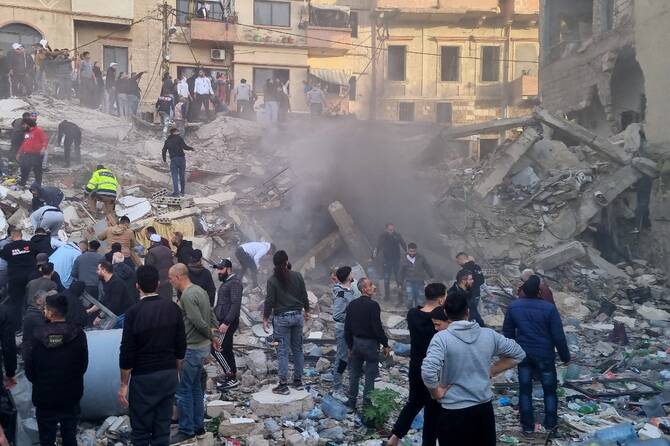
The death toll from the collapse of residential buildings in the Lebanese city of Tripoli rose to 15 after search and rescue operations ended, Lebanon’s National News Agency said on Monday, citing the civil defense chief.
Civil defense director general Imad Khreiss said rescue teams rescued eight people from the rubble of the collapsed buildings in the northern city’s Bab Al-Tabbaneh neighborhood.
Officials said on Sunday that two adjoining buildings had collapsed.
Abdel Hamid Karimeh, head of Tripoli’s municipal council, said he could not confirm how many people remained missing. Earlier, the head of Lebanon’s civil defense rescue service said the two buildings were home to 22 residents.
A number of aging residential buildings have collapsed in Tripoli, Lebanon’s second-largest city, in recent weeks, highlighting deteriorating infrastructure and years of neglect, state media reported, citing municipal officials.
The Lebanese cabinet said following a meeting that the city’s municipal council is set to issue a decision to evacuate 114 buildings at risk of collapse within a period not exceeding one month.
Temporary housing assistance would be made available for families being evacuated for one year, Lebanese Prime Minister Nawaf Salam said on X.
Karimeh said the issue of unsafe buildings in Tripoli was longstanding and driven by multiple factors, including construction violations, years of disorder, weak oversight and a lack of regular maintenance, partly linked to restrictive rent control laws that discourage owners from investing in repairs.
He said many buildings in the city were between 60 and 70 years old and had exceeded their structural lifespan without undergoing essential maintenance, increasing the risk of collapse. The problem, he added, exceeded the capacity of the municipality and residents alone, calling for direct state intervention.
Authorities have begun providing temporary shelter to displaced families, while Lebanon’s Higher Relief Committee is offering housing allowances for up to three months, Karimeh said.
He added that charities, the Ministry of Social Affairs and international organizations were coordinating to provide assistance, saying the aim was to secure a minimum acceptable level of support for affected households.

Building collapse in Lebanese city Tripoli kills 15
https://arab.news/26f7j
Building collapse in Lebanese city Tripoli kills 15
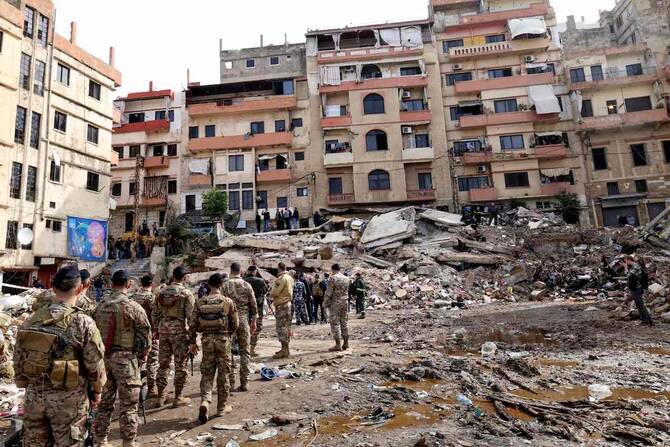
- Civil defense teams rescued eight people from the rubble of the collapsed buildings in the Bab Al-Tabbaneh neighborhood
- A number of aging residential buildings have crumbled in Tripoli in recent weeks
Israeli strikes kill 3 people in Gaza, hospital says
- Shifa Hospital reported the deaths amid the months-old ceasefire that has seen continued fighting
DEIR AL-BALAH: Israeli military strikes on Monday killed three people west of Gaza City, according to the hospital where the casualties arrived.
Shifa Hospital reported the deaths amid the months-old ceasefire that has seen continued fighting. The Israeli army said Monday it is striking targets in response to Israeli troops coming under fire in the southern city of Rafah, which it says was a violation of the ceasefire. The army said it is striking targets “in a precise manner.”
The four-month-old U.S-backed ceasefire followed stalled negotiations and included Israel and Hamas accepting a 20-point plan proposed by US President Donald Trump aimed at ending the war unleashed by Hamas’ Oct. 7, 2023, attack into Israel. At the time, Trump said it would lead to a “Strong, Durable, and Everlasting Peace.”
Hamas freed all the living hostages it still held at the outset of the deal in exchange for thousands of Palestinian prisoners held by Israel and the remains of others.
But the larger issues the agreement sought to address, including the future governance of the strip, were met with reservations, and the US offered no firm timeline.
Top UN official concerned over Israel’s West Bank decision
The United Nations top official on Monday expressed concern about the Israeli security cabinet’s decision to deepen the country’s control over the occupied West Bank.
Secretary-General Antonio Guterres is “gravely concerned” and warned that the Israeli decision could erode the prospect of a two-state solution, spokesperson Stéphane Dujarric said in a statement.
“Such actions, including Israel’s continued presence in the Occupied Palestinian Territory are not only destabilizing but – as recalled by the International Court of Justice – unlawful,” he said.
Israel ‘s security cabinet on Sunday approved measures that aim to deepen Israeli control over the occupied West Bank and weaken the already limited powers of the Palestinian Authority.
Israel’s far-right Finance Minister Bezalel Smotrich said the measures would make it easier for Jewish settlers to force Palestinians to give up land, adding that “we will continue to bury the idea of a Palestinian state.”
Israel captured the West Bank, as well as Gaza and east Jerusalem, in the 1967 Mideast war. The Palestinians want all three territories for a future state.
Rafah crossing improving, official says
The Palestinian official set to oversee day-to-day affairs in Gaza said on Monday that passage through the Rafah crossing with Egypt is starting to improve after a chaotic first week of reopening marked by confusion, delays and a limited number of crossings.
Ali Shaath, head of the National Committee for the Administration of Gaza, told Egypt’s Al-Qahera News that operations at the crossing were improving on Sunday. He said 88 Palestinians were scheduled to travel through Rafah on Monday, more than have crossed in the initial days since reopening. Israel did not immediately confirm the figures.
The European Union border mission at the crossing said in a statement Sunday that 284 Palestinians had crossed since reopening. Travelers included people returning after having fled the war and medical evacuees and their escorts. In total, 53 medical evacuees departed during the first five days of operations.
That remains well below the agreed target of 50 medical evacuees exiting and 50 returnees entering daily, negotiated by Israeli, Egyptian, Palestinian and international officials.
Shaath and other members of the committee remain in Egypt, without Israeli authorization to enter the war-battered enclave.
The Rafah crossing opened last week for the first time since mid-2024, one of the main requirements for the ceasefire between Israel and Hamas. It was closed Friday and Saturday because of confusion around operations.
Palestinian officials say nearly 20,000 people are seeking to leave Gaza for medical care unavailable in its largely destroyed health system.
Palestinians who returned to Gaza in the first days after the crossing reopened described hourslong delays and invasive searches by Israeli authorities and an Israeli-backed Palestinian armed group, Abu Shabab. Israel denied mistreatment.
Gaza’s Health Ministry said on Monday that five people were killed over the previous 24 hours, bringing the death toll to 581 since the October ceasefire. The truce led to the return of the remaining hostages — both living captives and bodies — from the 251 abducted during the Oct. 7, 2023, attack that triggered the war.
Hamas-led militants killed around 1,200 people, mostly civilians, in the attack. Israel’s military offensive has since killed over 72,000 Palestinians, according to the ministry, which operates under the Hamas-run government and is staffed by medical professionals. The UN and independent experts consider it the most reliable source on war casualties.