

Officer killed, ‘Afghan mastermind’ among four held after deadly Islamabad mosque blast — official

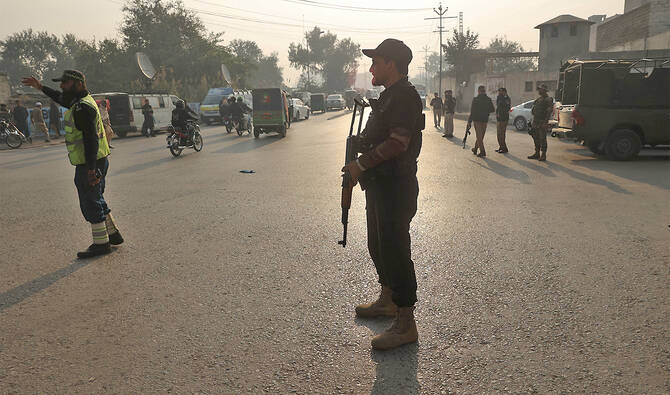
Police officers stand guard on a road after suicide bombers targeted the headquarters of a Pakistani paramilitary force in Peshawar, Pakistan on November 24, 2025. (REUTERS/File)
Short Url
Updated 07 February 2026
Follow

Officer killed, ‘Afghan mastermind’ among four held after deadly Islamabad mosque blast — official

  • Daesh has claimed responsibility for the suicide attack that killed 32 worshippers, injured over 150 others
  • Security official says Daesh conducted ‘planning, training and indoctrination for the attack in Afghanistan’

ISLAMABAD: A police officer was killed and four suspects, including the “Afghan Daesh mastermind,” were arrested in overnight raids in connection with a deadly suicide bombing in the Pakistani capital of Islamabad, police and security officials said on Saturday.

Officials have confirmed 32 deaths from Friday’s blast at the Qasr-e-Khadijatul Kubra mosque and imambargah in the Tarlai Kallan area on Islamabad’s outskirts, with more than 150 others injured.

The blast occurred during Friday prayers, when mosques around the country are packed with worshippers. A regional Daesh (Islamic States) affiliate said one of its members had targeted the congregation by detonating an explosive vest.

Pakistani intelligence and law enforcement agencies conducted several raids and arrested four suspects in Peshawar and Nowshera in connection with the bobing, while a police officer was killed and three others injured in shootout with militants, officials said.

“The operations were carried out based on technical intelligence and human intelligence,” said a security official, who requested anonymity, on Saturday afternoon.

“Four facilitators of the suicide attacker have been arrested. The Afghan Daesh mastermind behind the suicide attack has also been arrested,” he said. “The planning, training, and indoctrination for the attack were conducted by Daesh in Afghanistan.”

There was no immediate comment from the Afghan side to the statement.

The police officer, who was killed in the shootout with militants in the northwestern district of Nowshera, was identified as Assistant Sub-Inspector Ejaz Khattak, Nowshera police spokesperson Turk Ali Shah told Arab News.

Friday’s mosque blast was the deadliest in Islamabad since a 2008 suicide bombing at the Marriott Hotel that killed 63 people and wounded more than 250. In November, a suicide bomber struck outside a court in the capital, killing 12 people.

The latest attack comes as Prime Minister Shehbaz Sharif’s government deals with a surge in militancy across Pakistan. Pakistani officials have said the attacker was a Pakistani national who had recently traveled to Afghanistan.

On Friday evening, Tallal Chaudhry, Pakistan’s state minister for interior, blamed the Islamabad mosque attack on militants “sponsored by India and supported by Afghanistan.”

“He is not an Afghan national, but details of how many times he traveled to Afghanistan have been obtained,” Chaudhry said.

Islamabad has long accused Kabul of allowing its soil to be used by militant groups and New Delhi of backing their cross-border attacks against Pakistani civilians and security forces. The Afghan and Indian governments have consistently denied the allegations.


Return of millions of Afghans from Pakistan and Iran pushes Afghanistan to the brink, UN warns

Updated 14 February 2026
Follow

Return of millions of Afghans from Pakistan and Iran pushes Afghanistan to the brink, UN warns

  • Afghan authorities provide care packages for those returning that include food aid, cash, a telephone SIM card and transportation
  • But the returns have strained resources in a country struggling with a weak economy, severe drought and two devastating earthquakes

GENEVA: The return of millions of Afghans from neighboring Pakistan and Iran is pushing Afghanistan to the brink, the U.N. refugee agency said on Friday, describing an unprecedented scale of returns.

A total of 5.4 million people have returned to Afghanistan since October 2023, mostly from the two neighboring countries, UNHCR’s Afghanistan representative Arafat Jamal said, speaking to a U.N. briefing in Geneva via video link from Kabul, the Afghan capital.

“This is massive, and the speed and scale of these returns has pushed Afghanistan nearly to the brink,” Jamal said.

Pakistan launched a sweeping crackdown in Oct. 2023 to expel migrants without documents, urging those in the country to leave of their own accord to avoid arrest and forcible deportation and forcibly expelling others. Iran also began a crackdown on migrants at around the same time.

Since then, millions have streamed across the border into Afghanistan, including people who were born in Pakistan decades ago and had built lives and created businesses there.

Last year alone, 2.9 million people returned to Afghanistan, Jamal said, noting it was “the largest number of returns that we have witnessed to any single country.”

Afghanistan’s Taliban rulers have criticized the mass expulsions.

Afghanistan was already struggling with a dire humanitarian situation and a poor human rights record, particularly relating to women and girls, and the massive influx of people amounting to 12% of the population has put the country under severe strain, Jamal said.

Already in just the month and a half since the start of this year, about 150,000 people had returned to Afghanistan, he added.

Afghan authorities provide care packages for those returning that include some food aid, cash, a telephone SIM card and transportation to parts of the country where they might have family. But the returns have strained resources in a country that was already struggling to cope with a weak economy and the effects of a severe drought and two devastating earthquakes.

In November, the U.N. development program said nine out of 10 families in areas of Afghanistan with high rates of return were resorting to what are known as negative coping mechanisms — either skipping meals, falling into debt or selling their belongings to survive.

“We are deeply concerned about the sustainability of these returns,” Jamal said, noting that while 5% of those who return say they will leave Afghanistan again, more than 10% say they know of someone who has already left.

“These decisions, I would underscore, to undertake dangerous journeys, are not driven by a lack of a desire to remain in the country, on the contrary, but the reality that many are unable to rebuild their viable and dignified lives,” he said.