Moroccan lawyers protest bill they say threatens profession’s independence

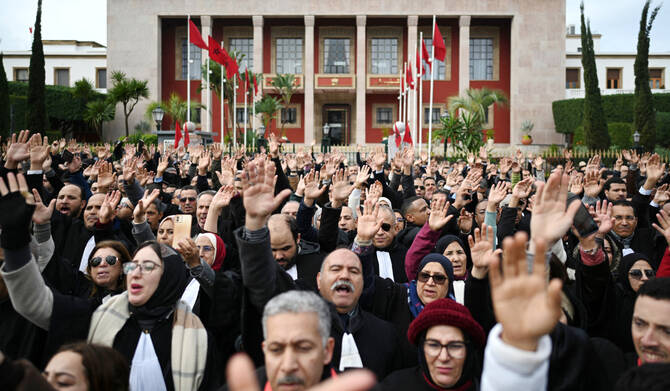
Lawyers take part in a protest in front of the Moroccan parliament in Rabat on February 6, 2026. (AFP)
Short Url
Updated 07 February 2026
Follow

Moroccan lawyers protest bill they say threatens profession’s independence

  • The government has presented the draft law as a means of “modernizing” the legal profession with anti-corruption measures

RABAT: Thousands of lawyers demonstrated on Friday outside Morocco’s parliament in Rabat, calling for the withdrawal of a draft law they said threatened their immunity and independence.
Dressed in black robes, they waved banners and chanted slogans against the bill, which is currently under parliamentary review.
The government has presented the draft law as a means of “modernizing” the legal profession with anti-corruption measures.
But the lawyers say some of its provisions could curtail their protections.
A main point of contention is the provision to grant the courts direct disciplinary power over lawyers. Normally, disciplinary matters are handled internally by the bar association.
“Our demand is simply the withdrawal of the draft law,” said Omar Mahmoud Bendjelloun, 49, from the Moroccan bar association, adding that the bill would “subjugate” the legal profession.
Lawyer Karima Salama, 47, called for “a participatory approach” to reforming the profession.
Justice Minister Abdellatif Ouahbi said during a parliamentary session on Tuesday that he was “ready to renounce, modify or reform anything that harms lawyers.”
Still, the minister insisted that “lawyering needs to change, and I will implement that change.”


Iran FM criticizes Israel for ‘doctrine of domination’

Updated 8 sec ago
Follow

Iran FM criticizes Israel for ‘doctrine of domination’

  • Doctrine allows Israel to expand its military arsenal while pressuring other countries in the region to disarm
  • His remarks came a day after renewed nuclear talks with Washington in Oman
DOHA: Iran’s Foreign Minister Abbas Araghchi on Saturday criticized what he said was a “doctrine of domination” that allows Israel to expand its military arsenal while pressuring other countries in the region to disarm.
His remarks came a day after renewed nuclear talks with Washington, with previous talks collapsing when Israel launched an unprecedented bombing campaign against Iran last June that triggered a 12-day war.
Araghchi was speaking at the Al Jazeera Forum conference in Qatar but made no reference to Friday’s talks with the United States.
“Israel’s expansionist project requires that neighboring countries be weakened: militarily, technologically, economically and socially,” Araghchi said.
“Under this project Israel is free to expand its military arsenal without limits ... Yet other countries are demanded to disarm. Others are pressured to reduce defensive capacity. Others are punished for scientific progress,” he added.
“This is a doctrine of domination.”
During the 12-day war Israel targeted senior Iranian military officials, nuclear scientists and sites as well as residential areas, with the US later launching its own attacks on key nuclear facilities.
Iran responded at the time with drone and missile attacks on Israel, as well as by targeting the largest US military base in the Middle East, located in Qatar.
On Friday, Araghchi led the Iranian delegation in indirect nuclear talks with US Middle East envoy Steve Witkoff in Muscat.
The top Iranian diplomat later described the atmosphere as having been “very positive,” while US President Donald Trump said the talks were “very good,” with both sides agreeing to proceed with further negotiations.
The talks followed threats from Washington and its recent deployment of an aircraft carrier group to the region following Iran’s deadly crackdown on anti-government protests last month.
The United States has sought to address Iran’s ballistic missile program and its support for militant groups in the region — issues which Israel has pushed to include in the talks, according to media reports.
Tehran has repeatedly rejected expanding the scope of negotiations beyond the nuclear issue.