

Saudi, Pakistani private entities sign agreement to launch $500 million joint venture projects

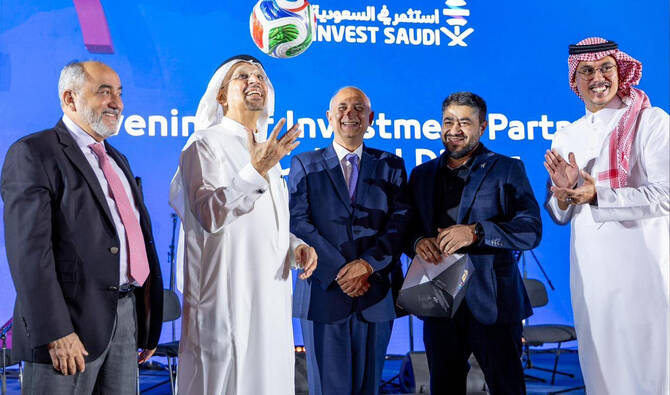
Officials of PREF and Saudi Bridge sign a memorandum of understanding (MoU) to establish a bilateral platform to encourage investments in joint venture projects worth $500 million, in Riyadh, Saudi Arabia, on February 3, 2026. (Haroon Sharif)
Short Url
Updated 09 February 2026
Follow

Saudi, Pakistani private entities sign agreement to launch $500 million joint venture projects

  • Pakistan Regional Economic Forum, Saudi Bridge private entities sign MoU in Riyadh to establish “Saudi-Pakistan Bridge Initiative“
  • Initiative to accelerate private sector investment flows, cross-border economic partnerships between Islamabad, Riyadh, regional nations

Karachi: The Pakistan Regional Economic Forum (PREF) and Saudi Bridge, two private business entities, this month signed a memorandum of understanding (MoU) to establish a bilateral platform that would encourage investments in joint venture projects worth $500 million, the PREF’s chairman confirmed on Monday. 

The PREF is a regional advisory private sector forum registered in Pakistan that says it facilitates the development of the regional market through multi-country joint ventures. Led by Pakistan’s former chairman of the Board of Investment, Haroon Sharif, PREF says it is supported by the Chinese government, other regional countries and private sector organizations.

Saudi Bridge is also a private sector entity that says on its website that it enables mutual understanding and creates opportunities between Saudi Arabia and other stakeholders around the world. Saudi Bridge says it delivers solutions that helps businesses and governments achieve sustainable, long-term impact. These solutions include market entries, strategic matchmakings, hosting delegations and ecosystem activations.

The PREF and Saudi Bridge signed the MoU in Riyadh on Feb. 3 to establish the “Saudi-Pakistan Bridge Initiative,” a joint statement by both sides said. The bridge initiative is a bilateral platform designed to accelerate private sector investment flows, market entry and cross-border economic partnerships between Saudi Arabia, Pakistan and other regional countries, the statement said. 

“PREF and Saudi Bridge are working on $500 million joint venture projects between the two countries and are also aiming to reach out to China and other countries,” Sharif told Arab News. 

The bridge initiative will function as an activation platform, enabling transaction-oriented collaboration between investors, enterprises, funds and ecosystem stakeholders, the joint statement said. 

The initiative will cover sectors such as energy, mining, sports goods manufacturing, logistics, food, agri-processing, health care, technology, industrial manufacturing, construction, and strategic services.

The platform will roll out sector-focused delegations, market entry and soft-landing programs, regulatory workshops, joint investment forums and a One-Stop Bridge Desk to support bilateral engagement over its initial three-year term, the joint statement added. 

Sharif clarified that projects part of the bridge would be executed in both countries. 

“In some cases, the production capacity will be enhanced here,” he said. “In some cases manufacturing will start in Saudi Arabia with the help of Pakistani expertise and Chinese technology.”

The agreement takes place as Pakistan and Saudi Arabia move to broaden their economic and defense cooperation in recent months. The two countries signed a strategic defense pact in September 2025, according to which both pledged to treat an attack against one of them as aggression against both. 

In October, both nations agreed to launch an economic cooperation framework to strengthen bilateral trade and investment relations.


Pakistan engages Saudi Arabia, China in bid to ease surging Middle East tensions 

Updated 10 March 2026
Follow

Pakistan engages Saudi Arabia, China in bid to ease surging Middle East tensions 

  • Pakistan’s foreign minister stresses need for de-escalation in conversations with Chinese, Saudi counterparts
  • Tensions in the Middle East continue to remain high as conflict between US, Israel and Iran intensifies

ISLAMABAD: Pakistan’s Deputy Prime Minister Ishaq Dar spoke to the foreign ministers of Saudi Arabia and China on Tuesday, stressing the importance of diplomatic engagement to de-escalate tensions in the Middle East as the Iran war intensifies. 

Pakistan has constantly engaged regional countries in efforts to broker a ceasefire in the Middle East, after the US and Isreal launched coordinated strikes against Iran on Feb. 28. 

Iran launched fresh attacks on Gulf countries on Tuesday morning, where it has targeted US military bases in recent weeks. In addition to firing missiles and drones at Israel and American bases in the region, Iran has also been targeting energy infrastructure which, combined with its stranglehold on the Strait of Hormuz, has sent oil prices soaring worldwide. 

Dar spoke to Saudi Foreign Minister Prince Faisal bin Farhan to discuss developments in the Middle East and ongoing deliberations at the UN Security Council, Pakistan’s foreign office said in a statement. 

“DPM/FM shared Pakistan’s perspective, underscoring the importance of continued coordination and diplomatic engagement to support de-escalation and promote peace and stability across the region and beyond,” the statement said. 

Dar, who also serves as Pakistan’s foreign minister, spoke to Chinese foreign minister Wang Yi over the telephone separately. The two discussed the evolving regional situation and broader global developments.

Dar underscored the need to ease tensions in the Middle East and the wider region during the conversation, the foreign office said. 

Yi appreciated Pakistan’s constructive efforts aimed at promoting de-escalation and stability in the region, it added. 

“The two leaders stressed the importance of de-escalation and emphasized the need to pursue dialogue and diplomacy in accordance with the principles of the UN Charter,” the foreign office’s statement said. 

The conflict in the Middle East has hit Pakistan hard as well, forcing Islamabad to hike petrol and diesel prices by Rs55 per liter last Friday. 

Pakistan’s government has also announced a set of austerity measures, which include closing schools and cutting down on government expenditures, as it evaluates petrol stocks and looks for alternative supply routes.