

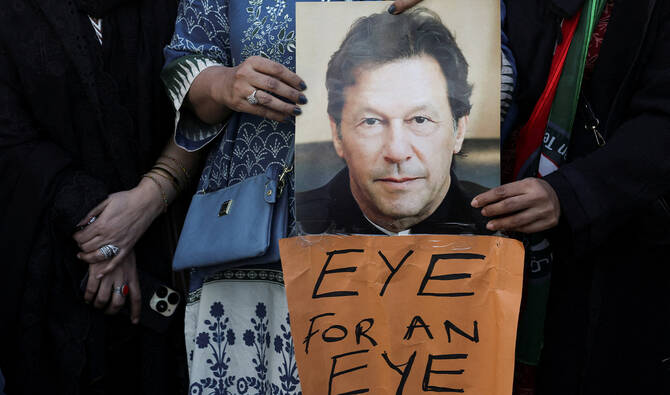

ISLAMABAD: Former prime minister Imran Khan’s Pakistan Tehreek-e-Insaf (PTI) party this week warned the government against shifting him to a hospital for treatment without informing his family and physicians, saying such a move would be in violation of the constitution and jail rules.
The PTI’s response came after the government announced on Saturday that it has decided to transfer the jailed former prime minister from the Central Prison in Rawalpindi to a hospital and form a medical board for his eye treatment.
The developments follow a report submitted to the Supreme Court by a lawyer appointed as a “friend of the court” who was asked to visit Khan at Rawalpindi’s Adiala jail earlier this month. The report said the 73-year-old had suffered severe vision loss in his right eye due to central retinal vein occlusion, leaving him with only 15 percent sight in the affected eye.
The report’s findings triggered a sit-in by an opposition alliance, including members of Khan’s PTI, outside Parliament House in Islamabad, who demanded his immediate transfer to Islamabad’s Al-Shifa Hospital. Khan was also allowed to speak to his sons for about 20 minutes, according to his family, despite the former premier’s limited interactions with his family and legal team in recent months due to restrictions that the PTI has challenged in court.
“The party’s stance in this regard is clear: transferring Imran Khan to any location without informing his family and physicians or commencing any medical examination or treatment in their absence, is a grave violation of the Constitution of Pakistan and jail rules,” the PTI said in a statement issued late Saturday.
“This will not be acceptable under any circumstances.”
The party said it rejects “any form of secrecy” around Khan’s health, adding that hiding facts about it would be tantamount to putting the former premier’s health at risk.
The PTI said Khan’s medical examinations and treatments should be ensured immediately in the presence of his personal physicians and at least one member of his family.
“Furthermore, it is essential that this process be conducted independently under the supervision of reputable doctors and hospitals recommended by the party,” it said.
“The government will be held entirely responsible for the consequences of any secretive or unilateral action.”
‘GOVERNMENT’S RESPONSIBILITY’
Parliamentary Affairs Minister Tariq Fazal Chaudhry said on Saturday that the government gives priority to humanitarian considerations and legal requirements.
“Providing facilities to every prisoner in accordance with the law is the government’s responsibility,” Chaudhry wrote on social media.
Meanwhile, Khan’s lawyers on Saturday filed a petition in the Islamabad High Court seeking suspension of a Dec. 20, 2025 conviction in a graft case involving state gifts, arguing that continued incarceration during the pendency of the appeal would result in a grave miscarriage of justice.
The petition says the judgment is under substantive legal challenge and requests suspension of the sentence until the appeal is decided, a remedy available under Pakistani law when serious questions are raised about a conviction.
Khan, who was ousted from office via a parliamentary vote in April 2022, has been in jail since August 2023 after his conviction on a slew of charges he says are politically motivated.
The opposition alliance has vowed to continue its sit-in outside Parliament House until Khan is shifted to the hospital.


