

REVIEW: ‘Survivor’ meets workplace horror in Sam Raimi’s deliciously funny ‘Send Help’

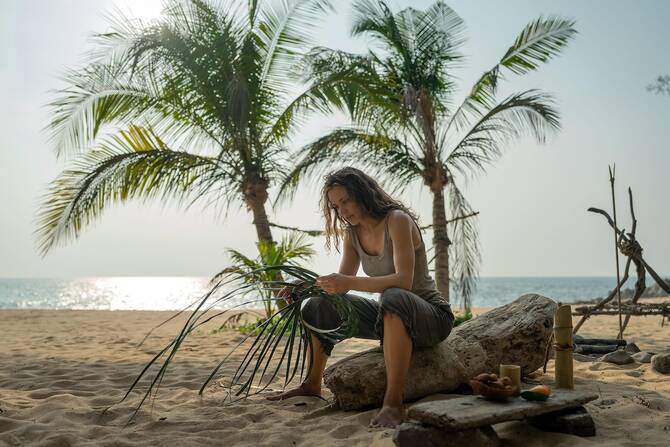
Rachel McAdams in 'Send Help.' (Supplied)
Short Url
Updated 30 January 2026
Follow

REVIEW: ‘Survivor’ meets workplace horror in Sam Raimi’s deliciously funny ‘Send Help’

DUBAI: Sam Raimi’s survival horror comedy “Send Help” finds the visionary director in fine form. Rachel McAdams and Dylan O’Brien star as beleaguered employee and passive-aggressive new boss respectively in a film that’s irreverent, camp and gruesomely gory — all trademarks of Raimi’s masterful touch.

The premise is simple. Two colleagues — Adams’ Linda Liddle has been passed over for her long-overdue promotion, while O’Brien’s tyrant nepo baby Bradley Preston has just been named CEO.  On a work trip, the two of them survive a devastating plane crash and wash up on a deserted island.

Few things are more terrifying — or more darkly comedic — than being helplessly dependent on someone you actively despise. Raimi milks this premise for every drop, staging set pieces that swing between slapstick and genuine tension, often within the same scene.

Between vomit gags and horrific physical violence, Raimi expertly shifts the scales of power between the two characters. There’s no time to relax or anticipate next moves.

McAdams is the film’s undeniable draw with her genre-defining turn as a disgruntled employee with an axe to grind. There’s a scene midway through when she chances on a waterfall and begins to find her confidence again. That shift from bumbling strategy planner to stunning island girl would have felt unearned in less professional hands.

O’Brien more than holds his own too, with a performance that’s reactive in the best way, shifting from lazy smugness to unsettling desperation as the power dynamic shifts.

Visually, “Send Help” is classic Raimi: exaggerated angles, kinetic camera work and smartly utilized gore.

What makes “Send Help” such a satisfying watch is its steadfast commitment to its own weirdness and a director confident enough to push every element but know exactly where to draw the line. Subjects including class, gender roles and power dynamics are handled with tightrope precision and a lightness of touch such that the film never feels preachy. It’s all deliciously unhinged and strikingly original. If you don’t have any weekend plans yet, this should make your list.


Riyadh to install 25 new public artworks after conclusion of Tuwaiq Sculpture symposium

Updated 09 March 2026
Follow

Riyadh to install 25 new public artworks after conclusion of Tuwaiq Sculpture symposium

  • Move will extend the impact of the annual art event beyond its conclusion, bringing large-scale contemporary artworks into the city’s streets and parks
  • Artworks produced during the symposium will now become part of Riyadh Art’s permanent collection

RIYADH: Some 25 sculptures created during the seventh edition of the Tuwaiq Sculpture symposium and exhibition will soon be installed across public spaces in Riyadh.

The move will extend the impact of the annual art event beyond its conclusion, organizers said, bringing large-scale contemporary artworks into the city’s streets and parks.

Organized by the Royal Commission for Riyadh City through the Riyadh Art Program, the 2026 edition has ended after nearly two months of live sculpting, exhibitions and public programming.

The artworks produced during the symposium will now become part of Riyadh Art’s permanent collection and will appear across the capital as part of a broader effort to integrate art into everyday urban life.

This year’s symposium began in January and took place along Prince Mohammed bin Abdulaziz Road, widely known as Tahlia Street.

The site was transformed into an open-air studio in which visitors could observe artists carving, welding and assembling sculptures.

The live sculpting phase, which was held between Jan. 10 and Feb. 5, brought together leading Saudi and international artists to produce 25 large-scale works.

The sculptures were created using locally sourced granite and reclaimed metal, highlighting both the region’s natural materials and the creative reuse of industrial elements.

Visitors were able to follow the process of each artwork’s development, from raw materials to finished sculptures, while also interacting with the artists and learning about their techniques and concepts.

The event also featured a wide-ranging community engagement program designed to deepen public understanding of contemporary art.

The program included 10 panel discussions, 105 training workshops and 15 masterclasses exploring sculptural techniques, materials and the role of public art in cities.

Educational outreach formed another key component of the symposium. Organizers hosted 25 educational visits for more than 600 students, while daily guided tours enabled visitors to explore the artworks and gain insight into the creative processes behind them.

After the live sculpting phase, the completed sculptures remained on-site until March 8, giving visitors the opportunity to experience the works in their original setting before their distribution across Riyadh.

The symposium was curated by Lulwah Al-Homoud, Sarah Staton, and Rut Blees Luxemburg, who guided the artistic direction around the theme “Traces of What Will Be,” exploring how sculpture can reflect future possibilities while responding to the city’s evolving identity.