

WHO does not recommend airport screening for Nipah

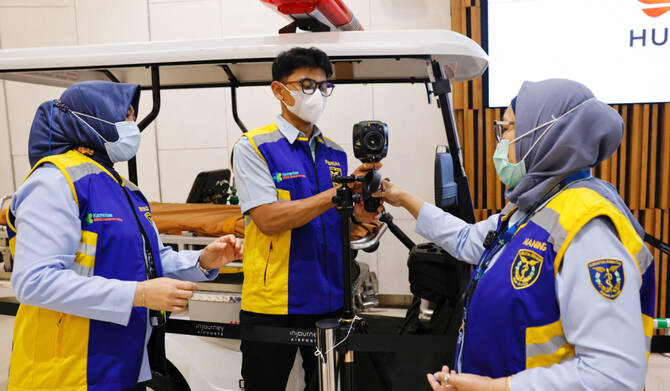
Airport health authorities wearing protective masks prepare a thermal imager at Soekarno Hatta International Airport, following the implementation of health screening for arriving passengers, after India confirmed two cases of the deadly Nipah virus, in Tangerang near Jakarta, Indonesia, January 30, 2026. (REUTERS)
Short Url
Updated 30 January 2026
Follow

WHO does not recommend airport screening for Nipah

  • The WHO said on Friday that it did not currently recommend airport screening, and the risk of the virus spreading from India was low

HYDERABAD: Airport screenings for Nipah virus, which have been stepped up across Asia this week after two cases were identified in India, are more about reassurance than science, several leading experts said on Friday.

Countries including Malaysia, Thailand, Indonesia, and Pakistan implemented temperature screenings at airports this week after India announced that two cases of the deadly Nipah virus had been identified in West Bengal.

The countries’ health ministries described the measures as precautionary steps to address a dangerous disease.

BACKGROUND

Hong Kong, Malaysia, Singapore, Thailand, and Vietnam are among the Asian countries that tightened airport screening this week after India reported new infections.

Nipah is ‌an infection that spreads mainly through ‌products contaminated by infected bats, ‌such as fruit. It can be fatal in up to 75 percent of cases, but it does not spread easily between people.

The WHO said on Friday that it did not currently recommend airport screening, and the risk of the virus spreading from India was low. “Based on what we currently know, there is a very low likelihood that this outbreak will cause a large international epidemic,” said Dr. Zakiul Hassan, a Nipah specialist at a global ‌health research institute in Bangladesh, where Nipah cases are reported almost every year.

Piero Olliaro, professor of poverty-related disease at the University of Oxford, said airport screenings for such a rare disease were likely to be ineffective.

“Countries sometimes do these things just to show them flexing the muscles … telling their people that they’re doing something to protect them,” he said.

Olliaro and other public health experts said airport temperature screenings rarely worked to stop the spread of disease.

During COVID-19, for example, they missed ⁠the majority of cases, studies have shown.

Additionally, many illnesses can cause fever, and follow-up testing for a rare disease such as Nipah is time-consuming, the experts added. Instead, the world’s focus on Nipah would be better directed toward improving understanding of the virus’s current spread and protecting those at risk with new vaccines and treatments.

“There are people suffering from this disease, and they deserve attention,” said Olliaro, adding that this would also help get ahead of any future pandemic risk, if the virus changes and becomes more of an international problem.

“Preparedness means we have ‌the tools now, and we are not trying to develop the tools when the horse has left the stable,” he said.

A WHO official in Geneva said that the risk of the spread of the Nipah virus is low, noting that none of the more than 190 contacts of the two people infected in India had tested positive or developed symptoms of the disease.

“The risk on a national, regional and global level is considered low,” Anais Legand, an official with WHO’s Health Emergencies Program, told a Geneva ⁠press briefing, saying that neither person traveled while symptomatic. ‌

Both of the infected patients are ‍hospitalized and are alive, she added, with one showing signs ‍of improvement.


Trump says he doesn’t know if aliens are real but directs government to release files on UFOs

Updated 2 sec ago
Follow

Trump says he doesn’t know if aliens are real but directs government to release files on UFOs

  • Former President Obama recently suggested in a podcast interview that aliens were real
  • Trump’s daughter-in-law Lara Trump suggested this week that the president was ready to speak about it
WASHINGTON: President Donald Trump said Thursday that he’s directing the Pentagon and other government agencies to identify and release files related to extraterrestrials and UFOs because of “tremendous interest.”
Trump made the announcement in a social media post hours after he accused former President Barack Obama of disclosing “classified information” when Obama recently suggested in a podcast interview that aliens were real.
Trump told reporters aboard Air Force One, “I don’t know if they’re real or not,” and said of Obama, “I may get him out of trouble by declassifying.”
In a post on his social media platform Thursday night, Trump said he was directing government agencies to release files related “to alien and extraterrestrial life, unidentified aerial phenomena (UAP), and unidentified flying objects (UFOs), and any and all other information connected to these highly complex, but extremely interesting and important, matters.”
Obama, who made his comments in a podcast appearance over the weekend, later clarified that he had not seen evidence that aliens “have made contact with us,” but said, “statistically, the universe is so vast that the odds are good there’s life out there.”
Trump told reporters Thursday that when it came to the prospect of extraterrestrial visitors: “I don’t have an opinion on it. I never talk about it. A lot of people do. A lot of people believe it.”
Trump’s daughter-in-law Lara Trump suggested this week that he was ready to speak about it, however, when she said on a podcast that the president had a speech prepared to deliver on aliens that he would give at the “right time.”
That was news to the White House. Press secretary Karoline Leavitt responded with a laugh when she was asked about it Wednesday and told reporters, “A speech on aliens would be news to me.”
Public interest in unidentified flying objects and the possibility of the government hiding secrets of extraterrestrial life re-emerged in the public consciousness after a group of former Pentagon and government officials leaked Navy videos of unknown objects to The New York Times and Politico in 2017. The renewed scrutiny prompted Congress to hold the first hearings on UFOs in 50 years in May 2022, though officials said that the objects, which appeared to be green triangles floating above a Navy ship, were likely drones.
Since then the Pentagon has promised more transparency on the topic. In July 2022 it created the All-Domain Anomaly Resolution Office, or AARO, which was intended to be a central place to collect reports of all military UFO encounters, taking over from a department task force.
In 2023, Dr. Sean Kirkpatrick, the head of AARO at the time, told reporters he didn’t have any evidence “of any program having ever existed as a to do any sort of reverse engineering of any sort of extraterrestrial (unidentified aerial phenomena).”
The information that has been made public shows that the vast majority of UFO reports made by the military go unsolved but the ones that are identified are largely benign in nature.
An 18-page unclassified report submitted to Congress in June 2024 said service members had made 485 reports of unidentified phenomena in the past year but 118 cases were found to be “prosaic objects such as various types of balloons, birds, and unmanned aerial systems.”
“It is important to underscore that, to date, AARO has discovered no evidence of extraterrestrial beings, activity, or technology,” the report stressed.