Pakistan is latest Asian country to step up checks for deadly Nipah virus

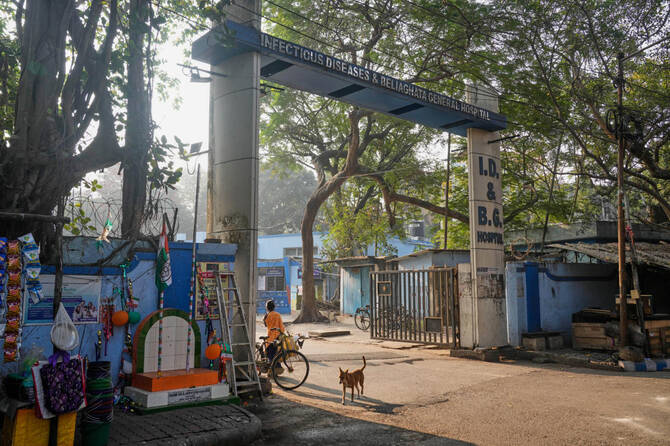
Above, the entrance of the Infectious Diseases and Beliaghata General Hospital, in Kolkata, India on Jan. 28, 2026. India earlier confirmed two cases of the deadly Nipah virus in West Bengal. (AP)
Short Url
Updated 30 January 2026
Follow

Pakistan is latest Asian country to step up checks for deadly Nipah virus

  • Vietnam, Thailand, Singapore, Hong Kong, Malaysia and Indonesia have also tightened screening
  • Nipah has high mortality rate but not easily transmitted; there is also no vaccine for it

LAHORE/HANOI: Authorities in Pakistan have ordered enhanced screening of people entering the country for signs of infections of the deadly Nipah virus after India confirmed two cases, adding to the number of Asian countries stepping up controls.
Thailand, Singapore, Hong Kong, Malaysia, Indonesia and Vietnam have also tightened screening at airports.
The Nipah virus can cause fever and brain inflammation and has a high mortality rate. There is also no vaccine. But transmission from person to person is not easy and typically requires prolonged contact with an infected individual.
“It has become imperative to strengthen preventative and surveillance measures at Pakistan’s borders,” the Border Health Services department said in a statement.
“All travelers shall undergo ⁠thermal screening and clinical assessment at the Point of Entry,” which includes seaports, land borders and airports, the department added.
The agency said travelers would need to provide transit history for the preceding 21-day period to check whether they had been through “Nipah-affected or high-risk regions.”
There are no direct flights between Pakistan and India and travel between the two countries is extremely limited, particularly since their worst fighting in decades in May last year.
In Hanoi, the Vietnamese capital’s health department on Wednesday ⁠also ordered the screening of incoming passengers at Noi Bai airport, particularly those arriving from India and the eastern state of West Bengal, where the two health workers were confirmed to have the virus in late December.
Passengers will be checked with body temperature scanners to detect suspected cases. “This allows for timely isolation, epidemiological investigation,” the department said in a statement.
That follows measures by authorities in Ho Chi Minh City, Vietnam’s largest city, who said they had tightened health controls at international border crossings.
India’s health ministry said this week that authorities have identified and traced 196 contacts linked to the two cases with none showing symptoms and all testing negative for the virus.
Nipah is a rare viral infection that spreads largely from infected ⁠animals, mainly fruit bats, to humans. It can be asymptomatic but it is often very dangerous, with a case fatality rate of 40 percent to 75 percent, depending on the local health care system’s capacity for detection and management, according to the World Health Organization.
The virus was first identified just over 25 years ago during an outbreak among pig farmers in Malaysia and Singapore, although scientists believe it has circulated in flying foxes, or fruit bats, for thousands of years.
The WHO classifies Nipah as a priority pathogen. India regularly reports sporadic infections, particularly in the southern state of Kerala, regarded as one of the world’s highest-risk regions for Nipah.
As of December 2025, there have been 750 confirmed Nipah infections globally, with 415 deaths, according to the Coalition for Epidemic Preparedness Innovations, which is funding a vaccine trial to help stop Nipah.


Italian police fire tear gas as protesters clash near Winter Olympics hockey venue

Updated 08 February 2026
Follow

Italian police fire tear gas as protesters clash near Winter Olympics hockey venue

  • Police vans behind a temporary metal fence secured the road to the athletes’ village, but the protest veered away, continuing on a trajectory toward the Santagiulia venue

MILAN: Italian police fired tear gas and a water cannon at dozens of protesters who threw firecrackers and tried to access a highway near a Winter Olympics venue on Saturday.
The brief confrontation came at the end of a peaceful march by thousands against the environmental impact of the Games and the presence of US agents in Italy.
Police held off the violent demonstrators, who appeared to be trying to reach the Santagiulia Olympic ice hockey rink, after the skirmish. By then, the larger peaceful protest, including families with small children and students, had dispersed.
Earlier, a group of masked protesters had set off smoke bombs and firecrackers on a bridge overlooking a construction site about 800 meters (a half-mile) from the Olympic Village that’s housing around 1,500 athletes.
Police vans behind a temporary metal fence secured the road to the athletes’ village, but the protest veered away, continuing on a trajectory toward the Santagiulia venue. A heavy police presence guarded the entire route.
There was no indication that the protest and resulting road closure interfered with athletes’ transfers to their events, all on the outskirts of Milan.
The demonstration coincided with US Vice President JD Vance’s visit to Milan as head of the American delegation that attended the opening ceremony on Friday.
He and his family visited Leonardo da Vinci’s “The Last Supper” closer to the city center, far from the protest, which also was against the deployment of US Immigration and Customs Enforcement agents to provide security to the US delegation.
US Homeland Security Investigations, an ICE unit that focuses on cross-border crimes, frequently sends its officers to overseas events like the Olympics to assist with security. The ICE arm at the forefront of the immigration crackdown in the US is known as Enforcement and Removal Operations, and there is no indication its officers are being sent to Italy.
At the larger, peaceful demonstration, which police said numbered 10,000, people carried cardboard cutouts to represent trees felled to build the new bobsled run in Cortina. A group of dancers performed to beating drums. Music blasted from a truck leading the march, one a profanity-laced anti-ICE anthem.
“Let’s take back the cities and free the mountains,” read a banner by a group calling itself the Unsustainable Olympic Committee. Another group called the Association of Proletariat Excursionists organized the cutout trees.
“They bypassed the laws that usually are needed for major infrastructure project, citing urgency for the Games,” said protester Guido Maffioli, who expressed concern that the private entity organizing the Games would eventually pass on debt to Italian taxpayers.
Homemade signs read “Get out of the Games: Genocide States, Fascist Police and Polluting Sponsors,” the final one a reference to fossil fuel companies that are sponsors of the Games. One woman carried an artificial tree on her back decorated with the sign: “Infernal Olympics.”
The demonstration followed another last week when hundreds protested the deployment of ICE agents.
Like last week, demonstrators Saturday said they were opposed to ICE agents’ presence, despite official statements that a small number of agents from an investigative arm would be present in US diplomatic territory, and not operational on the streets.