

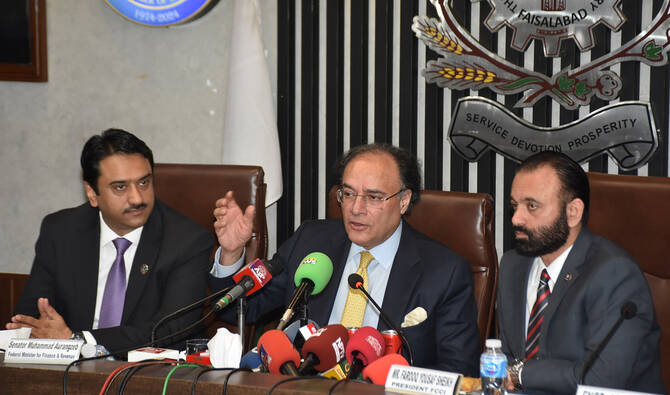

ISLAMABAD: Finance Minister Muhammad Aurangzeb said on Friday Pakistan aims to announce a medium-term tax strategy within six months to give businesses greater certainty for long-term investment and curb discretionary powers of tax officers as collection moves to an automated, data-driven system.
Pakistan’s tax system has for years been criticized by businesses for unpredictability, with tax policy undergoing frequent changes.
Pakistan has attempted to introduce reforms within the Federal Board of Revenue (FBR) in recent years to enhance tax collection and shift the agency toward a tax system with minimal human interaction. The government in February established a Tax Policy Office within the
Ministry of Finance, separating policy formulation from the FBR, which now focuses on administration and collection.
Speaking to the Faisalabad Chamber of Commerce and Industry, Aurangzeb said frequent annual changes had discouraged investment over the longer term.
“You invest for the next five, 10, 15, 20 years, and if we keep changing our tax policy every year because we need to make the math work, then that’s wrong,” he said, promising to announce the government’s medium-term tax strategy within six months.
Aurangzeb said the government seeks to minimize human intervention in the FBR by routing tax notices through an integrated “data lake” drawing on third-party records held by the national database authority and banks.
Under the current system, he said, a single officer handles assessment, audit, notice and negotiation, creating room for collusion.
“Give us a chance this time to run it on the basis of data,” he continued, adding that field officers would eventually retain only minimal discretionary powers.
The shift would take a year or two, he said, and had been explained to parliament’s finance committees before approval.
Aurangzeb noted the government had begun digital monitoring to curb evasion, starting with sugar, followed by cement, beverages, tobacco and now textiles.
He informed that monitoring of the sugar sector alone had yielded an additional Rs60 billion ($215.4 million) in sales tax.
The minister said beginning with sugar was deliberate since Prime Minister Shehbaz Sharif’s own family has stakes in the industry.
“Charity has to start from home,” he continued.
He said this year’s budget contained minimal new taxes and focused on enforcement, describing the burden on the documented corporate sector and salaried class as disproportionate and pointing to relief measures including a lower super tax and revised salary slabs.
The FBR collected a record Rs11.74 trillion ($42.2 billion) in taxes in the fiscal year ended June 30, up about 26 percent from a year earlier, though it narrowly missed its revised revenue target of Rs11.9 trillion ($42.7 billion).


