Death toll in Karachi mall fire rises to 73 after two more bodies recovered — rescue service

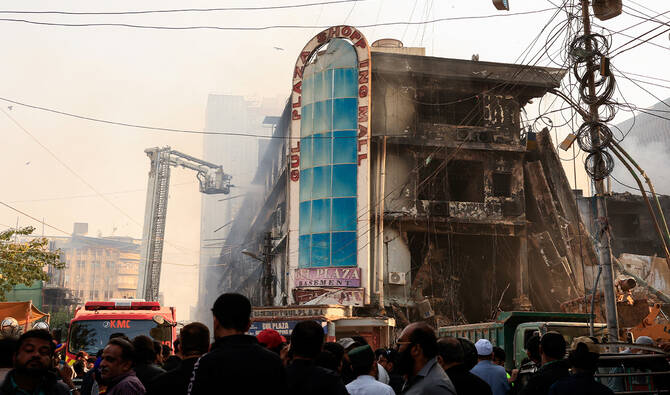
A general view shows the aftermath of a massive fire that broke out in the Gul Plaza Shopping Mall in Karachi, Pakistan, on January 19, 2026. (REUTERS)
Short Url
Updated 25 January 2026
Follow

Death toll in Karachi mall fire rises to 73 after two more bodies recovered — rescue service

  • Authorities have yet to confirm the cause of the fire at Gul Plaza which housed around 1,200 shops
  • The identification process has been slowed by the condition of the remains recovered from the site

KARACHI: The death toll from a devastating fire at a shopping mall in Pakistan’s largest city of Karachi climbed to 73 on Sunday, the Edhi rescue service said, following the recovery of the remains of two more persons.

The development came as rescuers and volunteers continued to comb through the debris at Gul Plaza, a densely packed commercial complex in the heart of Karachi where a deadly fire erupted on Jan. 17, for remains of the victims.

Over the past week, family members of more than a dozen missing persons have stayed near the destroyed plaza and hospital even after providing their DNA samples for testing, with some relatives also criticizing authorities for the slow pace of rescue efforts.

“The death toll in the Gul Plaza tragedy has reached 73,” the Edhi rescue service said in a statement on Sunday night. “The remains of two more bodies were shifted to the Edhi morgue today.”

There was no official comment on the increase in death toll.

“We have processed 71 sets of remains, of which 20 have been identified,” Chief Police Surgeon Dr. Summaiya Syed said on Friday.

The identification process has been significantly slowed by the condition of the remains recovered from the site, according to Syed. Many bodies were found in fragments, complicating DNA analysis and prolonging the process for families waiting for confirmation.

Authorities have yet to confirm the cause of the fire at the building, which housed around 1,200 shops. Traders say the blaze caused more than $53 million losses.

Fires are common in Karachi’s markets and factories, which are known for their poor infrastructure, but a blaze on such a scale is rare.

The provincial government has announced that it will give Rs10 million ($35,720) to each family of the deceased. All 1,200 shopkeepers will also be compensated.


Pakistan rules out military operation in northwestern Tirah Valley 

Updated 1 min 16 sec ago
Follow

Pakistan rules out military operation in northwestern Tirah Valley 

  • Residents in the northwestern Tirah Valley fled their homes this month fearing a military operation against militants
  • Khawaja Asif says army conducting intelligence-based operations in area, migration “routine” practice due to harsh cold 

ISLAMABAD: Defense Minister Khawaja Asif on Tuesday clarified that the military was not conducting a military operation in the northwestern Tirah Valley, saying that the ongoing residents’ migration from the area was a routine practice due to the harsh cold in the area during the winter season. 

The defense minister’s clarification came as residents of Tirah Valley in Pakistan’s northwestern Khyber Pakhtunkhwa (KP) province bordering Afghanistan fled their homes this month, fearing a planned military operation by the army against militants, particularly the Tehreek-e-Taliban Pakistan (TTP) group. 

Pakistan’s information ministry on Sunday issued a clarification that the armed forces were not involved in the “depopulation” of the valley. It pointed to a notification from the provincial Khyber Pakhtunkhwa Relief, Rehabilitation and Resettlement Department in December which demanded the release of funds, reportedly Rs4 billion [$14.24 million], for the voluntary movement of people from Tirah Valley. 

Speaking to reporters at a news conference alongside Information Minister Attaullah Tarar and Special Assistant to the PM for Information and KP Affairs Ikhtiar Wali Khan, Asif said the last military operation in the area was conducted several years ago. He said the military had decided that intelligence-based operations (IBOs) were more effective than military operations as they resulted in lower civilian casualties. 

“So over a long period of time, the army gave up [military] operation in favor of IBOs,” Asif said. “For many years this practice has been continuing. Hence, there is no question of an operation there.”

The defense minister described the migration of residents from Tirah Valley as a “routine” practice that has been taking place since decades due to the freezing cold in the winter season. 

He criticized the provincial government, led by the Pakistan Tehreek-e-Insaf (PTI) party for not serving the people of the area, accusing it of not building any schools, hospitals, or police stations in Tirah Valley.

Asif said around 400-500 TTP members lived in the valley with their families, alleging that hemp was being harvested there on over 12,000 acres of land. He said that while hemp is also used for medicinal and construction purposes, its dividends were going to militants and politicians. 

“All of this hemp is harvested there and the dividends from it either go to the people associated with politics or the TTP,” the minister said.

“We have initiated the process to stop this so that the people benefit from this harvest and so that schools and hospitals are constructed there.”

The minister said that a district-level jirga or tribal council met representatives of the KP government on Dec. 11, 24 and 31 to decide matters related to the residents’ migration in the area. 

Holding up the KP Relief, Rehabilitation and Resettlement Department notification, Asif said:

“In the presence of this notification, in the presence of this tribal council and in the presence of all of these things, where do you see the army?“

The minister accused the provincial government of deflecting its “failures” in the province to the armed forces or to a military operation that did not exist. 

The migration has exposed tensions between the provincial government and the military establishment over the use of force in the region.

KP Law Minister Aftab Alam Afridi said earlier this month that the provincial government will not allow a military operation to take place in the area, arguing that past military campaigns had failed to deliver lasting stability.