73 South Koreans repatriated from Cambodia being investigated for alleged online scams involvement

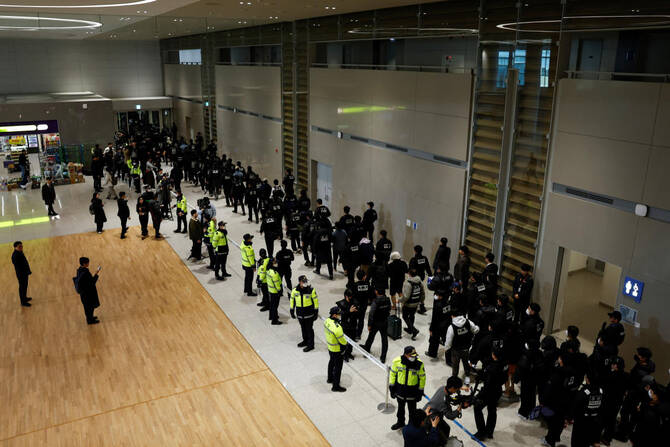
Police officers escort South Koreans allegedly involved in scam operations in Cambodia at Incheon International Airport in Incheon on Jan. 23, 2026. South Korean officials said in October that about 1,000 South Koreans were estimated to be in scam centers in Cambodia. (Reuters)
Short Url
Updated 23 January 2026
Follow

73 South Koreans repatriated from Cambodia being investigated for alleged online scams involvement

  • The 73 South Korean suspects allegedly scammed fellow Koreans out of 48.6 billion won $33 million
  • Cybercrime has flourished in Southeast Asia, particularly in Cambodia and Myanmar

SEOUL: Dozens of South Koreans allegedly involved in online scams in Cambodia were returned to South Korea on Friday to face investigations in what was the largest group repatriation of Korean criminal suspects from abroad.
The 73 South Korean suspects allegedly scammed fellow Koreans out of 48.6 billion won ($33 million), according to a South Korean government statement.
Upon arrival in South Korea’s Incheon airport aboard a chartered plane, the suspects — 65 men and eight women — were sent to police stations. Local TV footage showed the suspects, in handcuffs and wearing masks, being escorted by police officers and boarding buses.
They were among about 260 South Koreans detained in a crackdown in Cambodia in recent months.
“When it comes to crimes that harm our people, we’ll track down and arrest those involved to the very end and get them to face corresponding consequences,” senior police officer Yoo Seung Ryul told a televised briefing at the airport.
Public outrage over scam centers in Southeast Asia flared in South Korea when a Korean student was found dead last summer after reportedly being forced to work at a scam compound in Cambodia. Authorities said at the time he died after being tortured and beaten, and South Korea sent a government delegation to Cambodia in October for talks on a joint response.
The suspects repatriated Friday include a couple who allegedly operated a deepfake romance scam to dupe 12 billion won ($8.2 million) from about 100 people in fraudulent investment schemes. South Korea has made various efforts to bring them back home, including more than 10 rounds of video meetings with Cambodian officials, the Justice Ministry said in a statement.
At the airport briefing, senior Foreign Ministry official Yoo Byung-seok expressed gratitude to the the Cambodian government over Friday’s repatriation. He said South Korea hopes to continue close bilateral coordination until online scams targeting South Koreans are eradicated in Cambodia.
Cybercrime has flourished in Southeast Asia, particularly in Cambodia and Myanmar, as trafficked foreign nationals were employed to run romance and cryptocurrency scams, often after being recruited with false job offers and then forced to work in conditions of near-slavery. According to estimates from the UN Office on Drugs and Crime, scam victims worldwide lost between $18 billion and $37 billion in 2023.
In January, Cambodia said it had arrested and extradited to China a tycoon accused of running a huge online scam operation.
Since October, about 130 South Korean scam suspects from Cambodia as well as more than 20 such Korean suspects from Laos, Vietnam, Thailand and the Philippines have been sent back home. After Friday’s repatriation, about 60 South Koreans will remain detained in Cambodia awaiting repatriation, according to police.
South Korean officials said in October that about 1,000 South Koreans were estimated to be in scam centers in Cambodia. Some are believed to be forced laborers.
On Thursday, South Korean President Lee Jae Myung called for stern responses to transnational cybercrimes that he said erodes mutual trust in society and triggers diplomatic disputes with other countries.


In show of support, Canada, France open consulates in Greenland

Updated 50 min 11 sec ago
Follow

In show of support, Canada, France open consulates in Greenland

  • Decisions taken in a strong show of support for Greenland government amid threats by US President Trump to seize the island

COPENHAGEN, Denmark: Canada and France, which both adamantly oppose Donald Trump’s wish to control Greenland, will open consulates in the Danish autonomous territory’s capital on Friday, in a strong show of support for the local government.
Since returning to the White House last year, Trump has repeatedly insisted that Washington needs to control the strategic, mineral-rich Arctic island for security reasons.
The US president last month backed off his threats to seize Greenland after saying he had struck a “framework” deal with NATO chief Mark Rutte to ensure greater American influence.
A US-Denmark-Greenland working group has been established to discuss ways to meet Washington’s security concerns in the Arctic, but the details of the talks have not been made public.
While Denmark and Greenland have said they share Trump’s security concerns, they have insisted that sovereignty and territorial integrity are a “red line” in the discussions.
“In a sense, it’s a victory for Greenlanders to see two allies opening diplomatic representations in Nuuk,” said Jeppe Strandsbjerg, a political scientist at the University of Greenland.
“There is great appreciation for the support against what Trump has said.”
French President Emmanuel Macron announced Paris’s plans to open a consulate during a visit to Nuuk in June, where he expressed Europe’s “solidarity” with Greenland and criticized Trump’s ambitions.
The newly-appointed French consul, Jean-Noel Poirier, has previously served as ambassador to Vietnam.
Canada meanwhile announced in late 2024 that it would open a consulate in Greenland to boost cooperation.
The opening of the consulates is “a way of telling Donald Trump that his aggression against Greenland and Denmark is not a question for Greenland and Denmark alone, it’s also a question for European allies and also for Canada as an ally, as a friend of Greenland and the European allies also,” Ulrik Pram Gad, Arctic expert at the Danish Institute of International Studies, told AFP.
“It’s a small step, part of a strategy where we are making this problem European,” said Christine Nissen, security and defense analyst at the Europa think tank.
“The consequences are obviously not just Danish. It’s European and global.”

Recognition

According to Strandsbjerg, the two consulates — which will be attached to the French and Canadian embassies in Copenhagen — will give Greenland an opportunity to “practice” at being independent, as the island has long dreamt of cutting its ties to Denmark one day.
The decision to open diplomatic missions is also a recognition of Greenland’s growing autonomy, laid out in its 2009 Self-Government Act, Nissen said.
“In terms of their own quest for sovereignty, the Greenlandic people will think to have more direct contact with other European countries,” she said.
That would make it possible to reduce Denmark’s role “by diversifying Greenland’s dependence on the outside world, so that it is not solely dependent on Denmark and can have more ties for its economy, trade, investments, politics and so on,” echoed Pram Gad.
Greenland has had diplomatic ties with the European Union since 1992, with Washington since 2014 and with Iceland since 2017.
Iceland opened its consulate in Nuuk in 2013, while the United States, which had a consulate in the Greenlandic capital from 1940 to 1953, reopened its mission in 2020.
The European Commission opened its office in 2024.