KABUL: Severe storms and a rain-triggered landslide have killed at least nine children across southern and eastern Afghanistan, officials said, with residents facing further risks on Thursday as heavy snow hit the country.
Strong wind and heavy rain in Kandahar killed six children on Wednesday, and caused significant financial losses in several districts, the emergency department in the southern province said.
The storms also damaged homes, it said.
In a separate incident in eastern Nuristan province, a landslide triggered by heavy rain struck a house in Quraish village on Wednesday, killing three members of the same family and injuring two others.
“Two 10-year-old girls and a teenage boy were killed,” Nuristan provincial government spokesman Fraidoon Samim said.
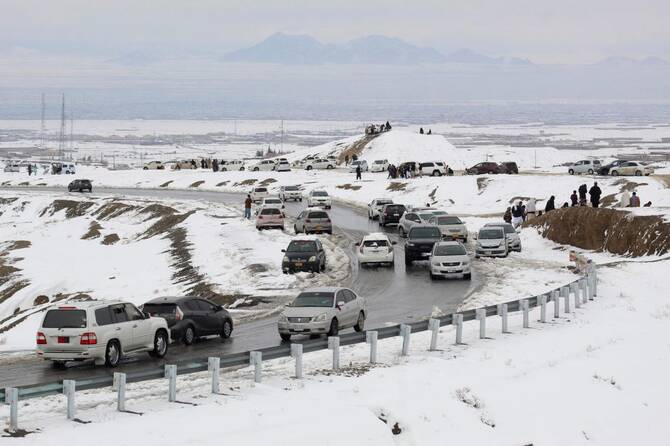
In central Ghazni province, an AFP correspondent said that around 80 centimeters (31 inches) of snow fell over the past 24 hours, forcing the closure of markets and blocking roads.
Heavy snow in many provinces of Afghanistan and the capital Kabul has also caused traffic accidents.
Afghanistan frequently experiences deadly floods, landslides and storms, particularly in remote areas with fragile infrastructure, leaving communities vulnerable to extreme weather.


Storms, heavy rain kill 9 children across Afghanistan
https://arab.news/wk6ud
Storms, heavy rain kill 9 children across Afghanistan

- Residents face further risks on Thursday as heavy snow hit the country


WHO says one person dead from Nipah virus in Bangladesh
- Nipah is an infection that spreads mainly through products contaminated by infected bats, such as fruit
DHAKA: The World Health Organization said on Friday that a woman had died in northern Bangladesh in January after contracting the deadly Nipah virus infection.
The case in Bangladesh, where Nipah cases are reported almost every year, follows two Nipah virus cases identified in neighboring India, which has already prompted stepped-up airport screenings across Asia.
The patient in Bangladesh, aged between 40-50 years, developed symptoms consistent with Nipah virus on January 21, including fever and headache followed by hypersalivation, disorientation and convulsion, the WHO added.
She died a week later and was confirmed to be infected with the virus a day later.
The person had no travel history but had a history of consuming raw date palm sap. All 35 people who had contact with the patient are being monitored and have tested negative for the virus, and no further cases have been detected to date, the WHO said.
Nipah is an infection that spreads mainly through products contaminated by infected bats, such as fruit. It can be fatal in up to 75 percent of cases, but it does not spread easily between people.
Countries including Malaysia, Thailand, Indonesia, and Pakistan implemented temperature screenings at airports after India said cases of the virus had been found in West Bengal.
The WHO said on Friday that the risk of international disease spread is considered low and that it does not recommend any travel or trade restrictions based on current information.
In 2025, four laboratory-confirmed fatal cases were reported in Bangladesh.
There are currently no licensed medicines or vaccines specific for the infection.


