

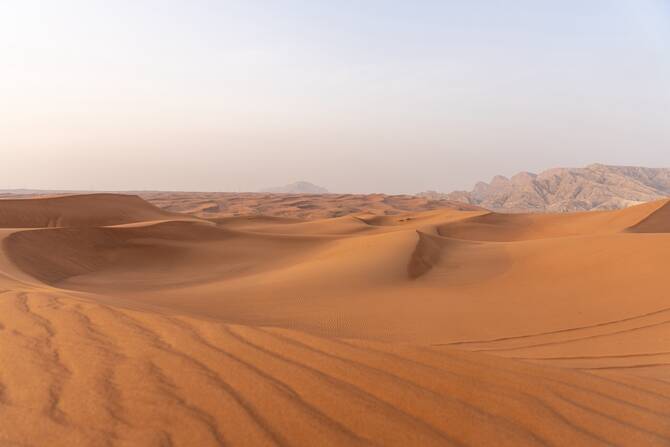
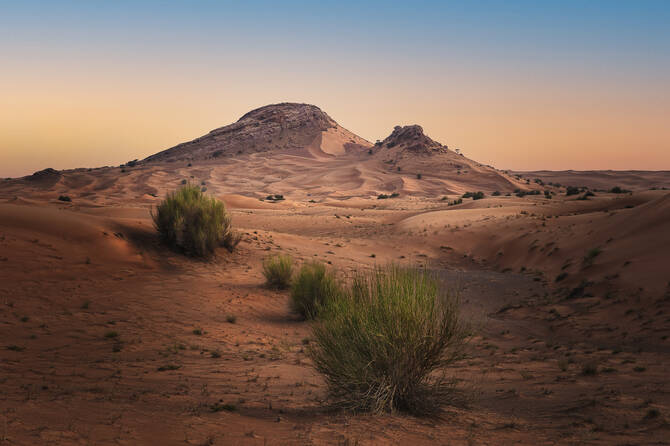
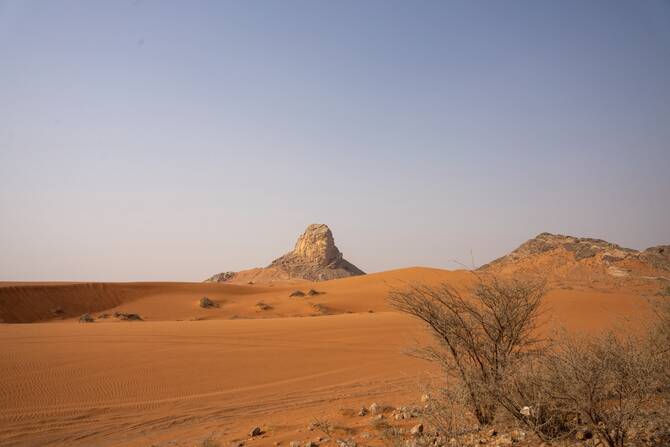
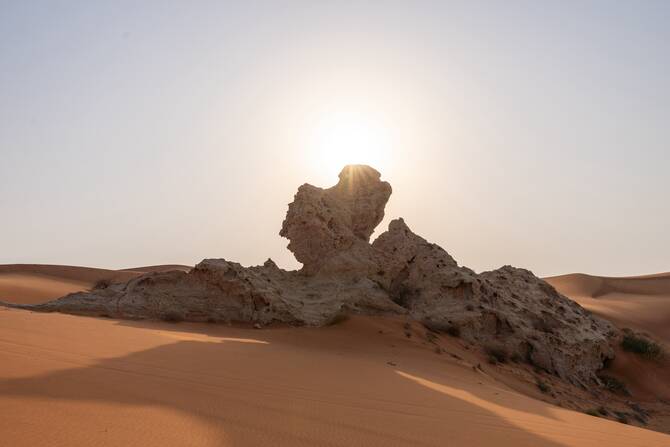

In the heart of Sharjah’s central region lies a landscape that is reshaping global understanding of early human history.
Al Faya Palaeolandscape, recently inscribed on the UNESCO World Heritage List, is not defined by monumental architecture, but by something far more profound: scientific evidence of human presence dating back more than 200,000 years.
Extending across a desert plain framed by limestone hills, Faya preserves one of the oldest and most continuous records of human occupation in Arabia. It is a site that speaks to resilience, adaptation, and survival where early humans found water, shelter, and vitalresources during periods of dramatic climatic change.
Unlike many prehistoric sites, Faya’s outstanding universal value lies in its exceptional stratigraphy. Archaeological excavations have revealed stone tools from the early Middle Paleolithic period, documenting repeated phases of human settlement during humid climatic windows. These discoveries challenge long-held theories that early human migration out of Africa followed only coastalroutes, offering compelling evidence that inland Arabia served as a critical corridor in humanity’s dispersal across continents.
Commenting on the site’s global importance, Eisa Yousef, director general of the Sharjah Archaeology Authority, highlighted the role Faya plays in advancing scientific understanding of early human life.
“Faya provides clear, well-documented evidence of early human presence in Arabia and demonstrates how prehistoric communities adapted to environmental and climatic changes over tens of thousands of years,” he said. “Its inscription on the UNESCO World Heritage List recognizes its outstanding universal value and its contribution to our shared human story.”
For Sharjah, the inscription of Faya marks the culmination of decades of archaeological research, conservation efforts, and international scientific collaboration. The Sharjah Archaeology Authority has led multidisciplinary studies at the site, bringing together archaeology, geology, palaeoclimatology, and anthropology to reconstruct ancient human behavior and environmental conditions.
The landscape itself tells a complex and layered story. In addition to stone tools, Faya contains geomorphological features that indicate the presence of freshwater sources, a rare and vital resource in today’s arid environment. These features provide criticalinsights into ancient climate patterns and help explain how early humans survived, adapted, and thrived in what would later become one of the world’s harshest landscapes.
“What makes Faya exceptional is the integrity of its archaeological layers,” Yousef explained. “They allow researchers to trace repeated episodes of human occupation, innovation, and movement across vast stretches of time. Few sites globally offer this level of continuity and clarity.”
Beyond its scientific importance, Faya reflects a broader evolution in how heritage is understood. It underscores the cultural value of natural landscapes as carriers of human memory, expanding the definition of heritage beyond monuments and cities to include deep time, the story of humanity before written history, borders, or civilizations.
Sharjah’s approach to safeguarding Faya is grounded in a long-standing cultural vision that places knowledge, research, and education at the center of heritage preservation.
This commitment was further reinforced during the official UNESCO inscription ceremony, when Sheikha Bodour bint Sultan Al-Qasimi announced the launch of the Faya Research Grant, a new international scientific initiative valued at AED2 million and running over three years.
The initiative reflects the Sharjah government’s strong belief in investing in culture and scientific knowledge. It aims to support specialized research on Faya, encourage the participation of young researchers, and create opportunities for Emirati students to join international scientific missions focused on expanding understanding of the site and its role in early human development.
According to Yousef, the grant represents a significant step in ensuring the site’s long-term scientific impact. “Research is central to the protection and interpretation of Faya,” he said. “By supporting new generations of researchers and enabling deeper scientific inquiry, initiatives such as the Faya Research Grant ensure that the site continues to contribute meaningfully to global knowledge.”
Conservation strategies at Faya have been carefully designed to protect the site’s authenticity while allowing for ongoing research and responsible public engagement. This balance between preservation and access has become a defining feature of Sharjah’s heritage policy, ensuring that Faya remains both protected and intellectually accessible.
The UNESCO inscription also reinforces the UAE’s growing role in global heritage discourse. By championing a site grounded in scientific evidence rather than monumental scale, the country is helping to broaden international perspectives on what constitutes heritage of outstanding universal value.
At a time when climate change and environmental uncertainty dominate global conversations, Faya offers timely lessons from the distant past. It tells a story of early humans who adapted to shifting environments, navigated scarcity, and survived through innovation and resilience, lessons that resonate powerfully today.
“Faya reminds us that adaptation has always been central to the human experience,” Yousef reflected. “By understanding how early communities responded to environmental challenges, we gain insights that are not only historical, but deeply relevant to the future.”
In preserving Faya, Sharjah has safeguarded far more than an archaeological site. It has protected a chapter of human history that belongs to all of humanity, reaffirming the emirate’s role as a global custodian of knowledge, science, and our shared origins.


