Russia hands life sentence to man over Kyiv-ordered killing of army general

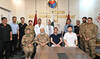
Akhmadzhon Kurbonov, charged with the December 2024 killing of the Russian army’s chemical weapons division head, Lt. Gen. Igor Kirillov, stands inside a glass cage during the verdict announcement at a military court in Moscow on Jan. 21, 2026. (AFP)
Short Url
Updated 21 January 2026
Follow

Russia hands life sentence to man over Kyiv-ordered killing of army general

  • A Moscow military court sentenced Akhmadzhon Kurbonov to life in prison
  • Three other men were handed sentences ranging from 18 to 25 years for being accomplices

MOSCOW: Russia on Wednesday jailed an Uzbek man for life and handed three other men long sentences over the 2024 killing of Russian army general in Moscow on Ukrainian orders, an AFP reporter in the court said.
Lt. Gen. Igor Kirillov was killed with his assistant when a booby-trapped electric scooter exploded as they left a residential building in Moscow at dawn.
A Moscow military court sentenced Akhmadzhon Kurbonov — accused of planting the device — to life in prison.
Three other men were handed sentences ranging from 18 to 25 years for being accomplices.
Kirillov is the highest-ranking Russian military official to be assassinated on Russian soil during the war so far, with President Vladimir Putin making a rare admission of security failings at the time.
Kyiv’s secret services had said the killing was the result of their “special operation,” calling Kirillov a “war criminal and an absolutely legitimate target.”
State prosecutors said Kurbonov, an Uzbek man born in 1995, had planted the bomb on the scooter and that he was promised money and a European passport.
The FSB security service said Kurbonov was working as a delivery man, and released a video in which he said he had “pressed the button.”
It also arrested a Russian citizen born in Azerbaijan — Robert Safaryan — accusing him of keeping components for the explosive device and handing them to Kurbonov.
Russia says two more men — Batukhan Tochiyev and Ramzan Padiyev — had rented a flat for Kurbonov on the orders of a “curator.”
Russia has also arrested several people abroad in absentia, saying they had organized the transport for the bomb from Poland to Russia.

- Army career -

Kirillov — 54 at the time of death — was killed alongside his assistant Ilya Polikarpov.
Since 2017, he had been the head of the Russian army’s radiological, chemical and biological defense forces.
Kyiv had accused him of giving orders to “use banned chemical weapons against the Ukrainian military.”
Under British and Canadian sanctions, he had built a career accusing the West of creating laboratories to spread mysterious diseases, without providing evidence.
In 2022, he had accused the United States of planning to use drones in Ukraine that would spread “infected insects into the air” to spread unnamed diseases — reviving similar claims of Soviet-era propaganda.
He had also repeatedly said that the West had created the Covid pandemic in a laboratory — a known conspiracy theory.
During Moscow’s intervention in the Syrian civil war, Kirillov had accused the Syrian opposition and the White Helmets humanitarian organization of staging chemical attacks — despite overwhelming evidence it was carried out by government forces.
Ukraine has organized a string of killings on Russian soil during Moscow’s offensive.


‘Doomsday Clock’ moves closer to midnight over threats from nukes, climate change, AI

Updated 6 sec ago
Follow

‘Doomsday Clock’ moves closer to midnight over threats from nukes, climate change, AI

  • At the end of the Cold War, the clock was as close as 17 minutes to midnight. In the past few years, to address rapid global changes, the group has changed from counting down the minutes until midnight to counting down the seconds

WASHINGTON: Earth is closer than it’s ever been to destruction as Russia, China, the US and other countries become “increasingly aggressive, adversarial, and nationalistic,” a science-oriented advocacy group said Tuesday as it advanced its “Doomsday Clock” to 85 seconds till midnight.

The Bulletin of the Atomic Scientist members had an initial demonstration on Friday and then announced their results on Tuesday.

The scientists cited risks of nuclear war, climate change, potential misuse of biotechnology and the increasing use of artificial intelligence without adequate controls as it made the annual announcement, which rates how close humanity is from ending.

Last year the clock advanced to 89 seconds to midnight.

Since then, “hard-won global understandings are collapsing, accelerating a winner-takes-all great power competition and undermining the international cooperation” needed to reduce existential risks, the group said.

They worry about the threat of escalating conflicts involving nuclear-armed countries, citing the Russia-Ukraine war, May’s conflict between India and Pakistan and whether Iran is capable of developing nuclear weapons after strikes last summer by the US and Israel.

International trust and cooperation is essential because, “if the world splinters into an us-versus-them, zero-sum approach, it increases the likelihood that we all lose,” said Daniel Holz, chair of the group’s science and security board.

The group also highlighted droughts, heat waves and floods linked to global warming, as well as the failure of nations to adopt meaningful agreements to fight global warming — singling out US President Donald Trump’s efforts to boost fossil fuels and hobble renewable energy production.

Starting in 1947, the advocacy group used a clock to symbolize the potential and even likelihood of people doing something to end humanity. 

At the end of the Cold War, it was as close as 17 minutes to midnight. In the past few years, to address rapid global changes, the group has changed from counting down the minutes until midnight to counting down the seconds.

The group said the clock could be turned back if leaders and nations worked together to address existential risks.