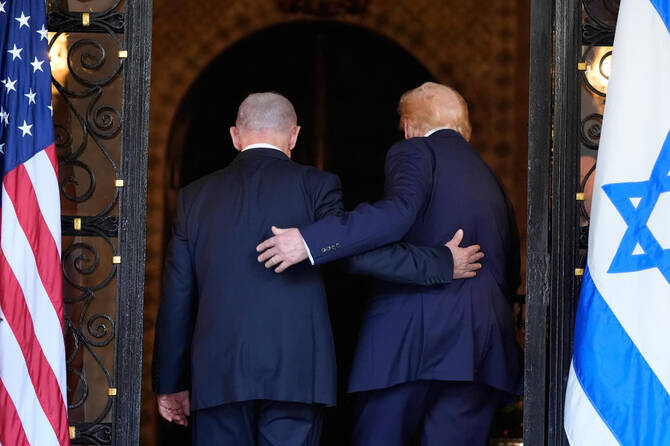
JERUSALEM: Prime Minister Benjamin Netanyahu of Israel said Wednesday he had agreed to join US President Donald Trump’s Board of Peace, after his office earlier criticized makeup of the board’s executive committee.
The board, chaired by Trump, was originally envisioned as a small group of world leaders overseeing the Gaza ceasefire plan. The Trump administration’s ambitions have appeared to balloon into a more sprawling concept, with Trump extending invitations to dozens of nations and hinting it will soon broker global conflicts.
Netanyahu’s office had previously said the executive committee — which includes Turkiye, a key regional rival — wasn’t coordinated with the Israeli government and “is contrary to its policy,” without clarifying its objections. Israel’s far-right finance minister, Bezalel Smotrich, has criticized the board and called for Israel to take unilateral responsibility for Gaza’s future.
Others who have joined the board are the UAE, Morocco, Vietnam, Belarus, Hungary, Kazakhstan and Argentina. Others, including the UK, Russia and the executive arm of the European Union, say they have received invitations but have not yet responded.
It came as Trump traveled to the World Economic Forum meeting in Davos, Switzerland, where he is expected to provide more details about the board. There are many unanswered questions. It was not immediately clear how many or which other leaders would receive invitations.
When asked by a reporter Tuesday if the board should replace the UN, Trump said, “It might.” He asserted that the world body “hasn’t been very helpful” and “has never lived up to its potential” but also said the UN should continue ”because the potential is so great.”
That has created controversy, with some saying Trump is trying to replace the UN French Foreign Minister Jean-Noel Barrot said Tuesday, “Yes to implementing the peace plan presented by the president of the United States, which we wholeheartedly support, but no to creating an organization as it has been presented, which would replace the United Nations.”
Told late Monday that French President Emmanuel Macron was unlikely to join, Trump said, “Well, nobody wants him because he’s going to be out of office very soon.” A day later, Trump called Macron “a friend of mine” but reiterated that the French leader is “not going to be there very much longer.”
The executive board’s members include US Secretary of State Marco Rubio, Trump envoy Steve Witkoff, Trump’s son-in-law Jared Kushner, former British Prime Minister Tony Blair, Apollo Global Management CEO Marc Rowan, World Bank President Ajay Banga, and Trump’s deputy national security adviser Robert Gabriel.
The White House also announced the members of another board, the Gaza Executive Board, which, according to the ceasefire, will be in charge of implementing the tough second phase of the agreement. That includes deploying an international security force, disarming Hamas and rebuilding the war-devastated territory.
Nickolay Mladenov, a former Bulgarian politician and UN Mideast envoy, is to serve as the Gaza executive board’s representative overseeing day-to-day matters. Additional members include: Witkoff, Kushner, Blair, Rowan, Turkish Foreign Minister Hakan Fidan; Qatari diplomat Ali Al-Thawadi; Hassan Rashad, director of Egypt’s General Intelligence Agency; Emirati minister Reem Al-Hashimy; Israeli businessman Yakir Gabay; and Sigrid Kaag, the Netherlands’ former deputy prime minister and a Mideast expert.
The board also will supervise a newly appointed committee of Palestinian technocrats who will be running Gaza’s day-to-day affairs.


![]()

Israel’s Netanyahu agrees to join Trump’s Board of Peace
Short Url
https://arab.news/6zy39
Israel’s Netanyahu agrees to join Trump’s Board of Peace
- Prime Minister Benjamin Netanyahu of Israel says he’s agreed to join Trump’s Board of Peace. Netanyahu made the announcement Wednesday from his office
- The announcement came after Israel said the makeup of the Board’s Gaza executive body did not align with Israel’s interests


Latest updates






© 2026 SAUDI RESEARCH & PUBLISHING COMPANY, All Rights Reserved And subject to Terms of Use Agreement.