

Syrian forces enter Hasakah after SDF releases Daesh detainees

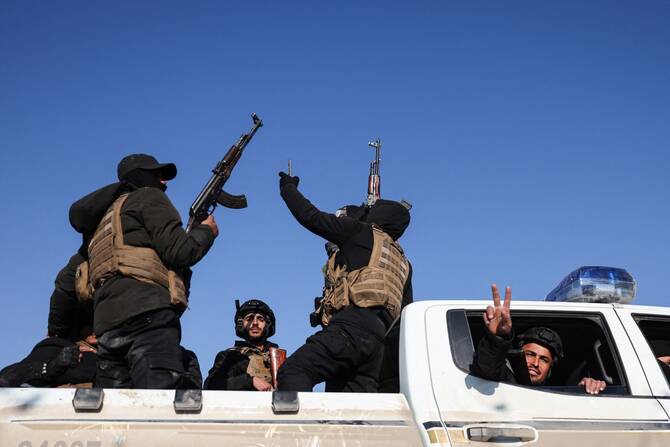
Syrian government forces react as they deploy in Deir Ezzor, eastern Syria, the day after an agreement between the Syrian government and the Kurdish forces, Jan. 19, 2026. (AFP)
Short Url
Updated 19 January 2026
Follow

Syrian forces enter Hasakah after SDF releases Daesh detainees

  • Army units are securing Al-Shaddadi prison and its surrounding areas while pursuing the arrests of Daesh detainees
  • The Syrian army said it holds the SDF fully responsible for the release of Daesh components

LONDON: The army of the Syrian Arab Republic launched sweeping operations south of Hasakah in the country’s northeast to arrest members of the Daesh terror group on Monday after the Syrian Democratic Forces released them from a prison in the town of Al-Shaddadi.

The army’s Operations Command announced that its units were securing Al-Shaddadi prison and its surrounding areas while also pursuing the arrests of Daesh detainees. The prison and Al-Shaddadi’s security facilities will be handed over to the Ministry of Interior immediately upon completion of security operations, according to the Syrian Arab News Agency.

Syrian military leaders contacted mediators and SDF officials to transfer control of the prison and its perimeter to the government’s internal security forces, but SDF leaders declined, according to SANA.

The Syrian army said it holds the SDF fully responsible for the release of Daesh components from Al-Shaddadi prison, emphasizing that army units would implement necessary measures to restore security in the area.

Syrian forces began deploying across the Jazira region on Monday to secure it under an agreement between the Syrian state and the SDF.


Turkiye’s foreign minister says the US and Iran showing flexibility on nuclear deal, FT reports

Updated 4 sec ago
Follow

Turkiye’s foreign minister says the US and Iran showing flexibility on nuclear deal, FT reports

  • Hakan Fidan: “It is positive that the Americans appear willing to tolerate Iranian enrichment within clearly set boundaries”
  • Washington has until now demanded Iran relinquish its stockpile of uranium enriched to up to 60 percent fissile purity
The United States and Iran are showing flexibility on a nuclear deal, with Washington appearing “willing” to tolerate some nuclear enrichment, Turkish Foreign Minister Hakan Fidan told the Financial Times in an interview published Thursday.
“It is positive that the Americans appear willing to tolerate Iranian enrichment within clearly set boundaries,” Fidan, who has been involved in talks with both Washington and Tehran, told the FT.
“The Iranians now recognize ‌that they ‌need to reach a deal with the ‌Americans, ⁠and the Americans ⁠understand that the Iranians have certain limits. It’s pointless to try to force them.”
Washington has until now demanded Iran relinquish its stockpile of uranium enriched to up to 60 percent fissile purity, a small step away from the 90 percent that is considered weapons grade.
Iranian ⁠President Masoud Pezeshkian has said Iran would continue ‌to demand the ‌lifting of financial sanctions and insist on its nuclear rights including ‌enrichment.
Fidan told the FT he believed Tehran “genuinely ‌wants to reach a real agreement” and would accept restrictions on enrichment levels and a strict inspection regime, as it did in the 2015 agreement with the US and others. US ‌and Iranian diplomats held talks through Omani mediators in Oman last week in ⁠an effort ⁠to revive diplomacy, after President Donald Trump positioned a naval flotilla in the region, raising fears of new military action. Trump on Tuesday said he was considering sending a second aircraft carrier to the Middle East, even as Washington and Tehran prepared to resume negotiations.
The Turkish foreign minister, however, cautioned that broadening the Iran-US talks to ballistic missiles would bring “nothing but another war.”
The US State Department and the White House did not respond to a request for comment outside regular business hours.