

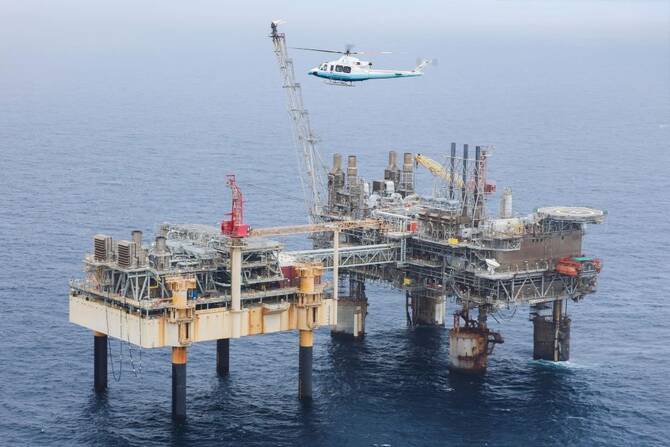
Philippines discovers new gas deposit to boost depleted reserves

President Ferdinand Marcos Jr. conducts a fly-by over of the Malampaya Phase 4 drilling project, off the island of Palawan, on July 14, 2025. (Presidential Communications Office)
Short Url
Updated 19 January 2026
Follow

Philippines discovers new gas deposit to boost depleted reserves

  • Source near Malampaya field believed to contain 2.8 billion cubic meters of gas
  • It will not take much time to access the gas, expert says, as infrastructure is ready

MANILA: The Philippines on Monday announced a new natural gas discovery, with the reservoir near the country’s largest offshore site estimated to be enough to power about 5.7 million households per year.

About 2.8 billion cubic meters (98 billion cubic feet) of gas were found 5km east of the Malampaya field near the island of Palawan, President Ferdinand Marcos Jr. said in a Facebook video.

“This is equivalent to nearly 14 billion kilowatt-hours of electricity per year. That means it could supply power to more than 5.7 million households, 9,500 buildings, or nearly 200,000 schools,” Marcos said.

“This helps Malampaya’s contribution and strengthens our domestic gas supply for many years to come. Initial testing showed that the well flowed at 60 million cubic feet (1.7 million cubic meters) per day.”

Malampaya, discovered in 1989 and operational since 2001, is the Philippines’ most important natural gas field, located off the west coast of Palawan Island. It is also a key part of the country’s energy infrastructure.

It supplies natural gas for electricity generation in Luzon, the main island of the Philippines, powering several major plants.

Prime Energy Resources Development, which manages the Malampaya project, said in a statement that the new reservoir, Malampaya East-1, was discovered by a “a fully Filipino-led team, reflecting the country’s growing capability in upstream energy development.”

Prime Energy’s well data indicate that Malampaya East-1 volumes are equivalent to about one-third of the remaining producible gas volumes at the original Malampaya.

Against the backdrop of Malampaya’s decline, it will help to secure the country’s gas supplies. It will also keep operational the expensive infrastructure that was installed to operate the legacy field.

“The original Malampaya was like 2.3 trillion cubic feet, so it’s like 4 percent of the original find. I still think that is significant in light of the decline of the Malampaya gas field,” said Alberto Dalusung III, energy transition adviser at the Institute for Climate and Sustainable Cities.

The new gas discovery benefits from ready access to processing facilities such as the 504 km undersea pipeline that was built for Malampaya, which will make it available sooner.

Dalusung estimated it would take up to two years for Filipino consumers to benefit from the new resources.

“The infrastructure is already there,” he said. “You don’t have to build the pipeline. All you have to do is find new gas resources, which we did.”


Bangladesh’s Yunus announces resignation, end of interim govt

Bangladesh’s interim leader Muhammad Yunus stepped down on February 16, 2026 in a farewell broadcast to the nation.
Updated 32 min 23 sec ago
Follow

Bangladesh’s Yunus announces resignation, end of interim govt

  • Yunus handed over power after congratulating the Bangladesh Nationalist Party and its leader Tarique Rahman

DHAKA: Bangladesh’s interim leader Muhammad Yunus stepped down on Monday in a farewell broadcast to the nation before handing over to an elected government.
“Today, the interim government is stepping down,” the 85-year-old Nobel Peace Prize winner said.
“But let the practice of democracy, freedom of speech, and fundamental rights that has begun not be halted.”
Yunus returned from self-imposed exile in August 2024, days after the iron-fisted government of Sheikh Hasina was overthrown by a student-led uprising and she fled by helicopter to India.
“That was the day of great liberation,” he said. “What a day of joy it was! Bangladeshis across the world shed tears of happiness. The youth of our country freed it from the grip of a demon.”
He has led Bangladesh as its “chief adviser” since, and now hands over power after congratulating the Bangladesh Nationalist Party (BNP) and its leader Tarique Rahman on a “landslide victory” in elections last week.
“The people, voters, political parties, and stakeholder institutions linked to the election have set a commendable example,” Yunus said.
“This election has set a benchmark for future elections.”
Rahman, 60, chief of the BNP and scion of one of the country’s most powerful political dynasties, will lead the South Asian nation of 170 million.
‘Rebuilt institutions’
Bangladeshi voters endorsed sweeping democratic reforms in a national referendum, a key pillar of Yunus’s post-uprising transition agenda, on the same day as the elections.
The lengthy document, known as the “July Charter” after the month when the uprising that toppled Hasina began, proposes term limits for prime ministers, the creation of an upper house of parliament, stronger presidential powers and greater judicial independence.
“We did not start from zero — we started from a deficit,” he said.
“Sweeping away the ruins, we rebuilt institutions and set the course for reforms.”
The referendum noted that approval would make the charter “binding on the parties that win” the election, obliging them to endorse it.
However, several parties raised questions before the vote, and the reforms will still require ratification by the new parliament.
The BNP alliance won 212 seats, compared with 77 for the Jamaat-e-Islami-led alliance, according to the Election Commission.
Jamaat chief Shafiqur Rahman conceded on Saturday, saying his party would “serve as a vigilant, principled, and peaceful opposition.”
Newly elected lawmakers are expected to be sworn in on Tuesday, after which Tarique Rahman is set to become Bangladesh’s next prime minister.
Police records show that political clashes during the campaign period killed five people and injured more than 600.
However, despite weeks of turbulence ahead of the polls, voting day passed without major unrest and the country has responded to the results with relative calm.
