

Jordan–Qatar committee meeting yields several cooperation agreements

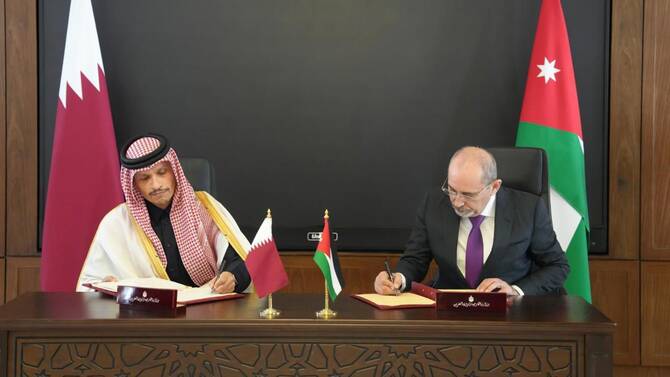
Jordan’s Deputy Prime Minister and Minister of Foreign and Expatriates Affairs, Ayman Safadi, and his Qatari counterpart, Sheikh Mohammed bin Abdulrahman Al-Thani, are signing documents after the fifth session of the Joint Higher Committee. (Petra)
Short Url
Updated 18 January 2026
Follow

Jordan–Qatar committee meeting yields several cooperation agreements

  • Memoranda of understanding enhance bilateral cooperation across various sectors, including politics, economics, tourism, religion, and youth initiatives
  • Safadi and Al-Thani welcomed the establishment of the Palestinian National Committee for the Administration of Gaza, as well as US efforts to promote peace and stability in the region

LONDON: Jordan and Qatar signed several agreements and memoranda of understanding during the fifth session of the Joint Higher Committee on Sunday.

The MoUs enhance bilateral cooperation across various sectors, including politics, economics, tourism, religion, and youth initiatives, between Doha and Amman.

The signature ceremony took place after a meeting between Jordan’s Deputy Prime Minister and Minister of Foreign and Expatriates Affairs Ayman Safadi, and Qatar’s Prime Minister and Minister of Foreign Affairs Sheikh Mohammed bin Abdulrahman Al-Thani.

Safadi and Al-Thani held a separate meeting attended by several officials, including Jordan’s Minister of Industry, Trade, and Supply Yarub Qudah; Minister of Tourism and Antiquities Emad Hijazeen; Qatar’s Minister of Commerce and Industry Sheikh Faisal bin Thani Al-Thani; and the chair of Qatar Tourism, Saad bin Ali Al-Kharji.

The meeting focused on strengthening strategic relations and discussed regional developments, emphasizing the need to end the Gaza crisis and establish a Palestinian state.

Safadi and Al-Thani welcomed the establishment of the Palestinian National Committee for the administration of Gaza, as well as US efforts to promote peace and stability in the region.

The ministers emphasized supporting Syria’s government in rebuilding to ensure unity, sovereignty, and the well-being of its people.

The Qatari foreign minister had a separate meeting with King Abdullah II on Sunday at Al-Husseiniya Palace in Amman, according to Petra, the state news agency.


UNICEF chief says GCC central to supporting operations across the region

Updated 03 February 2026
Follow

UNICEF chief says GCC central to supporting operations across the region

DUBAI: The Gulf Cooperation Council is playing a central role in combating acute crises affecting children and displaced people across the region, says UNICEF’s Gulf Area Office director, Lana Al-Wreikat.

Speaking to Arab News on the sidelines of the World Governments Summit on Tuesday, Wreikat said the GCC had become central to supporting refugees, hygiene and children’s health through funding and diplomatic support.

“Our work with the GCC countries when it comes to the humanitarian crisis goes beyond the refugee response,” Wreikat said.

“We are also dealing with displaced communities inside countries. We also deal with big issues and sectors like the water, sanitation, hygiene, promotion, nutrition, child protection, education. We have our core commitments for children and young people, and these translate across all these sectors. The GCC … has been a very generous donor for us.”

Wreikat revealed the UAE had just announced a $550 million donation for the UN’s 2026 global appeal, part of which goes to funding UNICEF’s operations.

She said Gulf countries had become crucial to supporting the organization diplomatically, especially in difficult situations with access difficulties.

“They also play a big role in terms of the humanitarian diplomacy and negotiations around access, where we really need to support maximum number of children,” she said.

“In terms of their priorities, what’s really high on the agenda is Gaza, Sudan, Yemen, and Syria.”