

Pakistan, Uzbekistan sign 28 agreements, MoUs to increase cooperation in several sectors

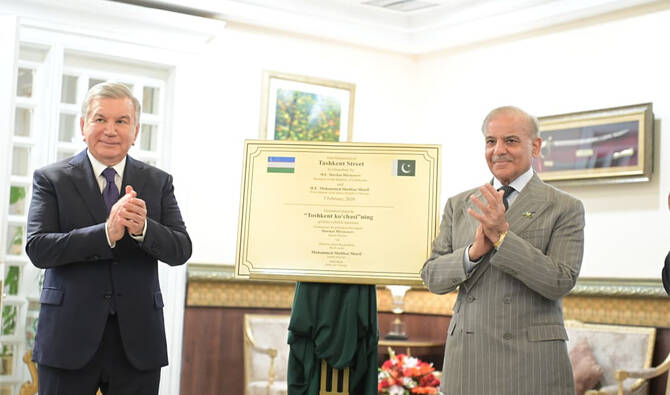
Prime Minister Muhammad Shehbaz Sharif and President of Uzbekistan Shavkat Mirziyoyev unveiling the memorial plaque of naming road in sector F-10 Islamabad as Tashkent Street during the official ceremony held at the Prime Minister's House, February 5, 2026.
Short Url
Updated 05 February 2026
Follow

Pakistan, Uzbekistan sign 28 agreements, MoUs to increase cooperation in several sectors

  • Uzbekistan President Shavkat Mirziyoyev arrives in Pakistan on two-day visit with high-level delegation 
  • Agreements, MoUs focus on defense cooperation, climate change, agriculture cooperation and other areas

ISLAMABAD: Pakistan and Uzbekistan signed 28 memoranda of understanding (MoUs) and agreements to enhance cooperation in several economic sectors as President Shavkat Mirziyoyev arrived in Islamabad on a two-day visit. 

Mirziyoyev arrived on Thursday evening with a high-level delegation of business leaders and officials. The Uzbek president was given a red-carpet welcome when his aircraft landed at the Nur Khan Airbase, the state-run Associated Press of Pakistan said. He was welcomed by President Asif Ali Zardari, Prime Minister Shehbaz Sharif and senior members of the cabinet upon his arrival. 

A ceremony was held to exchange 20 out of the 28 MoUs and agreements signed by both countries between their senior ministers and officials in Islamabad. 

The agreements focused on several areas such as defense cooperation, climate change, disaster risk reduction, disaster management, cooperation in agriculture, protocol on sanitary requirements for exports of fruits, cooperation in the area of mining and geosciences, transfer of sentenced persons and cooperation on combating drug trafficking. 

“We will continue to promote the economic interests of all sectors,” Prime Minister Sharif said in televised remarks after the agreements and MoUs were exchanged. 

“In particular, we will promote agriculture, pharmaceuticals, textile industry, tourism, IT, and agriculture,” he added. 

Sharif spoke about the Uzbekistan-Afghanistan-Pakistan (UAP) Railway Project, describing it as a “game-changer for the region.”

The UAP aims to establish a vital trade and transit corridor linking Uzbekistan with Pakistan via Afghanistan, offering the Central Asian republics direct access to Pakistani seaports. 

“And in line with your vision, I want to assure you that I will work very closely with you for regional connectivity, as we both are in total agreement that the Uzbekistan-Afghanistan-Pakistan rail project will be a game-changer, not only for our countries, but for the entire region,” Sharif said.

“And in that, we are ready to join hands and work together to raise funds for this project on the basis of our feasibility and business plan.”

Earlier, an honorary degree of the Doctorate of Philosophy and the honorary title of professor was conferred on Mirziyoyev by Pakistan’s NUST university in recognition of his services to promote bilateral ties between the two nations. 

The Uzbek president also paid a visit to the Global Industrial & Defense Solutions (GIDS) facility in Islamabad, a state-owned defense conglomerate, with his delegation. 

Pakistan’s Chief of Defense Forces Field Marshal Syed Asim Munir welcomed the delegation during their visit. 

Mirziyoyev was briefed on the diverse portfolio of GIDS encompassing advanced defense solutions, industrial capabilities and technological innovations, the Pakistani military’s media wing said.

“The delegation toured key facilities and witnessed various defense products reflecting Pakistan’s growing expertise in indigenous defense production and industrial development,” it added. 

Pakistan and Uzbekistan have steadily increased economic ties in recent years as Islamabad seeks greater access to landlocked Central Asian markets, aiming to position itself as a regional transit and trade hub linking South Asia with Central Asia.

Pakistan was the first Central Asian partner with which Uzbekistan signed a bilateral Transit Trade Agreement, along with a Preferential Trade Agreement in March 2022, covering 17 items, which became operational in 2023.


Pakistan mulls enforcing remote work, online classes rules to conserve energy amid Mideast crisis

Updated 5 sec ago
Follow

Pakistan mulls enforcing remote work, online classes rules to conserve energy amid Mideast crisis

  • Government committee reviews contingency plans as Iran closes Strait of Hormuz, disrupting global oil supply
  • Petroleum Division official warns fuel costs may rise if Pakistan is forced to import oil from longer routes

ISLAMABAD: Pakistan is considering a range of options to conserve energy which include ordering corporate offices to ensure work-from-home facility for staff and directing universities to shift classes online, a senior official confirmed on Thursday as the ongoing Middle East conflict threatens to disrupt the global supply of petroleum products. 

These proposals were discussed by a cabinet committee constituted by Prime Minister Shehbaz Sharif to monitor petroleum prices on Wednesday. The committee meets daily to review the stock of petroleum products in Pakistan and assess the evolving regional situation.

Tensions in the Middle East have surged since Saturday after the US and Israel’s coordinated strikes against Iran and Tehran’s retaliatory attacks against both and Gulf nations. Iran has closed the crucial Strait of Hormuz waterway, through which roughly 20 percent of global oil and gas supply passes through. 

Pakistan relies heavily on Middle Eastern crude oil, with the majority of its energy imports typically transiting through the strait, making any disruption a major risk to domestic fuel supplies.

“Yes, proposals such as work-from-home for corporate offices and online classes for higher education institutions were discussed in the high-level committee,” a senior official of the finance ministry told Arab News on condition of anonymity, as he was not authorized to speak to the media.

“However, final decisions will be taken in a couple of days after the action plan is finalized based on priority areas.”

The official said the government may also advise the public to avoid unnecessary travel, adding that fuel supplies would be ensured for various industries and other critical sectors.

Meanwhile, Pakistani authorities have imposed a ban on the export of petroleum condensate, a chemical used by oil refineries, to secure its domestic supply in case the Middle East crisis worsens further.

A senior official from Pakistan’s Petroleum Division told a Senate committee on Wednesday that the country currently has petroleum reserves sufficient to last around one month.

“The country has around one month of refined petroleum products available, along with more than ten days’ worth of crude oil stocks,” the official said, also requesting anonymity. 

He added that the government is working on contingency planning to meet future energy requirements if the conflict continues.

“Pakistan is exploring options to import fuel from Saudi Arabia through the Red Sea to ensure uninterrupted supplies,” he said. 

Pakistan’s petroleum ministry confirmed the same in a statement on Wednesday, following Petroleum Minister Ali Pervaiz Malik’s meeting with Saudi Ambassador Nawaf bin Said Al-Malki. 

The official warned that petroleum product prices may rise in line with global market trends, particularly if supplies have to be transported through alternative, longer routes.

He added that in the event of a prolonged conflict, Pakistan may consider importing fuel from the US and other countries.