

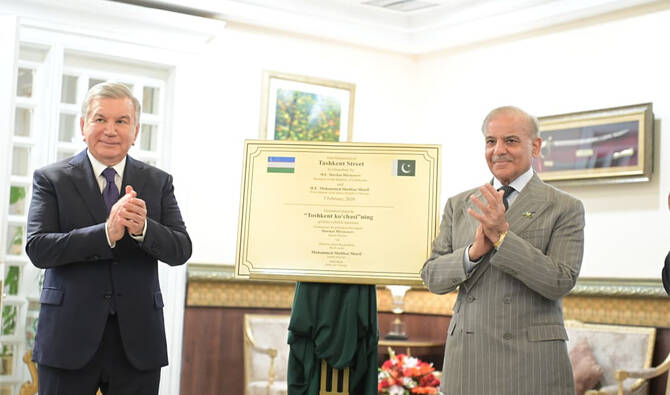

ISLAMABAD: Pakistan and Uzbekistan signed 28 memoranda of understanding (MoUs) and agreements to enhance cooperation in several economic sectors as President Shavkat Mirziyoyev arrived in Islamabad on a two-day visit.
Mirziyoyev arrived on Thursday evening with a high-level delegation of business leaders and officials. The Uzbek president was given a red-carpet welcome when his aircraft landed at the Nur Khan Airbase, the state-run Associated Press of Pakistan said. He was welcomed by President Asif Ali Zardari, Prime Minister Shehbaz Sharif and senior members of the cabinet upon his arrival.
A ceremony was held to exchange 20 out of the 28 MoUs and agreements signed by both countries between their senior ministers and officials in Islamabad.
The agreements focused on several areas such as defense cooperation, climate change, disaster risk reduction, disaster management, cooperation in agriculture, protocol on sanitary requirements for exports of fruits, cooperation in the area of mining and geosciences, transfer of sentenced persons and cooperation on combating drug trafficking.
“We will continue to promote the economic interests of all sectors,” Prime Minister Sharif said in televised remarks after the agreements and MoUs were exchanged.
“In particular, we will promote agriculture, pharmaceuticals, textile industry, tourism, IT, and agriculture,” he added.
Sharif spoke about the Uzbekistan-Afghanistan-Pakistan (UAP) Railway Project, describing it as a “game-changer for the region.”
The UAP aims to establish a vital trade and transit corridor linking Uzbekistan with Pakistan via Afghanistan, offering the Central Asian republics direct access to Pakistani seaports.
“And in line with your vision, I want to assure you that I will work very closely with you for regional connectivity, as we both are in total agreement that the Uzbekistan-Afghanistan-Pakistan rail project will be a game-changer, not only for our countries, but for the entire region,” Sharif said.
“And in that, we are ready to join hands and work together to raise funds for this project on the basis of our feasibility and business plan.”
Earlier, an honorary degree of the Doctorate of Philosophy and the honorary title of professor was conferred on Mirziyoyev by Pakistan’s NUST university in recognition of his services to promote bilateral ties between the two nations.
The Uzbek president also paid a visit to the Global Industrial & Defense Solutions (GIDS) facility in Islamabad, a state-owned defense conglomerate, with his delegation.
Pakistan’s Chief of Defense Forces Field Marshal Syed Asim Munir welcomed the delegation during their visit.
Mirziyoyev was briefed on the diverse portfolio of GIDS encompassing advanced defense solutions, industrial capabilities and technological innovations, the Pakistani military’s media wing said.
“The delegation toured key facilities and witnessed various defense products reflecting Pakistan’s growing expertise in indigenous defense production and industrial development,” it added.
Pakistan and Uzbekistan have steadily increased economic ties in recent years as Islamabad seeks greater access to landlocked Central Asian markets, aiming to position itself as a regional transit and trade hub linking South Asia with Central Asia.
Pakistan was the first Central Asian partner with which Uzbekistan signed a bilateral Transit Trade Agreement, along with a Preferential Trade Agreement in March 2022, covering 17 items, which became operational in 2023.


