

Pakistan traders seek waiver of port charges on Afghan cargo after re-export approval

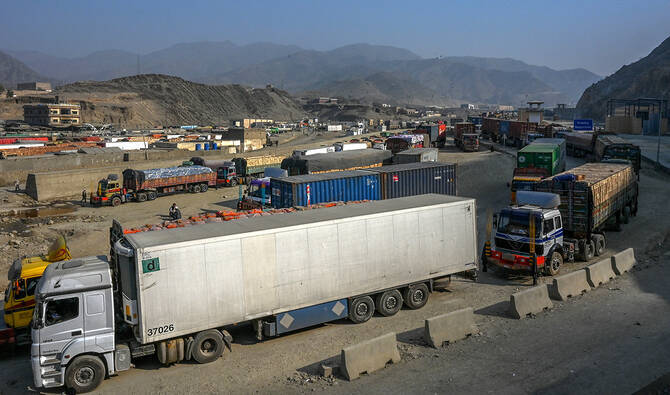
Stranded trucks are pictured near the Pakistan-Afghanistan border in Torkham on January 16, 2024. (AFP/ file)
Short Url
Updated 17 January 2026
Follow

Pakistan traders seek waiver of port charges on Afghan cargo after re-export approval

  • Afghan transit trade stalled after border closure following last year’s skirmishes between the two countries
  • Government’s re-export approval allows stranded Afghan cargo to be shipped out without entering Pakistan

KARACHI: Pakistani traders and logistics operators are calling for waivers and rationalization of detention and demurrage charges incurred on Afghan transit cargo that remained stuck at ports after cross-border trade with Afghanistan came to a halt, according to a trade body statement issued on Saturday.

The appeal follows a government decision earlier this month allowing the re-export of stranded Afghan transit goods, after prolonged border closures prevented cargo from moving onward to Afghanistan, leaving containers immobilized at Pakistani seaports and border crossing points.

Afghan transit trade through Pakistan was disrupted following the closure of the Pakistan-Afghanistan border due to skirmishes between the two countries in October last year, causing congestion at ports and triggering escalating detention and demurrage charges. Industry representatives say the situation imposed a substantial financial burden on importers, clearing agents and transporters, even though the goods were never intended for Pakistan’s domestic market.

“[We have] been actively engaging with the Directorate General of Transit Trade (DGTT), South Asia Pakistan Terminals (SAPT), and other port and terminal operators, including through formal representations, to seek waivers and rationalization of detention and demurrage charges,” the Pakistan-Afghanistan Joint Chamber of Commerce and Industry (PAJCCI) said.

The chamber said it had taken up the matter of stranded Afghan transit trade goods with the Ministry of Commerce following a high-level meeting held on Jan. 10, after which the ministry issued a notification on Jan. 12 permitting the re-export of stranded cargo from the ports of Karachi and Gwadar and designated border crossing points.

PAJCCI said its coordinated engagement with government departments and terminal operators aims to ensure the re-export decision results in “practical relief on ground,” enabling the smooth clearance and movement of cargo while preventing further financial losses for the trade community.

Pakistan’s commerce ministry has not publicly commented on whether waivers on detention and demurrage charges will be granted.


Death toll in Pakistan shopping plaza fire rises to 67, officials say

Updated 22 January 2026
Follow

Death toll in Pakistan shopping plaza fire rises to 67, officials say

  • Rescue teams still searching for damaged Gul Plaza in Karachi where blaze erupted on Saturday, says police surgeon
  • Karachi has a long history of deadly fires, often linked to poor safety standards, weak regulatory enforcement

KARACHI: The death toll from a devastating fire at a shopping plaza in Pakistan’s southern port city of Karachi jumped to 67 on Thursday after police and a hospital official confirmed that the remains of dozens more people had been found.

Police surgeon Dr. Summaiya Syed said rescue teams were still searching the severely damaged Gul Plaza in the Karachi, where the blaze erupted on Saturday.

Most remains were discovered in fragments, making identification extremely difficult, but the deaths of 67 people have been confirmed, she said. Asad Raza, a senior police official in Karachi, also confirmed the death toll. Authorities previously had confirmed 34 deaths.

Family members of the missing have stayed near the destroyed plaza and hospital, even after providing their DNA for testing. Some have tried to enter the building forcibly, criticizing the rescue efforts as too slow.

“They are not conducting the search properly,” said Khair-un-Nisa, pointing toward the rescuers. She stood outside the building in tears, explaining that a relative who had left to go shopping has been missing since the blaze.

Another woman, Saadia Saeed, said her brother has been trapped inside the building since Saturday night, and she does not know what has happened to him.

“I am ready to go inside the plaza to look for him, but police are not allowing me,” she said.

There was no immediate comment from authorities about accusations they have been too slow.

Many relatives of the missing claim more lives could have been saved if the government had acted more swiftly. Authorities have deployed police around the plaza to prevent relatives from entering the unstable structure, while rescuers continue their careful search.

Investigators say the blaze erupted at a time when most shop owners were either closing for the day or had already left. Since then, the Sindh provincial government has said around 70 people were missing after the flames spread rapidly, fueled by goods such as cosmetics, clothing, and plastic items.

The cause of the fire remains under investigation, though police have indicated that a short circuit may have triggered the blaze.

Karachi has a long history of deadly fires, often linked to poor safety standards, weak regulatory enforcement, and illegal construction.

In November 2023, a shopping mall fire killed 10 people and injured 22. One of Pakistan’s deadliest industrial disasters occurred in 2012, when a garment factory fire killed at least 260 people.