

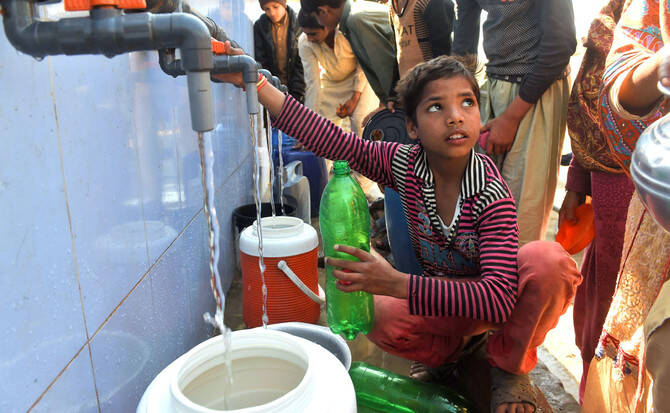

ISLAMABAD: Pakistan is facing a worsening water crisis driven by climate change, rapid population growth and rising demand, experts warned at a national conference in Islamabad this week, calling for urgent and coordinated action to avert long-term shortages.
The country is already classified as water-scarce, with declining availability, groundwater depletion and pollution compounding pressure on supplies. The challenge has intensified in recent years as climate change alters rainfall patterns and increases the frequency of extreme weather events, including floods and droughts.
“This is an alarming situation, because if we are having less than 1,000 cubic meters water per capita per year, so then the country is really under challenge,” Sohail Ali Naqvi, Director of the Freshwater Program at WWF-Pakistan, said at the Pakistan Water Stewardship Conference 2026 in Islamabad on Tuesday.
Pakistan’s per capita water availability has dropped sharply from around 5,600 cubic meters in 1956 to less than 800 cubic meters today, according to data shared at the event, well below internationally recognized scarcity levels.
The issue dominated discussions at the two-day conference, where policymakers, industry leaders and academics gathered to discuss solutions. The event was organized by WWF-Pakistan in collaboration with government institutions and industry partners.
Naqvi said the crisis extended beyond declining supply to issues of access and quality.
“Water is actually right now a lifeline for everyone, but particularly for Pakistan, the climate change is directly hitting us. So that’s why climate change is a water change,” he said.
“Because in Pakistan, water scarcity is one challenge and the other is the water pollution,” he added.
Participants said Pakistan’s exposure to climate shocks has made water management a central national challenge, with recurring floods and erratic rainfall highlighting the need for better planning and resilience.
Experts stressed that no single institution could address the crisis alone, pointing instead to the need for improved governance, stronger public-private partnerships


