Japan and US agree to expand cooperation on missiles, military drills

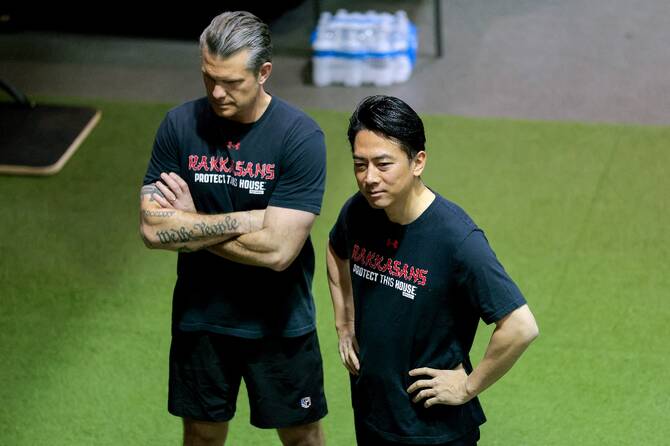
U.S. Secretary of War Pete Hegseth and Japanese Defense Minister Shinjirō Koizumi prepare for their workout in Joint Base Myer-Henderson Hall, Virginia. (AFP)
Short Url
Updated 16 January 2026
Follow

Japan and US agree to expand cooperation on missiles, military drills

  • The agreement came after Japanese defense minister Shinjiro Koizumi met Pentagon chief Pete Hegseth in Washington, where they also pledged to further cooperation on supply chains including critical minerals

TOKYO: Tokyo and Washington agreed Friday to boost joint production of defense equipment including missiles, and expand their military presence in waters southwest of mainland Japan, as China ramps up pressure on its Asian neighbor.
The agreement came after Japanese defense minister Shinjiro Koizumi met Pentagon chief Pete Hegseth in Washington, where they also pledged to further cooperation on supply chains including critical minerals.
Japan is embroiled in a heated diplomatic spat with China, triggered by Prime Minister Sanae Takaichi’s suggestion in November that Japan could intervene militarily if China attacks Taiwan.
China, which regards Taiwan as its own territory, reacted angrily, blocking exports to Japan of “dual-use” items with potential military applications, fueling worries in Tokyo that Beijing could choke supplies of much-needed rare earths.
As the “security environment is rapidly growing severe” in Asia, “the two ministers confirmed the Japan-US alliance remains absolutely unwavering,” the statement released by Tokyo’s defense ministry said.
They agreed to further advance joint production of air-to-air missiles and surface-to-air interceptors.
The allies also agreed to work on the expansion of “more sophisticated and practical joint drills in various locations including the Southwest region,” the statement said.
Beefing up defense around the so-called “Southwest” region, which includes areas such as the subtropical island of Okinawa, is one of Japan’s top priorities.
Okinawa, home to the vast majority of American military bases in Japan, serves as a key US outpost to monitor China, the Taiwan Strait and the Korean peninsula, with both Tokyo and Washington stressing its strategic importance.
Tokyo has also been steadily increasing its military budget, including in December when the right-leaning government of Takaichi approved a record nine trillion yen in defense spending for the upcoming fiscal year.
At the top of his meeting with Koizumi, Hegseth praised Japan for this effort, calling it “hard-nosed realism; practical, common-sense approach that puts both of our vital national interests together,” according to the US Department of War, recently re-branded from the Department of Defense.
Their meeting was preceded by a joint morning workout session at a military gym.
“The American military-style training was very tough,” Koizumi wrote on X.
“But I did my best to labor my way through it, telling myself: ‘this is all for the sake of strengthening the Japan-US alliance.’“


Trump’s failed bid to elevate an Arab American ally shows cracks in his political coalition

Osama Siblani, Donald Trump, Bill Bazzi and Amer Ghalib. (Agencies)
Updated 5 sec ago
Follow

Trump’s failed bid to elevate an Arab American ally shows cracks in his political coalition

  • “President Trump has an incredible relationships with Arab leaders around the world,” White House spokesperson Anna Kelly said in a statement

WASHINGTON: When Donald Trump won his comeback campaign, he credited the mayor of a small Detroit suburb with helping him make inroads with Michigan’s Arab American community. As a reward, Trump nominated Amer Ghalib to serve as US ambassador to Kuwait.
But Ghalib is not on his way to the oil-rich nation in the Arabian Gulf. Instead, he is still in Hamtramck, population 30,000, after his nomination stalled because of opposition from Trump’s fellow Republicans.
It’s not clear whether the White House will submit Ghalib’s name again, and he said it does not matter either way: “I’m not interested in it anymore.”
The nomination’s unraveling has exacerbated tensions between Republicans and an Arab American community that, dissatisfied with Democratic President Joe Biden’s handling of the war in Gaza, helped send Trump back to the White House. Although Trump was successful in 2024, a key constituency may not be there for his party in the November midterm elections, when control of Congress is up for grabs.
“It’s hard for me to try and convince the community to vote again Republican in 2026 and 2028 with this kind of an atmosphere,” said Bishara Bahbah, who chaired Arab Americans for Trump.
Opposition on Capitol Hill
At the last rally of his campaign, in the predawn hours before polls opened, Trump embraced Ghalib on a Michigan stage. He called the mayor “one of the greatest men in your state.” It was a long way from eight years earlier, when Trump campaigned on a promise to ban Muslims from entering the United States.
Not only did Trump win Michigan, he earned strong support from Arab Americans. He even won Dearborn, where nearly half the city’s roughly 110,000 residents are of Arab descent.
But after Trump selected Ghalib for the diplomatic post, the reception on Capitol Hill was markedly colder.
“Your long-standing views are directly contrary to the views and positions of President Trump and to the position of the United States,” Sen. Ted Cruz, R-Texas, said at a hearing last year. “I for one, I’m not going to be able to support your confirmation.”
Cruz was joined by senators from both parties in questioning Ghalib about past comments and social media activity, including some that were labeled as antisemitic. Asked about “liking” a Facebook comment comparing Jewish people to monkeys, Ghalib said he had a “bad habit” of acknowledging nearly every response on his posts but stressed that he disagreed with the statement.
Sen. Jeanne Shaheen, D-N.H., asked Ghalib about a previous comment that allegations of sexual violence during the Oct. 7, 2023, attack by Hamas against Israel were untrue. Ghalib said he condemned all abuses but claimed that he had not seen the evidence himself.
He drew further scrutiny for describing former Iraqi leader Saddam Hussein as a martyr.
While no vote was taken after the hearing, the Republican opposition put Ghalib’s nomination on a near-certain path to failure.
“President Trump has an incredible relationships with Arab leaders around the world,” White House spokesperson Anna Kelly said in a statement. She added that he “continues to deliver on the promises he made to Arab Americans and all communities by cooling inflation, securing the border, and restoring peace through strength.”
’Widespread disappointment’
Another former mayor who helped Trump with the Arab American community, Bill Bazzi of Dearborn Heights, had more luck than Ghalib. He was sworn in as US ambassador to Tunisia in October.
To some critics, the administration is sidelining Arab American voices after highlighting them during the campaign.
Bahbah said he recently spent more than a week in Michigan absorbing a sense of “widespread disappointment.”
“First of all, many of the promises that were made to the community have not been fulfilled. That’s what I’m told,” he said. “Secondly, the whole issue of immigration and visas is really rattling the community. ICE (Immigration and Customs Enforcement) is rattling the community, even those with citizenships.”
To top it off, Bahbah said, people feel that “grocery bills are much higher than they used to be.”
Many leaders in Michigan’s Arab American community emphasized that Trump’s success had less to do with support for the Republican candidate than anger at Biden.
But the reality of Trump’s second term has been more complicated than some expected. An agreement intended to stop the war in Gaza has brought mixed reactions because it “seems to be a one-sided ceasefire,” said Bahbah. He also said immigration enforcement has taken a toll in Arab American communities.
“People are terrorized,” Bahbah said. “They’re afraid.”
“This is not what the community voted for,” he added.
A splintering coalition
Ghalib emphasized that he is not upset with the president, saying “he was loyal and supportive.”
But he said “those who opposed me for nonsense reasons have made the community upset, and they will have to work hard to restore their relationship with the community.”
Ghalib’s criticism of Republicans reflects the fragility of the coalition Trump assembled in 2024. Not only did he improve his standing with Arab Americans, he also increased his share of Black and Latino voters.
But with dissatisfaction on the rise, sustaining that support is proving difficult.
Osama Siblani, editor of The Arab American News in Dearborn, said he does not believe that Trump’s success in 2024 will be repeated.
“He has no support in this community with or without Ghalib,” Siblani said.