

What We Are Buying Today: Snowhite Arabia beauty products

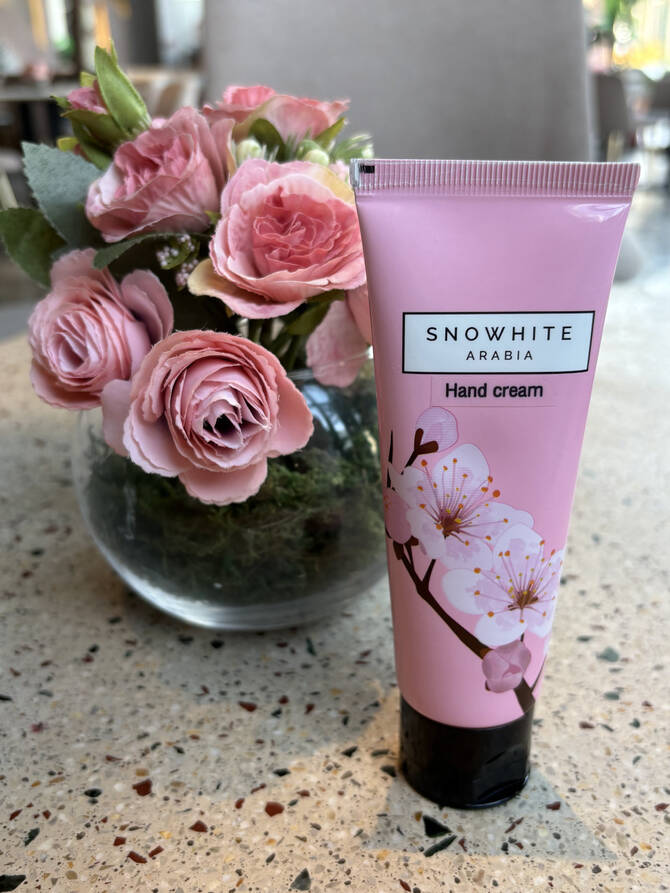
The Snowhite hand cream is moisturizing and fragrant. (AN photo)
Short Url
Updated 16 January 2026
Follow

What We Are Buying Today: Snowhite Arabia beauty products

The Saudi beauty market is saturated with shelves lined with creams, serums and promises. If you have entered a local pharmacy recently, you likely already noticed Snowhite Arabia’s products — the distinct pink packaging is hard to miss.

Consider this your sign to try it.

Founded in 2014 by Heba Al-Madani as a home-based workshop, Snowhite Arabia has since evolved into a substantial operation, manufactured at Al-Madani’s factory for Snowhite Est., proudly labeled with the “Saudi Made” stamp.

I started with the hand cream, which the package recommends using twice a day while avoiding direct sun exposure. The formula includes avocado oil, aloe vera juice and mango butter, among other ingredients.

The Snowhite hand cream is moisturizing and fragrant, but without a greasy or overly perfumed aftermath. After a few uses, my dry-prone hands felt noticeably smoother.

I also like how it is vibrantly-colored so I can easily fish it out of my tote bag to reapply when I am out and about.

For the home, I tried the Moroccan soap in the bath. Its dark color, slimy texture and pungent smell were slightly alarming at first. Once worked with a bit of water, it foamed easily, and I learned quickly that a little goes a long way. I now like it.

Snowhite Arabia also offers hair masks and other products, though these are the only ones I have tried so far. I am looking forward to trying the broccoli shampoo next.

For now, the hand cream stands out as the most practical winter companion and my current local favorite.

Follow them @snowhitesa_ on Instagram.


From historic desert landscapes to sound stages: AlUla’s bid to become the region’s film capital

Updated 23 sec ago
Follow

From historic desert landscapes to sound stages: AlUla’s bid to become the region’s film capital

DUBAI: AlUla is positioning itself as the center of cinema for the MENA region, turning its dramatic desert landscapes, heritage sites and newly built studio infrastructure into jobs, tourism and long‑term economic opportunity.

In a wide‑ranging interview, Zaid Shaker, executive director of Film AlUla, and Philip J. Jones, chief tourism officer for the Royal Commission for AlUla, laid out an ambitious plan to train local talent, attract a diverse slate of productions and use film as a catalyst for year‑round tourism.

“We are building something that is both cultural and economic,” said Shaker. “Film AlUla is not just about hosting productions. It’s about creating an entire ecosystem where local people can come into sustained careers. We invested heavily in facilities and training because we want AlUla to be a place where filmmakers can find everything they need — technical skill, production infrastructure and a landscape that offers limitless variety. When a director sees a location and says, ‘I can shoot five different looks in 20 minutes,’ that changes the calculus for choosing a destination.”

At the core of the strategy are state‑of‑the‑art studios operated in partnership with the MBS Group, which comprises Manhattan Beach Studios — home to James Cameron’s “Avatar” sequels. “We have created the infrastructure to compete regionally and internationally,” said Jones. “Combine those studios with AlUla’s natural settings and you get a proposition that’s extremely attractive to producers; controlled environment and unmatched exterior vistas within a short drive. That versatility is a real selling point. We’re not a one‑note destination.”

The slate’s flagship project, the romantic comedy “Chasing Red,” was chosen deliberately to showcase that range. “After a number of war films and heavy dramas shot here, we wanted a rom‑com to demonstrate the breadth of what AlUla offers,” said Shaker. “‘Chasing Red’ uses both our studio resources and multiple on‑location settings. It’s a story that could have been shot anywhere — but by choosing AlUla we’re showing how a comical, intimate genre can also be elevated by our horizons, our textures, our light.

“This film is also our first under a broader slate contract — so it’s a proof point. If ‘Chasing Red’ succeeds, it opens the door for very different kinds of storytelling to come here.”

Training and workforce development are central pillars of the program. Film AlUla has engaged more than 180 young Saudis in training since the start of the year, with 50 already slated to join ongoing productions. “We’re building from the bottom up,” said Shaker. “We start with production assistant training because that’s often how careers begin. From there we provide camera, lighting, rigging and data-wrangling instruction, and we’ve even launched soft‑skill offerings like film appreciation— courses that teach critique, composition and the difference between art cinema and commercial cinema. That combination of technical and intellectual training changes behavior and opens up real career pathways.”

Jones emphasized the practical benefits of a trained local workforce. “One of the smartest strategies for attracting productions is cost efficiency,” he said. “If a production can hire local, trained production assistants and extras instead of flying in scores of entry‑level staff, that’s a major saving. It’s a competitive advantage. We’ve already seen results: AlUla hosted 85 productions this year, well above our initial target. That momentum is what we now aim to convert into long‑term growth.”

Gender inclusion has been a standout outcome. “Female participation in our training programs is north of 55 percent,” said Shaker. “That’s huge. It’s not only socially transformative, giving young Saudi women opportunities in an industry that’s historically male-dominated, but it’s also shaping the industry culture here. Women are showing up, learning, and stepping into roles on set.”

Looking to 2026, their targets are aggressive; convert the production pipeline into five to six feature films and exceed 100 total productions across film, commercials and other projects. “We want private-sector partners to invest in more sound stages so multiple productions can run concurrently,” said Jones. “That’s how you become a regional hub.”

The tourism case is both immediate and aspirational. “In the short term, productions bring crews who fill hotels, eat in restaurants and hire local tradespeople,” said Shaker. “In the long term, films act as postcards — cinematic invitations that make people want to experience a place in person.”

Jones echoed that vision: “A successful film industry here doesn’t just create jobs; it broadcasts AlUla’s beauty and builds global awareness. That multiplies the tourism impact.”

As “Chasing Red” moves into production, Shaker and Jones believe AlUla can move from an emerging production destination to the region’s filmmaking epicenter. “We’re planting seeds for a cultural sector that will bear economic fruit for decades,” said Shaker. “If we get the talent, the infrastructure and the stories right, the world will come to AlUla to film. And to visit.”