
RIYADH: Jordan’s total exports rose 14.5 percent year on year in the first half of 2026, while the trade deficit narrowed as export growth outpaced the increase in imports, official data showed.
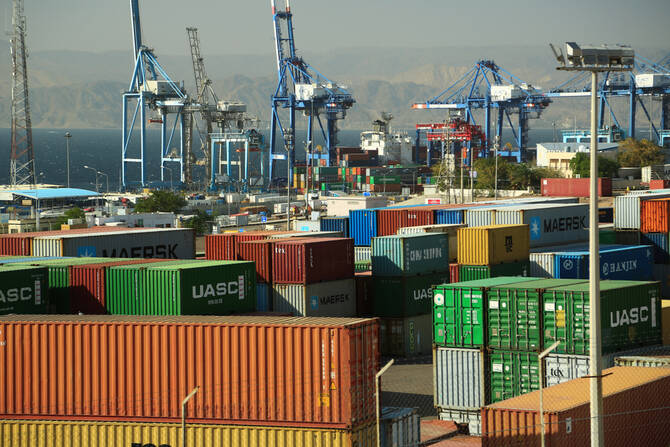
According to data from the Department of Statistics, total exports reached 6.41 billion Jordanian dinars ($9.04 billion) in the six months through June, comprising 4.67 billion dinars in national exports and 1.75 billion dinars in re-exports, Petra reported, citing the department’s monthly foreign-trade report.
National exports increased 6.2 percent, while re-exports surged 44.6 percent from the same period a year earlier. Imports rose at a slower pace, increasing 6.1 percent to 10.26 billion dinars. That narrowed the trade deficit by 5.5 percent, or 226 million dinars, to 3.85 billion dinars. Export coverage of imports improved to 63 percent from 58 percent a year earlier.
Jordan’s Economic Modernisation Vision identifies exports and international markets as key elements of its economic-growth strategy, with high-value industries including mining, chemicals, pharmaceuticals, food products and logistics among its priority sectors. The second phase of the vision covers 2026-29 and builds on progress made during the first phase.
“The increase in national exports was anchored by notable increases in crude potash, up 30.7 percent, fertilizers, up 14.1 percent, and apparel and accessories, up 3.0 percent. These gains offset declines in raw phosphate exports, which dropped 7.2 percent, and fine jewelry, which fell 9.8 percent,” Petra reported.
It added: “Export growth was largely buoyed by expanded shipments to Syria, non-Arab Asian nations including China, and European Union markets led by the Netherlands.”
The data point to continued diversification in Jordan’s export markets as the country seeks to expand its presence in regional and international markets.
Oil imports surge
On the import side, purchases of crude oil and petroleum products jumped 58.1 percent, while grain imports increased 10 percent.
Imports of machinery and tools fell 23.6 percent, while purchases of precious jewelry declined 19.8 percent. Imports of vehicles and cycles fell 5.9 percent, and electrical machinery and equipment declined 2.4 percent.
Saudi Arabia, the US and China were among Jordan’s main sources of imports, according to the data.
Jordan signs $340m ADFD agreements
Separately, Jordan signed two agreements worth $340 million with the Abu Dhabi Fund for Development, including $300 million in financing to support the government’s general budget and a $40 million contract to build and equip five public vocational and technical schools.
Jordanian Planning and International Cooperation Minister Zeina Toukan and ADFD Director General Mohammed Saif Suwaidi signed the agreements during the fund chief’s visit to Jordan.
The five schools will be built in Amman, Mafraq, Jerash and Irbid, according to Petra. The $40 million project is financed through an ADFD grant and forms part of the government’s Economic Modernisation Vision and its 2026-29 executive program.
The ADFD has also committed $70 million to supply natural gas to Rawda Industrial City in Ma’an and Muwaqqar Industrial City, according to Petra. Studies are underway for a separate project to extend gas supplies to the King Hussein Bin Talal Development Area in Mafraq.