Pakistan signs pact with Trump-linked crypto firm to explore digital payments

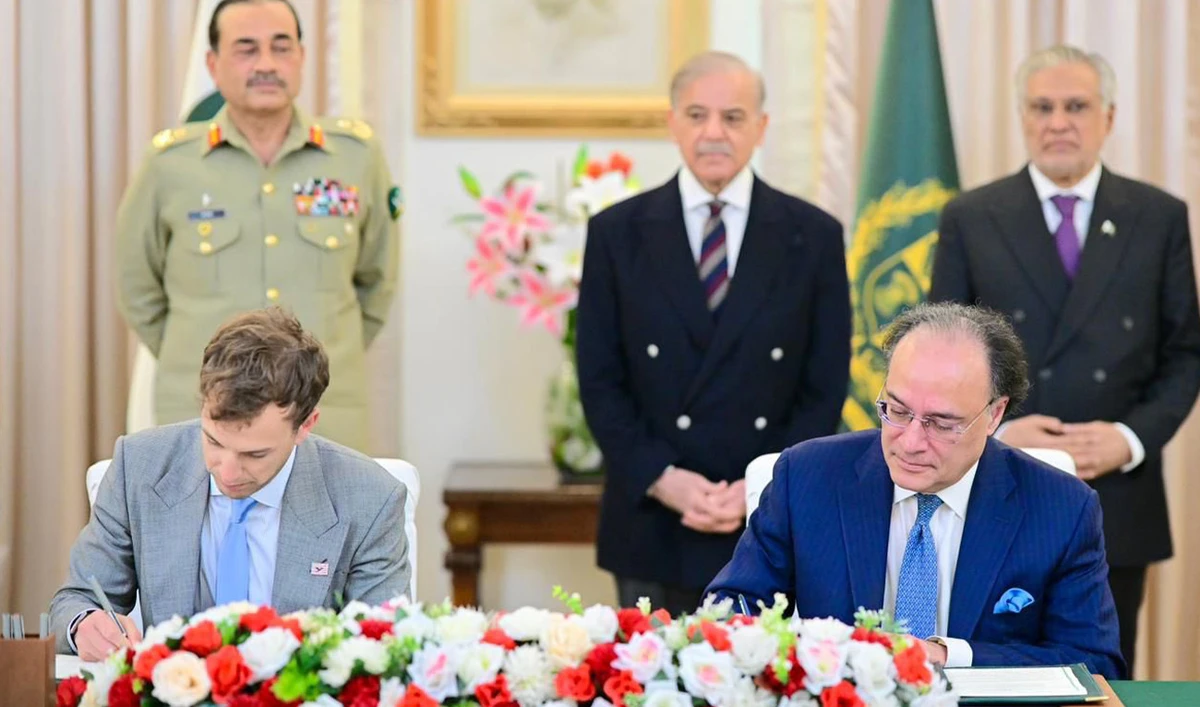
Finance Minister of Pakistan, Muhammad Aurangzeb (front-right) signing an MoU with a representative of the World Liberty Financial in Islamabad on January 14, 2026. (@PakistanVARA/X)
Short Url
Updated 14 January 2026
Follow

Pakistan signs pact with Trump-linked crypto firm to explore digital payments

  • Pakistan agrees to explore use of dollar-linked stablecoin under regulatory framework
  • Government seeks faster remittances and tighter oversight of digital finance

ISLAMABAD: Pakistan on Wednesday signed a memorandum of understanding (MoU) with a company affiliated with World Liberty Financial, the main crypto venture linked to the family of US President Donald Trump, to explore the use of a dollar-linked stablecoin for cross-border payments, according to an official statement.

The MoU, signed through Pakistan’s finance ministry with SC Financial Technologies LLC, provides a framework for technical discussions on digital payment systems, including the potential use of World Liberty Financial’s USD1 stablecoin for international transactions, a statement circulated by the Pakistan Virtual Asset Regulatory Authority (PVARA) said. USD1 is a digital token designed to maintain a one-to-one value with the US dollar issued by World Liberty Financial, a crypto firm linked to the Trump family’s business network. Unlike volatile cryptocurrencies, stablecoins are intended to be backed by dollar assets and are increasingly being examined by governments as potential tools for faster cross-border payments. Pakistani officials said the MoU does not authorize adoption but creates a framework to study such technologies under regulatory oversight.

The deal represents one of the first publicly announced tie-ups between World Liberty Financial and a sovereign state, as governments begin to examine the role of stablecoins in regulated payment systems.

World Liberty has fueled a sharp rise in income for the Trump family business, the Trump Organization, including from foreign entities, according to a Reuters report.

“Pakistan recognizes that the future of finance is being shaped today,” Finance Minister Muhammad Aurangzeb said, according to the statement. “Our focus is to stay ahead of the curve by engaging with credible global players, understanding new financial models and ensuring that innovation, where explored, is aligned with regulation, stability and national interest.”

The MoU signing comes amid warming ties between Pakistan and the United States.

World Liberty Financial’s engagement with Pakistan follows earlier contacts between the company and Pakistani institutions, including a letter of intent signed in April with the Pakistan Crypto Council to facilitate knowledge-sharing on emerging financial technologies.

Separately, Pakistan’s military said a delegation from World Liberty Financial USA, led by its chief executive Zachary Witkoff, also met on Wednesday with Asim Munir, the country’s army chief and chief of defense staff.

According to a statement from the military’s media wing, the meeting discussed Pakistan’s economic landscape, investor confidence and the potential for fintech-driven financial inclusion and cross-border digital finance. Munir reaffirmed Pakistan’s commitment to economic stability and to providing an environment conducive to responsible private-sector investment, the statement said.

Pakistan has stepped up efforts to regulate its digital asset sector and is exploring digital currency initiatives as part of broader measures to reduce cash usage.

The country also wants to improve cross-border payments, including remittances, a key source of foreign exchange, with the central bank saying it is preparing a pilot for a digital currency and finalizing legislation to regulate virtual assets.
Tens of thousands flee northwest Pakistan over fears of military operation

Updated 9 sec ago
Follow

Tens of thousands flee northwest Pakistan over fears of military operation

  • More than 70,000 people, mostly women and children, have fled remote Tirah region bordering Afghanistan 
  • Government says no military operation underway or planned in Tirah, a town in Khyber Pakhtunkhwa province

BARA, Pakistan: More than 70,000 people, mostly women and children, have fled a remote region in northwestern Pakistan bordering Afghanistan over uncertainty of a military operation against the Pakistani Taliban, residents and officials said Tuesday.

Pakistan’s Defense Minister Khawaja Mohammad Asif has denied the claim by residents and provincial authorities. He said no military operation was underway or planned in Tirah, a town in Khyber Pakhtunkhwa province.

Speaking at a news conference in Islamabad, he said harsh weather, rather than military action, was driving the migration. His comments came weeks after residents started fleeing Tirah over fears of a possible army operation.

The exodus began a month after mosque loudspeakers urged residents to leave Tirah by Jan. 23 to avoid potential fighting. Last August, Pakistan launched a military operation against Pakistani Taliban in the Bajau r district in the northwest, displacing hundreds of thousands of people.

Shafi Jan, a spokesman for the provincial government in Khyber Pakhtunkhwa, posted on X that he held the federal government responsible for the ordeal of the displaced people, saying authorities in Islamabad were retracting their earlier position about the military operation.

Khyber Pakhtunkhwa Chief Minister Suhail Afridi, whose party is led by imprisoned former Prime Minister Imran Khan, has criticized the military and said his government will not allow troops to launch a full-scale operation in Tirah.

The military says it will continue intelligence-based operations against Pakistani Taliban, who are known as Tehrik-e-Taliban Pakistan, or TTP. Though a separate group, it has been emboldened since the Afghan

Taliban returned to power in 2021. Authorities say many TTP leaders and fighters have found sanctuary in Afghanistan and that hundreds of them have crossed into Tirah, often using residents as human shields when militant hideouts are raided.

Caught in the middle are the residents of Tirah, who continued arriving in Bara.

So far, local authorities have registered roughly 10,000 families — about 70,000 people — from Tirah, which has a population of around 150,000, said Talha Rafiq Alam, a local government administrator overseeing the relief effort. He said the registration deadline, originally set for Jan. 23, has been extended to Feb. 5.

He said the displaced would be able to return once the law-and-order situation improves.

Among those arriving in Bara and nearby towns was 35-year-old Zar Badshah, who said he left with his wife and four children after the authorities ordered an evacuation. He said mortar shells had exploded in villages in recent weeks, killing a woman and wounding four children in his village. “Community elders told us to leave. They instructed us to evacuate to safer places,” he said.

At a government school in Bara, hundreds of displaced lined up outside registration centers, waiting to be enrolled to receive government assistance. Many complained the process was slow.

Narendra Singh, 27, said members of the minority Sikh community also fled Tirah after food shortages worsened, exacerbated by heavy snowfall and uncertain security.

“There was a severe shortage of food items in Tirah, and that forced us to leave,” he said.

Tirah gained national attention in September, after an explosion at a compound allegedly used to store bomb-making materials killed at least 24 people. Authorities said most of the dead were militants linked to the TTP, though local leaders disputed that account, saying civilians, including women and children, were among the dead.