

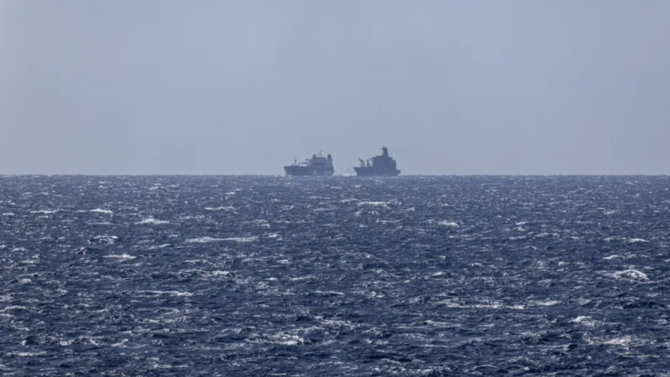

RIYADH: A convoy of at least 25 supertankers is heading to the port of Yanbu on the Red Sea, as Saudi Arabia races to get its oil to market after the US-Israel war with Iran halted shipping through the Strait of Hormuz.
This fleet will provide the capacity to ship approximately 50 million barrels of oil from the port, according to ship-tracking data compiled by Bloomberg.
If these tankers successfully load their cargoes, it will be a significant step toward easing the unprecedented disruption to energy supplies from the Arabian Gulf, Asharq Bloomberg reported.
This comes as the widening war in Iran has effectively halted tanker traffic through the Strait of Hormuz, sending oil prices into sharp swings and highlighting the strategic importance of the narrow waterway to global energy supplies.
The Strait of Hormuz is the narrow mouth of the Arabian Gulf through which about a fifth of the world’s oil passes. Any disruption to traffic through the passage is highly disruptive to the oil trade.
Disruptions caused oil to spike on March 9, only for it to swiftly fall back after US President Donald Trump suggested the war could be near an end.
“Container lines, oil tankers and LNG (liquefied natural gas) carriers are reducing operations in the Gulf. As a consequence, trade flows are redirected through ports on the Indian Ocean — e.g. Fujairah, Khorfakkan, Sohar — supported by land transport and rail connections. In Saudi Arabia, the land bridge railway is also being leveraged to enhance inland logistics resilience,” Paolo Carlomagno, partner at Arthur D. Little, told Arab News.
“On crude oil, existing pipelines, such as Saudi Arabia’s East-West pipeline and Abu Dhabi’s link to Fujairah, allow part of the exports to bypass the Strait. However, these solutions mainly cover crude, leaving refined products under continued pressure,” Carlomagno added.
The ADL partner went on to note that the situation is different for LNG, for which limited alternative export routes exist in the region.
“The highest impact in case of long-term closure of Hormuz, is to be expected on the Asian countries: India, China, Japan, South Korea, buying substantial volumes of oil from the Gulf,” Carlomagno added.
From his side, Nick Bartlett, co-founder of Wayfindr, said that on the traffic front, the general flow is clearly diverging and that the Red Sea and Suez volumes are structurally reducing, with significant volume already rerouted away from those corridors.
“The Strait of Hormuz, on the other hand, has seen a sudden and acute collapse in tanker traffic, which carries major implications for global oil flow. To put that in context, on a normal day, around a hundred cargo-carrying vessels transit the strait, the majority of which are carrying oil exports. That’s an enormous chokepoint when things go wrong. The impact is both acute and fast-moving,” Bartlett said.
He added: “There's a significant downstream effect on the oil exports running through the strait, and we're already seeing it ripple outward. By the end of February, and certainly into March, we've seen a meaningful spike in the barrel price of oil. And when oil prices move, everything follows: food at the supermarket, airline tickets, petrol, courier surcharges, and even the ocean vessels that carry the crude themselves. There’s a certain irony there.”
The co-founder further highlighted that beyond fuel, we will start to see freight rates climb as a result of constrained capacity and rerouting.
“So, the impact isn't just on global oil supply — it flows all the way down to pricing at the consumer level. Both dimensions are significant, and if the situation persists, the pressure on supply chains will compound quickly,” he concluded.
Vessels struck

The Thailand-flagged cargo ship Mayuree Naree engulfed in black smoke in the Strait of Hormuz, March 11, 2026. Royal Thai Navy handout via Reuters
Three vessels have been hit by unknown projectiles in the Strait of Hormuz, maritime security and risk firms said on Wednesday, bringing the number of ships struck in the region since the Iran conflict began to at least 14.
The Thai-flagged Mayuree Naree dry bulk vessel had been struck by "two projectiles of unknown origin" while sailing through the Strait on Wednesday, causing a fire and damaging the engine room, the ship's Thai-listed operator Precious Shipping PSL.BK said in a statement.
"Three crew members are reported missing and believed to be trapped in the engine room," Precious Shipping said.
"The company is working with the relevant authorities to rescue these three missing crew members," it said, adding that the remaining 20 crew members had been safely evacuated and were ashore in Oman.
Images provided by the Thai navy showed smoke pouring out of the back of the ship.
Earlier on Wednesday, the Japan-flagged container ship ONE Majesty sustained minor damage from an unknown projectile 25 nautical miles (46 km) northwest of Ras Al Khaimah in the UAE two maritime security firms said.
A third vessel, a bulk carrier, was also hit by an unknown projectile approximately 50 miles northwest of Dubai, maritime security firms said.
The projectile had damaged the hull of the Marshall Islands-flagged Star Gwyneth, maritime risk management company Vanguard said, adding that the vessel's crew were safe. Owner Star Bulk Carriers said the ship was hit in the hold area whilst anchored. There were no crew injuries and no listing.
Maersk bookings suspension
Maersk, one of the world’s biggest container shipping groups, has 10 ships stranded in the Gulf and would need at least a week to 10 days to return to normal operations if a ceasefire is reached, the company’s CEO Vincent Clerc told the Wall Street Journal on March 11.
The Danish company also announced with regard to reefers, dangerous goods, and out-of-gauge as well as in-gauge cargo types, the suspension of all bookings to and from the UAE, Oman, Iraq, and Kuwait, as well as Jordan, Qatar, Bahrain, and Saudi Arabia.
The suspension applies to cargo originating from, destined for, or transshipping through these countries.
“We are closely monitoring the evolving situation in the Middle East and would like to provide you with an update on what it means for your shipments and our services across the region,” Maresk said in a statement.
MSC emergency fuel surcharge
Shipping company MSC said that it would apply an emergency fuel surcharge to all cargo from Northern Europe and the Mediterranean to Australia and New Zealand from March 16, Reuters reported.
MSC said the surcharge would be $200 per per twenty-foot equivalent unit from Northern Europe and Mediterranean to Australia and New Zealand for dry containers, and $300 per TEU for refrigerated containers.


