

School resumes in tents under shadow of Gaza’s ‘yellow line’

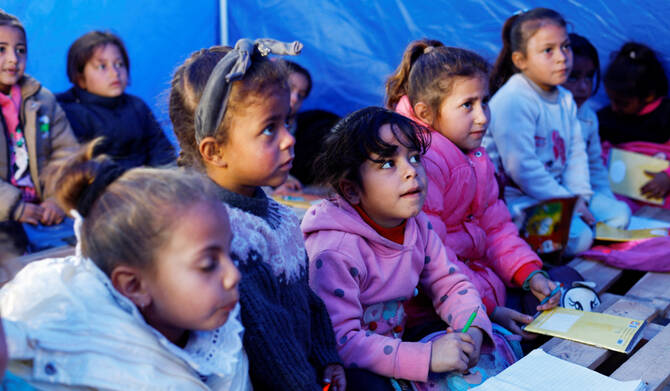
Displaced Palestinian students study inside a tent near the Israeli-designated "yellow line" in Beit Lahiya, northern Gaza Strip, January 6, 2026. (REUTERS)
Short Url
Updated 12 January 2026
Follow

School resumes in tents under shadow of Gaza’s ‘yellow line’

  • 400 children attending lessons at the makeshift facility, set up in the ruins of the community of Beit Lahiya
  • Although we do not sit on chairs, thank God we started attending school. During the war, there were no schools, and we were bored

GAZA/CAIRO: She spends her lessons in the wintry cold on the floor of a crowded tent, her teacher interrupted by regular gunfire and explosions from Israeli-controlled territory less than 1,000 meters away. ​But Toulin Al-Hindi, 7, is grateful to be in school at last after more than two years of war.

She is one of some 400 children attending lessons at the makeshift North Educational School, set up in blue plastic tents in the ruins of northern Gaza’s community of Beit Lahiya, within eyesight of the “yellow line” held by Israeli forces.
During a recent lesson, more than a dozen girls sat on the floor in two rows in one small ‌tent, keeping warm ‌in sweaters and puffy jackets, their notebooks out ‌in front ​of ‌them on a handful of slatted wooden crates. 
They cheerfully sang out numbers while their teacher drew shapes on a chalkboard.
“Although we do not sit on chairs, thank God we started attending school,” said Toulin. 
“During the war, there were no schools, and we were bored.”
Her mother, Yasmine Al-Ajouri, says she worries from the moment her daughter leaves for school until she comes home.
“Take care, take cover next to a wall, be quick on the road,” Yasmine said she tells her daughter.
Under ‌the ceasefire in place since October, Israel still occupies ‍more than half of the Gaza ‍Strip and bars civilians from other areas. 
Nearly all buildings in the ‍Israeli-controlled sector have been leveled and residents driven out.
That leaves virtually the entire population of more than 2 million people confined to around a third of Gaza’s territory, mostly in makeshift tents and damaged buildings, where life has resumed under the control of an ​administration led by Hamas.
Although major fighting has been halted, Israel has routinely opened fire at Palestinians it accuses of approaching the yellow line, saying it aims to eliminate threats to troops.
More than 440 Palestinians have been killed since the October deal came into effect. 
Palestinians say Israeli forces have been moving some of the yellow concrete markers westward, encroaching into unoccupied territory. Israel denies this.
Staff at Toulin’s school said they hear fire daily.

“We taught the children that as soon as we hear fire ... to lie down. This is not safe, and safety depends on God, but this is what we can do,” said Yara Abu Ghalweh, a school supervisor.
Israel’s assault on Gaza has killed more than 71,000 people, according to the enclave’s ‌Health Ministry. 
The war was triggered by a Hamas-led attack on southern Israel on Oct. 7, 2023


Israel agrees to reopen Rafah crossing only for Gaza pedestrians

Updated 1 min 49 sec ago
Follow

Israel agrees to reopen Rafah crossing only for Gaza pedestrians

  • The announcement came after visiting US envoys reportedly pressed Israeli officials to reopen the crossing, a vital entry point for aid into Gaza

JERUSALEM: Israel said Monday it would only allow pedestrians to travel through the Rafah crossing between Gaza and Egypt as part of its “limited reopening” once it has recovered the remains of the last hostage in the Palestinian territory.
Reopening Rafah, a vital entry point for aid into Gaza, forms part of a truce framework announced by US President Donald Trump in October, but the crossing has remained closed since Israeli forces took control of it during the war in the Palestinian territory.
Visiting US envoys had reportedly pressed Israeli officials to reopen the crossing during talks in Jerusalem over the weekend.
World leaders and aid agencies have repeatedly pushed for more humanitarian convoys to be able to access Gaza, which has been left devastated by more than two years of war and depends on the inflow of essential medical equipment, food and other supplies.
Prime Minister Benjamin Netanyahu’s office said on Monday that Israel had agreed to a reopening “for pedestrian passage only, subject to a full Israeli inspection mechanism.”
The move would depend on “the return of all living hostages and a 100 percent effort by Hamas to locate and return all deceased hostages,” it said on X.
It remained unclear whether the reopening would allow medical patients to leave Gaza for treatment in Egypt or other countries.
The Israeli military said it was searching a cemetery in the Gaza Strip on Sunday for the remains of the last hostage, Ran Gvili.
“Upon completion of this operation, and in accordance with what has been agreed upon with the US, Israel will open the Rafah Crossing,” said Netanyahu’s office.
The announcement came after Gaza’s newly appointed administrator, Ali Shaath, said the crossing would open “in both directions” this week.
“For Palestinians in Gaza, Rafah is more than a gate, it is a lifeline and a symbol of opportunity,” Shaath said at the World Economic Forum in Davos on Thursday.
Israeli media had also reported that US envoys Steve Witkoff and Jared Kushner had urged Netanyahu to reopen Rafah during their Jerusalem talks.
Before the war erupted in October 2023, Rafah had been the only gateway connecting Gazans to the outside world and enabling international humanitarian aid to enter the territory, home to 2.2 million people living under Israeli blockade.

Last hostage

A spokesman for Hamas’s Ezzedine Al-Qassam Brigades, Abu Obeida, said on Sunday that the group had “provided mediators with all the details and information in our possession regarding the location of the captive’s body,” referring to Gvili.
Obeida added that “the enemy (Israel) is currently searching one of the sites based on information transmitted by the Al-Qassam Brigades.”
Except for Gvili, all of the 251 people taken hostage during Hamas’s October 7, 2023 attack on Israel have since been returned, whether living or dead.
A non-commissioned officer in the Israeli police’s elite Yassam unit, Gvili was killed in action on the day of the attack and his body was taken to Gaza.
The first phase of the US-backed ceasefire deal had stipulated that Hamas hand over all the hostages in Gaza.
Gvili’s family has expressed strong opposition to launching the second phase of the plan, which includes reopening Rafah, before they have received his remains.
“First and foremost, Ran must be brought home,” his family said in a statement on Sunday.
The Gaza war was sparked by Hamas’s October 7, 2023 attack on Israel, which resulted in the deaths of 1,221 people, according to an AFP tally based on official Israeli figures.
The Israeli retaliation flattened much of Gaza, a territory that was already suffering severely from previous rounds of fighting and from an Israeli blockade imposed since 2007.
The two-year war between Israel and Hamas has left at least 71,657 people dead in Gaza, according to the territory’s health ministry, figures considered reliable by the United Nations.