

Iran’s president says rioters must not disrupt society

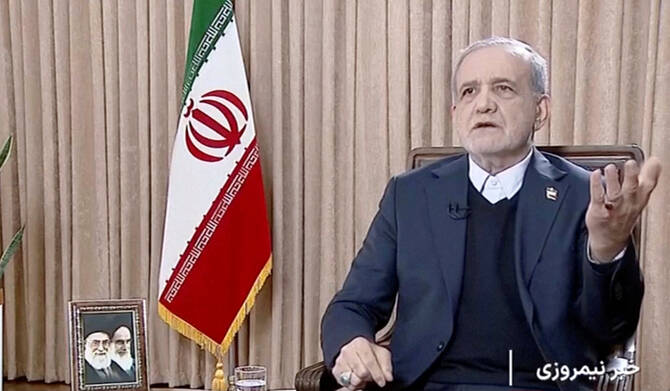
Iran's President Masoud Pezeshkian speaks during an interview with the state TV, amid protests, in Tehran, Iran in this screengrab obtained from a video released on January 11, 2026. (Reuters)
Short Url
Updated 12 January 2026
Follow

Iran’s president says rioters must not disrupt society

  • Pezeshkian accused the US and Israel of “trying to escalate this unrest with regard to the economic discussion and solutions we are working on”

TEHRAN: Iranian President Masoud Pezeshkian on Sunday said “rioters” should not be allowed to disrupt society, in his first remarks after three nights of intensified protests against the country’s authorities.
Pezeshkian, in an interview with state TV on Sunday, said “protesting is the people’s right,” but echoed authorities in drawing a line between outcry over Iran’s dire economy and “rioters” they allege are backed by the US and Israel.
“The people (of Iran) should not allow rioters to disrupt society. The people should believe that we (the government) want to establish justice,” he told state broadcaster IRIB.
Pezeshkian called on Iranians to “come together and not let these people riot” on the streets.
“If people have a concern, we will hear them. It is our duty to hear them and solve their problems. However, our highest duty is not to allow rioters to come and disrupt society,” he said.
Pezeshkian accused the US and Israel of “trying to escalate this unrest with regard to the economic discussion and solutions we are working on.”
“They have taken some people here inside and abroad and trained them. They brought terrorists in from abroad into the country,” he said, calling those who had set the mosque on fire “not human.”
State TV has aired images of buildings, including a mosque on fire, with authorities saying members of the security forces have been killed.
US President Donald Trump has said his country “stands ready to help” demonstrators and threatened new military action against Iranian authorities “if they start killing people.”
Israeli Prime Minister Benjamin Netanyahu said on Sunday that he hoped Iran would soon be freed from what he described as the “yoke of tyranny.”


Hundreds flee to government-held areas in north Syria ahead of possible offensive

Updated 16 January 2026
Follow

Hundreds flee to government-held areas in north Syria ahead of possible offensive

  • Many of the civilians who fled used side roads to reach government-held areas
  • Men, women and children arrived in cars and pickup trucks that were packed with bags of clothes

DEIR HAFER, Syria: Scores of people carrying their belongings arrived in government-held areas in northern Syria on Friday ahead a possible attack by Syrian troops on territory held by Kurdish-led fighters east of the city of Aleppo.
Many of the civilians who fled used side roads to reach government-held areas because the main highway was blocked with barriers at a checkpoint that previously was controlled by the Kurdish-led and US-backed Syrian Democratic Forces, Associated Press journalists observed.
The Syrian army said late Wednesday that civilians would be able to evacuate through the “humanitarian corridor” from 9 a.m. to 5 p.m. Thursday. The announcement appeared to signal plans for an offensive against the SDF in the area east of Aleppo.
There were limited exchanges of fire between the two sides.
Men, women and children arrived in cars and pickup trucks that were packed with bags of clothes, mattresses and other belongings. They were met by local officials who directed them to shelters.
In other areas, people crossed canals on small boats and crossed a heavily damaged pedestrian bridge to reach the side held by government forces.
The SDF closed the main highway but about 4,000 people were still able to reach government-held areas on other roads, Syrian state TV reported.
A US military convoy arrived in Deir Hafer in the early afternoon but it was not immediately clear whether those personnel will remain. The US has good relations with both sides and has urged calm.
Inside Deir Hafer, many shops were closed and people stayed home.
“When I saw people leaving I came here,” said Umm Talal, who arrived in the government-held area with her husband and children. She added that the road appeared safe and her husband plans to return to their home.
Abu Mohammed said he came from the town of Maskana after hearing the government had opened a safe corridor, “only to be surprised when we arrived at Deir Hafer and found it closed.”
SDF fighters were preventing people from crossing through Syria’s main east-west highway and forcing them to take a side road, he said.
The tensions in the Deir Hafer area come after several days of intense clashes last week in Aleppo, previously Syria’s largest city and commercial center, that ended with the evacuation of Kurdish fighters from three neighborhoods north of the city that were then taken over by government forces.
The fighting broke out as negotiations stalled between Damascus and the SDF over an agreement reached in March to integrate their forces and for the central government to take control of institutions including border crossings and oil fields in the northeast.
The US special envoy to Syria, Tom Barrack, posted on X Friday that Washington remains in close contact with all parties in Syria, “working around the clock to lower the temperature, prevent escalation, and return to integration talks between the Syrian government and the SDF.”
The SDF for years has been the main US partner in Syria in fighting against the Daesh group, but Turkiye considers the SDF a terrorist organization because of its association with Kurdish separatist insurgents in Turkiye.