

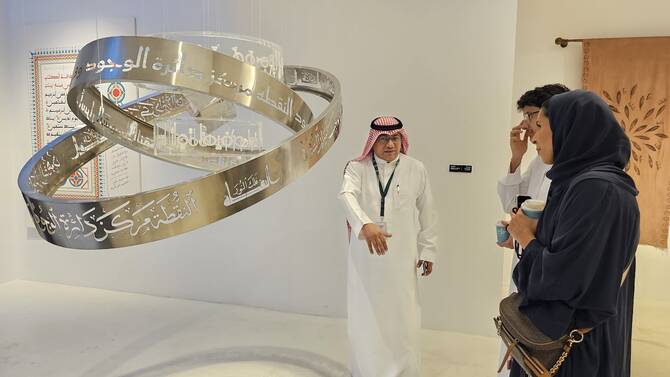
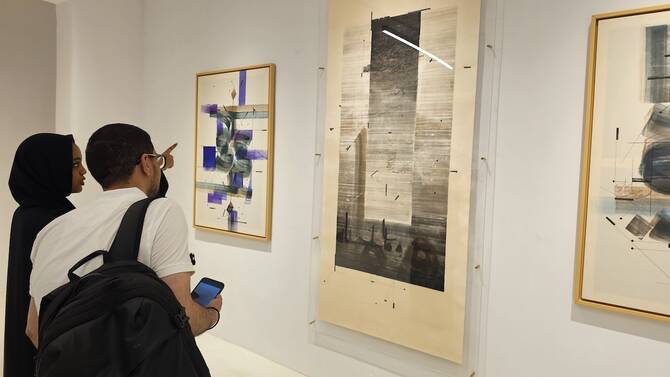


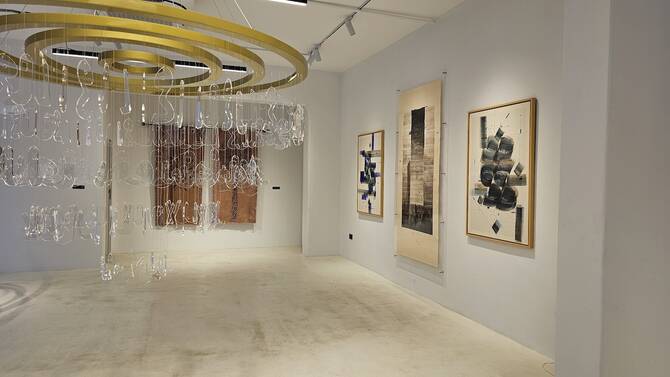


JEDDAH: Al Falah, Jeddah’s oldest school, hosted the “Dar Al-Qalam Residency Program” exhibition over the weekend, presenting a modern take on Arabic calligraphy.
The program exhibited works by members of an artist-in-residency program run by the Prince Mohammed bin Salman Global Center for Arabic Calligraphy, an initiative of the Saudi Ministry of Culture.
The residency brought together Saudi and international artists in an intensive eight-week program dedicated to contemporary Arabic calligraphy.
It explored the art of Arabic calligraphy through four key themes: its traditional roots, the arts that accompany it, leading contemporary practices and questions surrounding the future of innovation in this art form.
The exhibition was curated by Abdelrahman El-Shahed, supported by assistant curator Layal Al-Gain.
The artists who took part in the second edition of the residency were: Om Kalthoom, Budor Alyafie Al-Alawi, Bushra Al-Kebsi, Rafiq Ullah Khan, Zainab Al-Sabba, Somaya Al-Sayed, Laya Al-Kaff, Mustafa Al-Arab, Hind Djafer and Yomna Ayman.
Curator Abdelrahman El-Shahed told Arab News: “My vision for this edition was centered on exploring Arabic calligraphy as a living, evolving art form. The artists were guided through four main paths, from traditional calligraphy and its related arts to contemporary practices and future innovation. What stood out most was the depth of research and experimentation, which really shaped the final works presented in the Open Studio.”
Assistant curator Layal Al-Gain told Arab News that artists who reside in the heart of Jeddah historical area are offered a transformative platform to sharpen their creative skills through expert mentorship, production support and curatorial guidance.
One of the most conceptually layered projects is by Budoor, who worked with textiles to explore the Kiswah of the Kaaba as a historical and cultural archive. “I see the Kiswah not just as a covering, but as a civilizational symbol and a textile of memory. Over centuries, its materials, colors and techniques have changed, and those changes reflect how people have related to the sacred, to power and to craftsmanship,” she said.
Her installation uses layered fabrics to suggest the accumulation of time. “Textile becomes a way of reading history rather than a decorative surface,” she said adding, “Through this residency, my practice moved from fashion and design toward research and installation, where fabric becomes a structure for thinking about continuity and change.”
Artist Alsayed turned to nature and language in her project “The Word Is a Tree,” inspired by the Quranic parable that compares a good word to a good tree. “I’ve always been drawn to trees as symbols of legacy. Here I wanted to think about how words grow inside people and influence their hearts, just like roots.”
Using lino printing, she carved Kufic words into blocks and printed them repeatedly onto dyed fabric, while another piece uses expressive handwriting to suggest the branching form of a tree. “Being surrounded by artists from different disciplines really expanded my perspective. I feel the calligraphy input I received here will continue to influence both my writing and my art.”
Whereas, Al-Kebsi’s work moves calligraphy toward abstraction, light and time. Her compositions use circular forms in which Arabic letters appear only as traces.
“I was interested in how form can carry a sense of time without directly representing it. The letter appears and disappears, leaving a visual memory rather than readable meaning.”
“Discipline and continuity during the residency allowed the ideas to mature and transformed my practice. The focused environment made me more aware that growth comes from consistent making, reflection and patience.”
“The participating artists came from a wide range of multi-disciplinary backgrounds including art, photography, design, architecture and other fields, and what is beautiful about that (is that) they have joined together by their love and passion for the Arabic calligraphy as they approach it in a different way,” Al-Gain said.
The program offered an intensive framework of practical workshops, critique sessions, lectures, research activities and field visits.
These were complemented by meetings with experts and peers, fostering critical exchange within a historically and culturally resonant setting.
For Saudi artist Om Kalthoom, the experience was deeply introspective.
“I have been in residency programs (before) but this one is very impressive because the subject is related to Arabic calligraphy,” she said.
“Being immersed in the heart of this great historical area allowed me to see making as both an act of listening and an act of thinking.”
Speaking about her work, she explained: “It is called ‘Beyond the Light.’ it is a direct message with Arabic letters.
“I try in this project to give visitors a space where they can think, search and connect these letters.”
Saudi artist Laya Al-Kaff said: “We are here to celebrate the Arabic letter not simply as text but as a form of visual expression in itself.”
Al-Kaff said the Dar Al-Qalam Residency Programme was a great experience. “It is a great opportunity (for) us as artists to engage with the residents’ artistic processes, trace the evolving forms of Arabic calligraphy in contemporary practice.
“In this work, I rethought my own background as an artist. I graduated with a degree in dentistry, oral medicine, therefore decided to combine the anatomy I studied at university with the one-line art.”
Rafiqullah Khan, from Pakistan, said he was “thrilled to be part of the second Al‑Qalam Arabic Calligraphy Residency, an initiative of the Prince Mohammed bin Salman Global Center for Arabic Calligraphy.”
“This program gives calligraphers and visual artists a nurturing space to experiment, share knowledge and celebrate Arab identity on both local and world stages.”
He said he was “immersed in the historic heart of Al‑Balad, Jeddah, wandering coral‑stone alleys, sketching timeless facades, and letting the city’s layered stories flow into my work.”
Zainab Al-Sabaa, a Bahraini artist, designer and architect told Arab News that she was inspired by Jeddah’s historical area.
Aligned with Saudi Arabia’s Vision 2030 and the National Culture Strategy, Dar Al-Qalam contributes to a wider effort to support creative practice, nurture artistic research and reposition traditional art forms within global contemporary discourse.


