

Kyiv mayor calls for temporary evacuation over heating outages

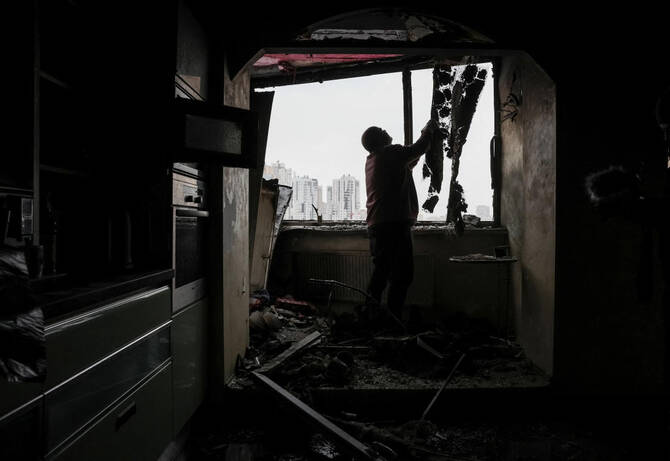
A resident cleans his flat in an apartment building damaged by a Russian drone strike, amid Russia’s attack on Ukraine, in Kyiv, Jan. 9, 2026. (Reuters)
Short Url
Updated 09 January 2026
Follow

Kyiv mayor calls for temporary evacuation over heating outages

  • “Moscow is trying to use cold weather as a tool of terror,” Zelensky said
  • He said 20 residential buildings in Kyiv had been damaged, including the Qatari embassy

KYIV: Mass heating outages caused by Russian strikes on Kyiv are set to last into the weekend, as the capital’s mayor called on residents to temporarily leave the city with sub-zero temperatures expected to fall even lower.
A massive missile and drone attack on Kyiv killed four and ripped open apartment blocks. Moscow also fired its feared Oreshnik ballistic missile at western Ukraine, drawing condemnation from Europe.
The barrage came hours after Moscow rejected a plan by Kyiv and its Western allies to deploy peacekeeping forces to Ukraine should a ceasefire be reached.
AFP journalists in Kyiv saw residents running for shelter late Thursday night as the air raid siren echoed, and heard Russian drones exploding into residential buildings and missiles whistling over the capital.
“Moscow is trying to use cold weather as a tool of terror,” Ukrainian President Volodymyr Zelensky said at a meeting in Kyiv with British Defense Secretary John Healy.
He said 20 residential buildings in Kyiv had been damaged, including the Qatari embassy, in one of the largest attacks on the capital for months.
Qatar expressed “deep regret” over the embassy hit and said that none of its staff there had been harmed.

- ‘Very difficult’ situation -

The Russian barrage left around half of all apartment blocks in the capital, some 6,000 buildings, without heating, Mayor Vitaliy Klitschko said.
Temperatures are set to fall to -15C on Saturday.
Officials said they were hopeful some heating could be restored on Friday night.
“In some areas where the damage is more complex, additional time is needed,” Ukraine’s Restoration Minister Oleksiy Kuleba said.
Klitschko said the situation was “very difficult” and called on “residents of the capital who have the opportunity to temporarily leave the city for places with alternative sources of power and heat to do so.”
City authorities said they had set up 1,200 warming centers.

- Russia fires rarely-used missile -

A medic who died at a building that was struck in a repeat attack was among the four killed, officials said. Another 26 were wounded.
Nina, 70, who lives in one of the buildings hit, told AFP she was angry that the world was talking about a possible deal to end the conflict at a time when Russia was launching such deadly barrages.
“Where is Europe, where is America? It doesn’t hurt them the same way,” she said.
Her neighbor, 58-year-old Kostiantyn Kondratchenko fought the second-floor blaze from a drone hit with a hose used to water flowers, he told AFP.
The barrage is just the latest to batter Ukraine as diplomats wrangle for a breakthrough in what has been Europe’s deadliest conflict since World War II.
Russia has shown no sign of slowing down its ground offensive or aerial bombardments.
Moscow’s defense ministry said it had fired the Oreshnik ballistic missile on “strategic targets” — only the second time the new weapon, which the Kremlin says is impossible to stop, is known to have been used.

- ‘Escalatory and unacceptable’ -

Ukrainian authorities said a ballistic missile traveling “at about 13,000 kilometers (8,000 miles) per hour” had struck an “infrastructure facility” near the western city of Lviv.
It said Russia had attacked “civilian infrastructure,” without specifying the target or extent of any damage.
The Oreshnik is an intermediate-range ballistic missile that can be equipped with both nuclear and conventional warheads.
Lviv region officials said that radiation levels were within normal range after the attack.
France, Germany and Britain condemned Moscow’s “escalatory and unacceptable” use of Oreshnik, a UK government spokeswoman said after a call between leaders of the three countries.
Across the border in Russia’s Belgorod, the governor said more than half a million people were without power or heating after a Ukrainian attack targeted the region’s utilities.
Despite intense diplomatic efforts led by US President Donald Trump, a deal to end the fighting remains elusive.
Moscow baulked this week after European leaders and US envoys announced post-war guarantees for Ukraine would include a US-led monitoring mechanism and a multinational force.
Russia called the plan “dangerous” and “destructive.”
Key territorial issues are also unresolved as Russia insists on getting full control of Ukraine’s Donbas region, part of which is still controlled by Kyiv.
Russia occupies around 20 percent of Ukraine.
Tens of thousands have been killed since it invaded in February 2022, millions forced to flee their homes and much of eastern and southern Ukraine decimated.


Venezuela’s acting president calls for oil industry reforms to attract more foreign investment

Updated 4 sec ago
Follow

Venezuela’s acting president calls for oil industry reforms to attract more foreign investment

  • In her speech, Rodríguez said money earned from foreign oil sales would go into two funds: one dedicated to social services for workers and the public health care system, and another to economic development and infrastructure projects

CARACAS, Venezuela: Venezuela’s acting President Delcy Rodriguez used her first state of the union address on Thursday to promote oil industry reforms that would attract foreign investment, an objective aggressively pushed by the Trump administration since it toppled the country’s longtime leader less than two weeks ago.
Rodríguez, who has been under pressure from the US to fall in line with its vision for the oil-rich nation, said sales of Venezuelan oil would go to bolster crisis-stricken health services, economic development and other infrastructure projects.
While she sharply criticized the Trump administration and said there was a “stain on our relations,” the former vice president also outlined a distinct vision for the future between the two historic adversaries, straying from her predecessors, who have long railed against American intervention in Venezuela.
“Let us not be afraid of diplomacy” with the US, said Rodriguez, who must now navigate competing pressures from the Trump administration and a government loyal to former President Nicolás Maduro.
The speech, which was broadcast on a delay in Venezuela, came one day after Rodríguez said her government would continue releasing prisoners detained under Maduro in what she described as “a new political moment” since his ouster.
Trump on Thursday met at the White House with Venezuelan opposition leader María Corina Machado, whose political party is widely considered to have won 2024 elections rejected by Maduro. But in endorsing Rodríguez, who served as Maduro’s vice president since 2018, Trump has sidelined Machado.
In her speech, Rodríguez said money earned from foreign oil sales would go into two funds: one dedicated to social services for workers and the public health care system, and another to economic development and infrastructure projects.
Hospitals and other health care facilities across the country have long suffered. Patients are asked to provide practically all supplies needed for their care, from syringes to surgical screws. Economic turmoil, among other factors, has pushed millions of Venezuelans to migrate from the South American nation in recent years.
In moving forward, the acting president must walk a tightrope, balancing pressures from both Washington and top Venezuelan officials who hold sway over Venezuela’s security forces and strongly oppose the US Her recent public speeches reflect those tensions — vacillating from conciliatory calls for cooperation with the US, to defiant rants echoing the anti-imperialist rhetoric of her toppled predecessor.
American authorities have long railed against a government they describe as a “dictatorship,” while Venezuela’s government has built a powerful populist ethos sharply opposed to US meddling in its affairs.
For the foreseeable future, Rodríguez’s government has been effectively relieved of having to hold elections. That’s because when Venezuela’s high court granted Rodríguez presidential powers on an acting basis, it cited a provision of the constitution that allows the vice president to take over for a renewable period of 90 days.
Trump enlisted Rodríguez to help secure US control over Venezuela’s oil sales despite sanctioning her for human rights violations during his first term. To ensure she does his bidding, Trump threatened Rodríguez earlier this month with a “situation probably worse than Maduro.”
Maduro, who is being held in a Brooklyn jail, has pleaded not guilty to drug-trafficking charges.
Before Rodríguez’s speech on Thursday, a group of government supporters was allowed into the presidential palace, where they chanted for Maduro, who the government insists remains the country’s president. “Maduro, resist, the people are rising,” they shouted.