Thirty-nine dead in Gambia migrant boat sinking, officials say

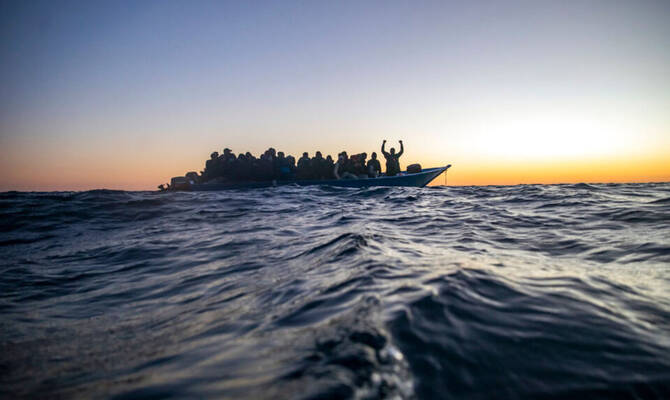
The death toll after a boat carrying Europe-bound migrants capsized off Gambia’s coast on New Year’s Eve has risen to 39, two government officials told Reuters. (AP/File)
Short Url
Updated 08 January 2026
Follow

Thirty-nine dead in Gambia migrant boat sinking, officials say

  • The migration ‌route ⁠used ​by ‌West Africans trying to reach Spain via the Canary Islands is one of the world’s deadliest

BANJUL: The death toll after a boat carrying Europe-bound migrants capsized off Gambia’s coast on New Year’s Eve has risen to 39, two government officials told Reuters, as ​survivors described the vessel as “overcrowded and dilapidated.”
Gambia’s defense ministry last week put the death toll at seven and said more than 200 people could have been on board.
A total of 112 people had been rescued as of Wednesday, said Sima Lowe, public relations officer for Gambia’s Immigration Department, and a senior defense ministry official who asked not to be named as ‌he was not ‌authorized to speak to press.
The migration ‌route ⁠used ​by ‌West Africans trying to reach Spain via the Canary Islands is one of the world’s deadliest.
Survivors interviewed by Reuters after being released from hospital in Gambia this week said the boat had been heading for Europe.
Their stories highlight the risks and challenges faced by would-be migrants from West Africa who are often fleeing poverty, unemployment and ⁠lack of opportunities in their home countries.
“It’s ... desperation driving me to risk my ‌life, seeking better opportunities in Europe due ‍to poverty and lack of prospects ‍at home,” said Sadibou Fatty, who described the journey as “traumatic.”
“I ‍survived the tragedy but lost friends and fellow passengers,” he said, adding that, unlike many others on board, he knew how to swim.
Of the 39 dead, 24 were recovered in Gambian territory, while 15 were ​recovered in Senegalese territory, the defense official said.
Passengers on board included citizens of Gambia, Senegal, Guinea, Mali, Ivory Coast, ⁠Burkina Faso and Sierra Leone, the official said.
“My friends in Europe inspired me to take the ‘back way,’” said Kajali Camara, another survivor, referring to irregular immigration routes via small boats.
“They’re supporting their families back home, and I wanted a better life too,” he said.
Gambia’s government said it intercepted more than 2,700 would-be migrants in 2025.
During the first 11 months of 2025, irregular migration into the European Union along the West African route fell 60 percent, according to the EU’s border agency Frontex.
The drop is largely due to ‌stronger prevention efforts by departure countries working with EU member states, Frontex has said.


Hundreds of thousands of Catholics join Black Nazarene procession in Manila

Updated 6 sec ago
Follow

Hundreds of thousands of Catholics join Black Nazarene procession in Manila

  • Around 80 percent of Philippines’ 110 million population are Roman Catholics 
  • The annual 6km procession began at 4 a.m. on Friday

MANILA: Hundreds of thousands of Catholics took part in a barefoot procession in Manila on Friday, carrying the Black Nazarene, a centuries-old ebony statue of Jesus Christ believed by devotees to have miraculous powers.

Around 80 percent of the Philippines’ 110 million population identify as Roman Catholic, a legacy of more than 300 years of Spanish colonization.

After a midnight mass joined by tens of thousands of worshippers, the procession began at the Quirino Grandstand at 4 a.m., with the statue of Jesus placed on a cross carried by a four-wheel carriage, which then slowly traveled through Manila’s roads, thronged by massive crowds, for around 6 kilometers. 

The procession — which is known as the Traslacion (“transfer”) or as the Feast of the Black Nazarene — commemorates the 1787 relocation of the Black Nazarene from a church inside the colonial Spanish capital of Intramuros in Manila’s center to its present location in Quiapo Church. 

For many Filipino Catholics, the annual procession and the festivities surrounding it are deeply personal — a way of expressing deep faith and spiritual devotion, and conveying their personal prayers. 

“As early as Jan. 8, you will already see a long queue of devotees near the Quirino Grandstand. Many of them are there to get the chance to wipe a towel on the image of the Nazarene. That’s their devotion,” Jomel Bermudez told Arab News. 

Many devotees believe the statue is miraculous, and that touching it, or the ropes attached to its float, can heal illness or help provide good health, jobs and a better life. This belief is partly because the statue has survived multiple earthquakes, fires, floods, and even the bombing of Manila in the Second World War.

“We wipe (the towels) on our bodies, especially on sick people,” Bermudez continued. “My father, for example, was diagnosed with leukemia and now he is already recovered. He was one of my prayers last year. He is 56, and he survived.” 

On Friday, many devotees were clad in maroon and yellow as they flooded the streets to swarm the statue, jostling for a chance to pull its thick rope. 

Bermudez, who first participated in the procession in 2014, said he was inspired to do so by seeing the effect it had had on friends who had taken part.  

“I saw friends whose lives really changed. That encouraged me to change too,” he said, adding that this year he is one of a group on the sidelines helping to keep the procession moving. 

“My prayers before were already answered. This time, I’m praying for my children’s success in life,” he said. 

Jersey Banez, a 23-year-old devotee, was among those who arrived as early as 2 a.m. to take part in the procession. 

“I do this every year. I’m just grateful for a happy life,” he told Arab News. “My prayer is still the same: to have a happy family and a happy life, and that everyone and everything that needs to change will change.”