


NEW YORK CITY: A report by the UN Human Rights Office published on Wednesday details the “asphyxiating impact” of Israeli laws, policies and practices on nearly every aspect of Palestinian life in the occupied West Bank, including East Jerusalem.
It warns that Israel is violating obligations under international law that require states to prohibit and eradicate racial segregation and apartheid.
The report describes systemic discrimination against Palestinians in the territory as a “long-standing concern,” but notes that the conditions have sharply deteriorated since at least December 2022. It presents extensive examples showing how the daily lives of Palestinians have become increasingly constrained and insecure.
“Israeli authorities treat Israeli settlers and Palestinians residing in the West Bank under two distinct bodies of law and policies, resulting in unequal treatment on a range of critical issues, including movement and access to resources such as land and water,” it states.
“Palestinians continue to be subjected to large-scale confiscation of land and deprivation of access to resources. This has had the effect of dispossessing them of their lands and homes, alongside other forms of systemic discrimination, including criminal prosecution in military courts during which their due process and fair trial rights are systematically violated.”
The report concludes there are reasonable grounds to believe that the Israeli policies of separation, segregation and subordination are designed to maintain the oppression and domination of Palestinians, and intended to be permanent.
“Acts committed with the intention to maintain such a policy amount to a violation of Article 3 of the International Convention on the Elimination of All Forms of Racial Discrimination, which prohibits racial segregation and apartheid,” it warns.
“Since Oct. 7, 2023, the government of Israel further expanded the use of unlawful force, arbitrary detention and torture, repression of civil society and undue restrictions on media freedoms, severe movement restrictions, settlement expansion and related violations in the occupied West Bank, which has marked an unprecedented deterioration of the human rights situation there.”
The report adds that this deterioration is compounded by the continuation and escalation of settler violence, which is often carried out with the “acquiescence, support and participation” of Israeli security forces.
The system of military justice applied to Palestinians provides little or no human rights protections, in stark contrast to Israeli civil law, which affords far greater protections to settlers.
“The military legal system is a significant tool in controlling Palestinians in the occupied West Bank,” according to the report.
It documents patterns of “unlawful killings” and other forms of “state and setter violence,” citing numerous cases in which lethal force was deliberately used when unwarranted, in a discriminatory manner and with apparent intent to kill.
On Jan. 28, 2025, security forces shot 10-year-old Saddam Hussein Rajab in the abdomen. He died from his injuries on Feb. 7. Video footage showed the boy standing empty-handed at the entrance of a building in Tulkarem when he was shot. Israeli forces initially claimed the boy “was messing with the ground” in a suspicious manner, before announcing an investigation.
On Feb. 9, 2025, security forces killed 23-year-old Sondos Shalabi, who was eight months pregnant. They said she had been shot because she was “looking suspiciously at the ground” but acknowledged she was unarmed and no explosive devices were found nearby.
The UN report adds that “discriminatory movement restrictions” severely undermine the human rights of Palestinians by infringing on the right to work, blocking access to land, and causing widespread financial hardship.
It also notes that roads built exclusively for Israeli settlers, connecting settlements, have resulted in the fragmentation of Palestinian communities.
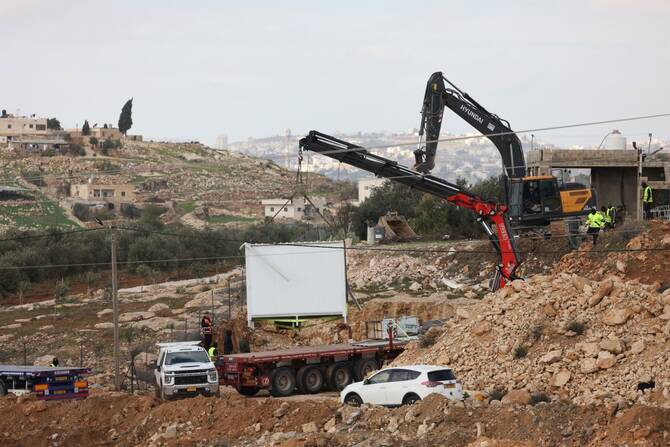
In addition, thousands of Palestinians have been evicted from their homes across the West Bank. The report said this might amount to unlawful transfer, which is a war crime.
Palestinians are further deprived of their natural resources. The report describes how Israeli authorities confiscate and demolish Palestinian water infrastructure while diverting flows to settlements. This forces the Palestinian Authority to purchase large quantities of water from an Israeli government company that extracts water from the occupied West Bank.
“There is a systematic asphyxiation of the rights of Palestinians in the West Bank,” said the UN’s human rights chief, Volker Turk.
“Whether accessing water, school, rushing to hospital, visiting family or friends, or harvesting olives, every aspect of life for Palestinians in the West Bank is controlled and curtailed by Israel’s discriminatory laws, policies and practices.
“This is a particularly severe form of racial discrimination and segregation that resembles the kind of apartheid system we have seen before.
“Every negative trend documented in the report has not only continued but accelerated. And every day this is allowed to continue, the consequences worsen for Palestinians.”
Impunity for violations remains widespread, the report found, including violence committed by Israeli security forces and settlers. Of more than 1,500 killings of Palestinians recorded between Jan. 1, 2017, and Sep. 30, 2025, Israeli authorities opened just 112 investigations, resulting in only one conviction.
Meanwhile thousands of Palestinians remain arbitrarily detained by Israeli authorities, most of them under “administrative detention” without charge or trial.
Illegal settlement expansions continue unabated; Israeli authorities and settlers have appropriated tens of thousands of hectares of Palestinian land, largely for settlements and outposts that are deemed illegal under international law.
The report cites the recent approval by Israel’s Security Cabinet of 19 new settlements, a move that Israeli officials have said is intended to block the possibility of establishing a Palestinian state.
“The Israeli authorities must repeal all laws, policies and practices that perpetuate systemic discrimination against Palestinians based on race, religion or ethnic origin,” Turk said.
He called on Israel to end its unlawful presence in occupied Palestinian territory, dismantle all settlements, evacuate settlers, and respect the right of the Palestinian people to self-determination.


