

Israel issues over 3,000 tenders for E1 settlement in Jerusalem

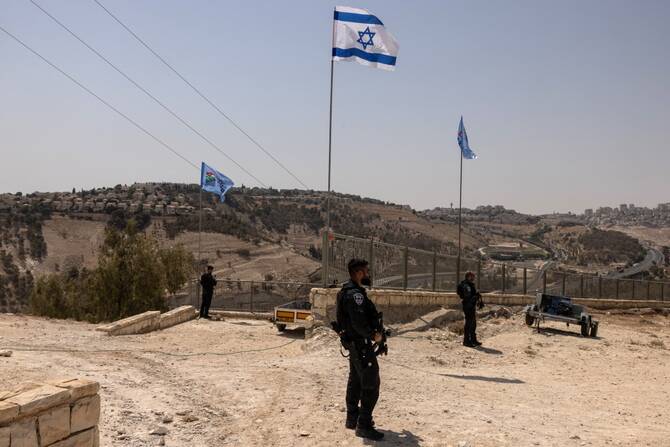
Israeli policemen stand guard near the settlement of Maale Adummim, in a land corridor known as E1, outside Jerusalem in the occupied West Bank, Aug. 14, 2025. (AFP)
Short Url
Updated 07 January 2026
Follow

Israel issues over 3,000 tenders for E1 settlement in Jerusalem

  • The settlement would divide the occupied West Bank, hindering the establishment of a viable and territorially contiguous Palestinian state

LONDON: Israeli authorities have issued tenders for the construction of 3,401 settlement units in the area known as E1, east of Jerusalem.

Muayyad Shaban, head of the Commission against the Wall and Settlements, said Israeli authorities had transitioned from planning and approval to implementation of the E1 plan.

The settlement, if developed, would divide the occupied West Bank, hindering the establishment of a viable and territorially contiguous Palestinian state.

After nearly 30 years of delay under intense international opposition to the plan, Israeli Finance Minister Bezalel Smotrich approved plans for 3,400 homes in E1 last August.

Shaban said E1 constituted “a highly dangerous escalation in the repercussions of the accelerated assault on Palestinian lands through colonial settlement plans.”

The plan would separate Jerusalem from surrounding Palestinian areas and connect the Maale Adumim settlement to the city, undermining the possibility of a contiguous Palestinian state, he added.

In 2025, Israeli authorities issued plans for 10,098 new settlement units, marking an unprecedented increase in settlement tenders.

Over 7,000 units were allocated to Maale Adumim, along with 900 units for Efrat in Bethlehem and 700 for Ariel in Salfit, reflecting a push to deepen colonial control over Palestinian land, the Commission against the Wall and Settlements reported.


Iraqi army fully takes over key base following US withdrawal

Updated 6 sec ago
Follow

Iraqi army fully takes over key base following US withdrawal

BAGHDAD: US forces have fully withdrawn from an air base in western Iraq in implementation of an agreement with the Iraqi government, Iraqi officials said Saturday.
Washington and Baghdad agreed in 2024 to wind down a US-led coalition fighting the Daesh group in Iraq by September 2025, with US forces departing bases where they had been stationed.
However, a small unit of US military advisers and support personnel remained. Iraqi Prime Minister Mohammed Shia Al-Sudani in October told journalists that the agreement originally stipulated a full pullout of US forces from the Ain Al-Asad air base in western Iraq by September. But “developments in Syria” since then required maintaining a “small unit” of between 250 and 350 advisers and security personnel at the base.
Now all US personnel have departed.
Iraqi Army Chief of Staff Lt. Gen. Abdul Amir Rashid Yarallah oversaw the assignment of tasks and duties to various military units at the base on Saturday following the withdrawal of US forces and the Iraqi Army’s full assumption of control over the base, the military said in a statement.
The statement added that Yarallah “instructed relevant authorities to intensify efforts, enhance joint work, and coordinate between all units stationed at the base, while making full use of its capabilities and strategic location.”
A Ministry of Defense official who spoke on condition of anonymity because he was not authorized to comment publicly confirmed that all US forces had departed the base and had also removed all American equipment from it.
There was no statement from the US military on the withdrawal.
US forces have retained a presence in the semi-autonomous Kurdish region in northern Iraq and in neighboring Syria.
The departure of US forces may strengthen the hand of the government in discussions around disarmament of non-state armed groups in the country, some of which have used the presence of US troops as justification for keeping their own weapons.
Al-Sudani said in a July interview with The Associated Press that once the coalition withdrawal is complete, “there will be no need or no justification for any group to carry weapons outside the scope of the state.”