

Pakistani stock market breaches 182,000-mark as cash inflows extend new year rally

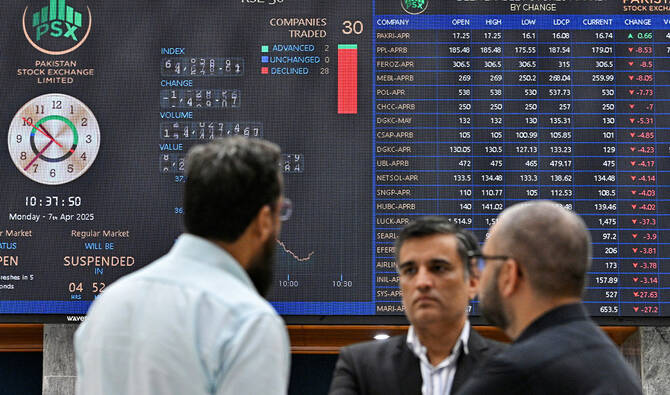
Stock brokers monitor share prices on a digital screen during a trading session at the Pakistan Stock Exchange, in Karachi on April 7, 2025. (AFP/File)
Short Url
Updated 07 January 2026
Follow

Pakistani stock market breaches 182,000-mark as cash inflows extend new year rally

  • KSE-100 index gained 3,373.30 points, or 1.88%, to close at 182,408.23 points
  • The stock market has delivered 4.8% returns in the first three sessions of 2026

KARACHI: Pakistani stocks extended their new year rally and breached the 182,000-point mark for the first time ever on Monday, with analysts attributing the gains to a fresh wave of cash inflows driven by increased liquidity.

The benchmark KSE-100 index at the Pakistan Stock Exchange (PSX) gained 3,373.30 points, or 1.88%, to close at 182,408.23, up from the previous close of 179,034.93.

Shahid Ali Habib, chief executive officer (CEO) at Arif Habib Limited, said a fresh wave of inflows from domestic institutions has fueled the strong start to the new year, with the index continuing to touch new all-time highs.

“Aggressive buying was seen today in blue chips which took the KSE-100 through the 180k mark,” he told Arab News.

“UBL (United Bank Limited), HBL (Habib Bank Limited) and ENGROH (Engro Holdings) contributed more than 1,000-points of the total 3,300-points DoD (day to day) gain (+1.88%).”

Pakistan’s stock market has marked a strong start to 2026 as broad-based institutional buying lifted major sectors and bolstered investor confidence at the beginning of the year.

The stock market has delivered a 4.80% return (8,353.92 points) in the first three sessions of 2026, according to Topline Securities market research firm.

Najeeb Ahmed Khan Warsi, chief business officer at Al-Habib Capital Market Private Limited, said the surge was driven by liquidity influx, positive listed company results and supportive government policies.

“With economic data fueling investor confidence, the bullish trend continues,” he added.

Ahsan Mehanti, the CEO of Arif Habib Commodities said the bullish activity was led by “industrials on weak global crude prices.”

“Upbeat data on fertilizer sales surging by 34pc YoY [year on year] and oil sales up 6pc YoY in Dec’25 and strong rupee played catalyst role in record close at PSX,” he said.


Pakistan eyes Iran route for potato exports as price slump persists amid Afghan border closure

Updated 5 sec ago
Follow

Pakistan eyes Iran route for potato exports as price slump persists amid Afghan border closure

  • Pakistan closed land borders with Afghanistan in October 2025, leading to oversupply of potatoes in markets 
  • Pakistan exports vegetables, particularly potatoes, a big chunk of which goes to Central Asian states via Afghanistan

ISLAMABAD: Pakistan is considering using the Iran corridor to export the surplus quantity of potatoes it has produced to Central Asian countries, Food Security Minister Rana Tanveer Hussain said on Monday as Islamabad grapples with a potato price glut triggered by the Afghan border closure. 

Potato prices in Pakistan fell sharply as Islamabad closed its Chaman and Torkham border crossings with Afghanistan in October 2025 after fierce clashes between both countries left dozens dead. 

Afghanistan is a huge market for Pakistani potatoes. The suspension of trade with Kabul has created an oversupply of the vegetable in Pakistan, leading to a sharp decline in its prices. Pakistani farmers have complained of suffering heavy losses as the border crossings remain closed. 

Speaking at a meeting of the National Assembly Standing Committee on Food Security, Hussain said the border closures had initially caused problems but Islamabad has identified an alternative route to export potatoes to Central Asian countries.

“Authorities are considering the Zahedan-Taftan land route,” Hussain told participants of the meeting. 

Hussain said Pakistan generally stores 7 to 8 million metric tons of potatoes annually, adding that the country does not have the capacity to store more than that. 

“However, this year 13 million metric tons of potatoes were cultivated, which has caused the market to crash,” he explained.

Pakistan exports vegetables, particularly potatoes, a big chunk of which goes to Tajikistan, Kazakhstan, Kyrgyzstan, Turkmenistan, Uzbekistan and beyond via Afghanistan.

Hussain said another alternative trade route, one to China, was even shorter but the multiple visa requirement there would create complications for Pakistani exporters. 

He said due to the mountainous terrain in China, fuel and other transportation costs would also be higher. 

The Commerce Division officials present at the meeting said the route through Iran is longer compared to Afghanistan. 

“The prime minister is personally looking into the issue,” Hussain assured members of the committee. 

The minister said Russia was not importing Pakistan’s potatoes as it had imposed restrictions due to quality issues a few years earlier. 

Pakistan’s agriculture sector accounted for 24 percent of the country’s gross domestic product (GDP) and employed more than 37 percent of its labor force in 2024, according to the Economic Survey 2024-25.

Landlocked Afghanistan has also leaned more heavily on trade routes via Iran and Central Asia since the border closures last year, as it aims to reduce its dependence on Pakistan amid surging tensions between the neighbors.