

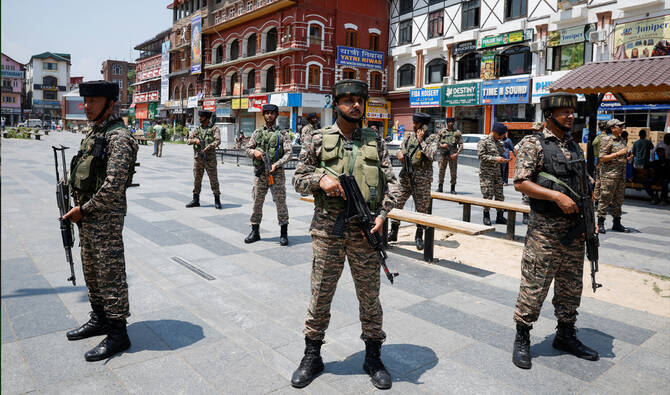

ISLAMABAD: Prime Minister Shehbaz Sharif stressed on Monday that the only path to durable peace in South Asia was through a just resolution of the Kashmir dispute, urging the international community to take steps to rein in New Delhi from alleged rights violations in the territory.
The message came from Sharif’s office on the occasion of the ‘Right to Self-Determination Day,’ which Pakistan marks every year on Jan. 5 to pay tribute to the people of Indian-administered Kashmir. It commemorates the day when the United Nations Security Council passed a resolution in 1949, supporting the right of the people of Jammu and Kashmir to decide their future through a free and fair plebiscite under UN supervision.
The Muslim-majority Himalayan region of Kashmir has been divided between Pakistan and India since their independence from British rule in 1947. Both countries govern parts of the territory but claim it in full, having fought two of their three wars over the disputed region.
“The world must also recognize that a just resolution of the Jammu and Kashmir dispute is the only way to achieve durable peace in South Asia,” Sharif said, according to a statement from the Prime Minister’s Office (PMO).
“We urge the international community to urgently call upon India to halt its widespread human rights violations in IIOJK [Illegally Occupied Jammu and Kashmir], reverse its unilateral and illegal actions of 5 August 2019, repeal the draconian laws and give the right to self-determination to the Kashmiri people, as enshrined in the United Nations Security Council resolutions.”
The Pakistani prime minister was referring to India’s decision of Aug. 5, 2019, in which it repealed Article 370 of its constitution that granted special autonomous status to the part of Kashmir New Delhi administers. The move infuriated Pakistan, with Islamabad describing it as a “unilateral” step.
Pakistan accuses the Indian government of using oppressive tactics to suppress the people of Kashmir. It alleges New Delhi imprisons Kashmir leaders and activists without any charge and muzzles free speech in the territory.
India denies the charges and accuses Pakistan of supporting militant outfits in the region, allegations that Islamabad denies.
“All Indian coercive measures have failed to subjugate the will of the people of IIOJK or suppress their quest for the right to self-determination,” Sharif said. “The people of Pakistan salute their indomitable courage, commitment and resilience, in the face of Indian atrocities.”
The Pakistani prime minister’s message comes as tensions persist between the nuclear-armed nations. India and Pakistan engaged in the worst fighting since 1999 in May 2025 when the two countries pounded each other with missiles, drone strikes, fighter jets and traded artillery fire for four days before Washington brokered a ceasefire on May 10.
Tensions surged after India blamed Pakistan for supporting a militant attack in Indian-administered Kashmir on Apr. 22 that killed over 20 people, mostly Hindu tourists. Pakistan denied involvement and called for a credible investigation to probe the incident.


