

Ukraine targets Moscow daily with drones this year, Russia says, in apparent escalation

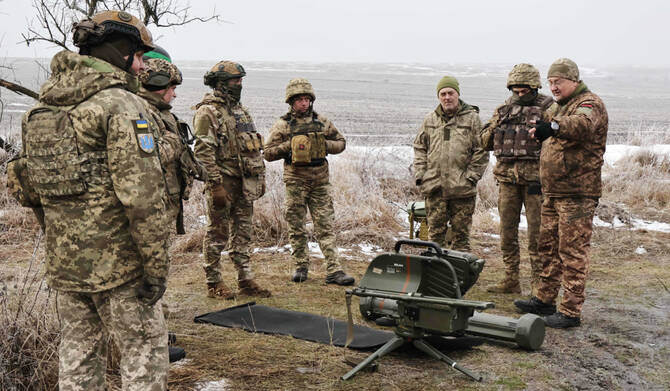
Servicemen of the 65th Infantry Division practice firing a MILAN lightweight infantry anti-tank missile system during exercises in the Zaporizhzhia region on January 4, 2026, amid the Russian invasion of Ukraine. (AFP)
Short Url
Updated 05 January 2026
Follow

Ukraine targets Moscow daily with drones this year, Russia says, in apparent escalation

  • The attacks have forced temporary closures ⁠at Moscow airports and at scores of other Russian airports for safety reasons, Russia’s aviation watchdog Rosaviatsiya said on Telegram
  • Moscow Mayor ‍Sergei Sobyanin has reported multiple interceptions since New ‍Year’s Eve without giving further details

MOSCOW: Ukraine has targeted Moscow with drones every day of 2026 so far, according to data published by Russia’s Defense Ministry, in what appeared to ​mark an escalation from earlier, more sporadic attacks on the Russian capital.
By midnight on Sunday alone, Russian air defense systems had destroyed 57 drones over the Moscow region out of 437 downed over Russia, the ministry said on its Telegram messaging app.
The daily activity suggests a shift from past patterns, ‌when Moscow was hit ‌more intermittently, often around ‌symbolic ⁠dates or ​as a ‌form of signalling rather than a near routine pressure campaign.
There was no immediate comment from Ukraine, but Kyiv has increasingly used long range drones to strike targets deep inside Russia. Ukraine says such attacks aim to disrupt military logistics and energy infrastructure, raise costs for Moscow’s ⁠war effort and respond to repeated Russian missile and drone attacks ‌in the war that Russia launched nearly ‍four years ago.
Moscow Mayor ‍Sergei Sobyanin has reported multiple interceptions since New ‍Year’s Eve without giving further details.
Russia typically reports only how many drones its air defenses say they downed, not how many Ukraine launched, and rarely discloses the full extent of ​damage unless civilians are killed or civilian sites are hit.
The attacks have forced temporary closures ⁠at Moscow airports and at scores of other Russian airports for safety reasons, Russia’s aviation watchdog Rosaviatsiya said on Telegram.
The disruption comes during Russia’s extended New Year and Orthodox Christmas break, which this year runs through January 9, when many Russians take vacations and travel domestically and abroad, making it one of the country’s busiest periods for transport and tourism.
According to RIA state news calculations, Russia’s air defenses intercepted and destroyed at least ‌1,548 Ukrainian drones over Russian territory and the Crimean Peninsula over the past week. 


UNICEF warns of rise in sexual deepfakes of children

Updated 12 sec ago
Follow

UNICEF warns of rise in sexual deepfakes of children

  • The findings underscored the use of “nudification” tools, which digitally alter or remove clothing to create sexualized images

UNITED NATIONS, United States: The UN children’s agency on Wednesday highlighted a rapid rise in the use of artificial intelligence to create sexually explicit images of children, warning of real harm to young victims caused by the deepfakes.
According to a UNICEF-led investigation in 11 countries, at least 1.2 million children said their images were manipulated into sexually explicit deepfakes — in some countries at a rate equivalent to “one child in a typical classroom” of 25 students.
The findings underscored the use of “nudification” tools, which digitally alter or remove clothing to create sexualized images.
“We must be clear. Sexualized images of children generated or manipulated using AI tools are child sexual abuse material,” UNICEF said in a statement.
“Deepfake abuse is abuse, and there is nothing fake about the harm it causes.”
The agency criticized AI developers for creating tools without proper safeguards.
“The risks can be compounded when generative AI tools are embedded directly into social media platforms where manipulated images spread rapidly,” UNICEF said.
Elon Musk’s AI chatbot Grok has been hit with bans and investigations in several countries for allowing users to create and share sexualized pictures of women and children using simple text prompts.
UNICEF’s study found that children are increasingly aware of deepfakes.
“In some of the study countries, up to two-thirds of children said they worry that AI could be used to create fake sexual images or videos. Levels of concern vary widely between countries, underscoring the urgent need for stronger awareness, prevention, and protection measures,” the agency said.
UNICEF urged “robust guardrails” for AI chatbots, as well as moves by digital companies to prevent the circulation of deepfakes, not just the removal of offending images after they have already been shared.
Legislation is also needed across all countries to expand definitions of child sexual abuse material to include AI-generated imagery, it said.
The countries included in the study were Armenia, Brazil, Colombia, Dominican Republic, Mexico, Montenegro, Morocco, North Macedonia, Pakistan, Serbia, and Tunisia.