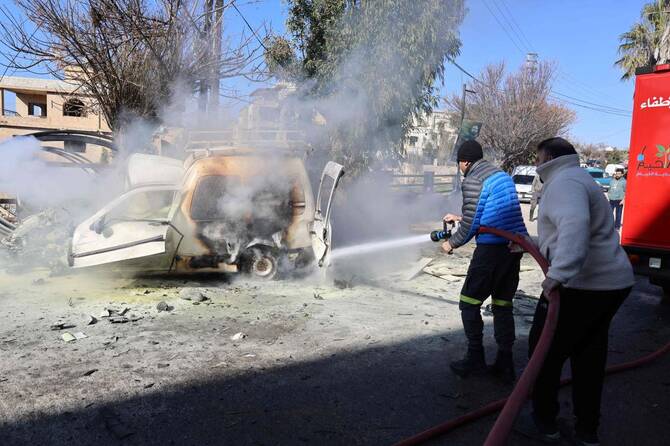
BEIRUT: Lebanon said a strike in the south killed two Sunday while Israel said it had struck a Hezbollah operative, the latest raids as Beirut seeks to disarm the Iran-backed group.
Despite a year-old ceasefire between Israel and Hezbollah, Israel carries out regular strikes on Lebanon, usually saying it is targeting Hezbollah sites and operatives, and has maintained troops in five areas it deems strategic.
Lebanon’s health ministry said two people were killed in an “Israeli enemy strike that targeted a vehicle” near the town of Jmaijmeh, around 10 kilometers (six miles) from the border.
An Israeli military statement said that “in response to Hezbollah’s continued violations of the ceasefire understandings,” it had struck an operative from the militant group in the area.
Under heavy US pressure and fears of expanded Israeli strikes, Beirut has committed to disarming Hezbollah, which was badly weakened after more than a year of hostilities with Israel including two months of open war that ended with the November 2024 ceasefire.
Lebanon’s army was expected to complete the disarmament south of the Litani River — about 30 kilometers from the border with Israel — by the end of 2025, before tackling the rest of the country.
Lebanon’s cabinet is to meet on Thursday to discuss the army’s progress, while the ceasefire monitoring committee — comprising Lebanon, Israel, the United States, France and UN peacekeepers — is also set to meet this week.
On Sunday, Israel’s Foreign Minister Gideon Saar acknowledged on X that the Lebanese government and army had made efforts to disarm Hezbollah but said “they are far from sufficient,” citing “Hezbollah’s efforts to rearm and rebuild, with Iranian support.”
Israel has previously questioned the Lebanese military’s effectiveness and has accused Hezbollah of rearming, while the group itself has rejected calls to surrender its weapons.
At least 350 people have been killed by Israeli fire in Lebanon since the ceasefire, according to an AFP tally of Lebanese health ministry reports.

Two dead in Israeli strike on south Lebanon
https://arab.news/j2hs7
Two dead in Israeli strike on south Lebanon
- Lebanon’s health ministry said two people were killed in an “Israeli enemy strike that targeted a vehicle” near the town of Jmaijmeh
Jordan-EU Summit confirms commitment to regional security, investment
- Jordan, EU to hold investment conference in April to enhance economic partnerships
- Ursula von der Leyen says King Abdullah is key partner for Europe in Middle East, relations between parties ‘built on stability, on security, but also on prosperity’
LONDON: King Abdullah II of Jordan hosted the first Jordan-EU Summit in Amman on Thursday, with European Council President Antonio Costa and European Commission President Ursula von der Leyen in attendance.
King Abdullah noted that the summit had built on last year’s Strategic and Comprehensive Partnership agreement with the EU, enhancing political dialogue and economic cooperation, according to the Jordan News Agency.
He spoke of his appreciation of the EU’s support for Jordan’s modernization and highlighted the country’s readiness to enhance cooperation in security, defense, education, and youth empowerment.
“Our partnership is also vital in supporting sustainable growth, job creation, and innovation, by strengthening economic resilience and expanding cooperation in trade and investment,” King Abdullah added.
Crown Prince Hussein attended the expanded meeting with EU leaders at Al-Husseiniya Palace.
Jordan and the EU are to hold an investment conference in April to enhance economic partnerships between the two parties, while the first EU-Jordan Security and Defense Dialogue is also scheduled for this year in Amman.
Costa said that bilateral relations with Jordan were strong and would continue to strengthen. He praised Jordan’s initiatives to address the humanitarian crisis in Gaza by establishing air and land corridors; its contribution to regional stability; its efforts to de-escalate tensions; and its pursuit of peace.
Von der Leyen said that King Abdullah was a key partner for Europe in the Middle East, and that relations between the EU and Jordan were “built on stability, on security, but also on prosperity.”
She added: “In times of growing geopolitical challenges, it is good to know that the European Union and Jordan stand side by side, because this is what friends do."
She noted that the EU aimed to increase investments in Jordan to 1.4 billion euros.
The summit also covered regional and international developments, including Lebanon, the Syrian Arab Republic, Ukraine, the reform of the Palestinian Authority, and Israeli settlement policy in the West Bank.
Jordan’s Prime Minister Jaafar Hassan, Deputy Prime Minister and Foreign Minister Ayman Safadi, Director of the Office of His Majesty Alaa Batayneh, Minister of Planning and International Cooperation Zeina Toukan, Jordan’s Ambassador to Belgium Yousef Bataineh, and a number of European officials also attended the summit.