


Maduro now in New York jail as Trump says US to ‘run’ Venezuela

1 / 2
One of the helicopters carrying Venezuela's President Nicolas Maduro and his wife Cilia Flores arrives after they were captured overnight in Venezuela by U.S. forces, at the Westside Heliport in New York City, U.S. January 3, 2026. (REUTERS)
2 / 2
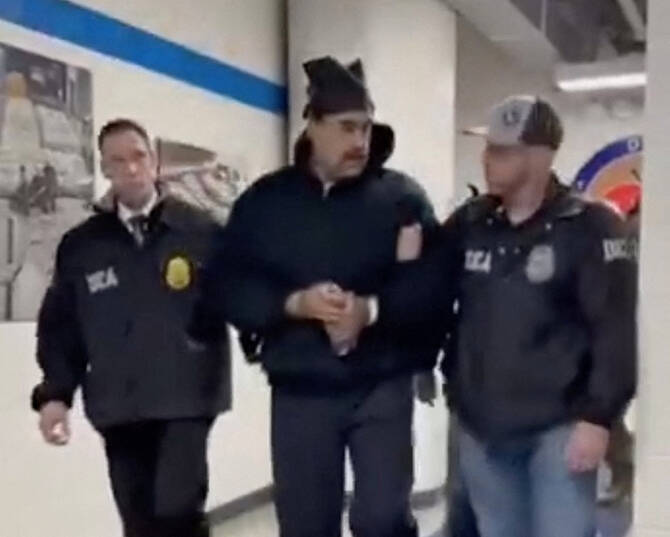
This screengrab taken from the X account of Rapid Response 47, the official White House rapid response account, shows Venezuelan President Nicolas Maduro (C) escorted by DEA agents inside the headquarters of the US Drug Enforcement Administration (DEA) in lower Manhattan, New York, on January 3, 2026. (AFP)
Short Url
Updated 04 January 2026
Follow

Maduro now in New York jail as Trump says US to ‘run’ Venezuela

  • The 63-year-old leader was to be taken first to the offices of the US Drug Enforcement Administration, then to the Metropolitan Detention Center, a federal facility in Brooklyn, according to US media

PALM BEACH, United States: Venezuelan President Nicolas Maduro was in a New York jail Saturday, hours after American special forces seized and flew him out of his country — which Donald Trump said would come under effective US control.
The US president’s announcement followed a lightning pre-dawn attack in which commandos grabbed Maduro and his wife while air strikes pounded sites in and around Caracas.
A US government plane carrying Maduro landed at a military base shortly after nightfall, and he was transported by helicopter to New York City, where the couple were to be arraigned on drug trafficking and weapons charges.
The White House posted video on X of Maduro, handcuffed and in sandals, escorted by federal agents through a US Drug Enforcement Administration facility in New York.
“Good night, happy new year,” the 63-year-old leftist is heard saying in English.
Despite the success of the risky raid, what happens next is highly uncertain.
Trump said he was “designating people” from his cabinet to be in charge in Venezuela but gave no further details.
In another surprise, Trump indicated US troops could be deployed, saying Washington is “not afraid of boots on the ground.”
But he appeared to reject the possibility of the country’s opposition taking power and said he could work instead with Maduro’s vice president, Delcy Rodriguez.
One aspect that became clearer was Trump’s interest in Venezuela’s vast oil reserves.
“We’re going to have our very large United States oil companies... go in, spend billions of dollars, fix the badly broken infrastructure,” he said.
“We’ll be selling large amounts of oil.”

Trump dismisses opposition leader 

US-backed opposition leader Maria Corina Machado, who won last year’s Nobel Peace Prize, posted on social media that “the hour of freedom has arrived.”
She called for the opposition’s 2024 election candidate, Edmundo Gonzalez Urrutia, to “immediately” assume the presidency.
But Trump was surprisingly cold about expectations that Machado could become Venezuela’s new leader, saying she doesn’t have “support or respect” there.
Instead, he touted Rodriguez, saying “she’s essentially willing to do what we think is necessary to make Venezuela great again.”
Rodriguez poured cold water on that, demanding Maduro’s release and vowing to “defend” the country.
Late Saturday, Venezuela’s Supreme Court ordered Rodriguez to assume presidential powers “in an acting capacity.”
Reflecting the confusion, Trump indicated US involvement is likely for the long haul.
“We’re going to stay until such time as the proper transition can take place,” he said.
Venezuela’s ally China said it “strongly condemns” the US operation, and called for Maduro to be “immediately released.”
“The US’s move is in clear violation of international law, basic norms in international relations, and the purposes and principles of the UN Charter,” China’s Foreign Affairs Ministry said in a statement Sunday.
Meanwhile, France warned a solution cannot “be imposed from outside.”
United Nations Secretary-General Antonio Guterres said he was “deeply concerned that the rules of international law have not been respected.”
At Venezuela’s request, the UN Security Council will meet Monday to discuss the crisis, the Somali presidency of the Council told AFP.

Blackout and bombing 

Venezuelans had been bracing for attacks as US forces spent months massing off the coast.
Caracas residents woke to explosions and the whir of military helicopters around 2:00 am (0600 GMT). Air strikes hit a major military base and an air base, among other sites, for nearly an hour.
The top US military officer, General Dan Caine, said 150 aircraft took part in the operation, supporting troops who choppered in to seize Maduro with the help of months of intelligence into his daily habits — down to “what he ate” and what pets he kept.
Maduro and his wife “gave up” without a struggle and there was “no loss of US life,” he said.
Venezuelan authorities have yet to release casualty figures. But Trump told the New York Post that “many” Cubans in Maduro’s security detail were killed.
Within hours of the operation, Caracas had fallen eerily quiet, with police stationed outside public buildings and the smell of smoke drifting through the streets.

Shifting justifications 

The US and numerous European governments did not recognize Maduro’s legitimacy, saying he stole elections in 2018 and 2024.
Maduro — in power since 2013 after taking over from leftist mentor Hugo Chavez — long accused Trump of seeking regime change in order to control Venezuela’s oil reserves.
Trump has offered several justifications for the aggressive policy toward Venezuela, at times stressing illegal migration, narcotics trafficking and oil.
But he had previously avoided openly calling for regime change.
Several members of Congress quickly questioned the legality of the operation. But Trump’s key ally Mike Johnson, top Republican in the House of Representatives, said it was “justified.”


FBI says arson suspect targeted Mississippi synagogue because it’s a Jewish house of worship

Updated 6 sec ago
Follow

FBI says arson suspect targeted Mississippi synagogue because it’s a Jewish house of worship

JACKSON, Mississippi: A suspect in an arson fire at a synagogue that was bombed by the Ku Klux Klan decades ago admitted to targeting the historic institution because it’s a Jewish house of worship and confessed what he had done to his father, who turned him in to authorities after observing burn marks on his son’s ankles, hands and face, the FBI said Monday.
Stephen Pittman was charged with maliciously damaging or destroying a building by means of fire or an explosive. The 19-year-old suspect confessed to lighting a fire inside the building, which he referred to as “the synagogue of Satan,” according to an FBI affidavit filed in US District Court in Mississippi on Monday.
At a first appearance hearing Monday in federal court, a public defender was appointed for Pittman, who attended via video conference call from a hospital bed. Both of his hands were visibly bandaged. He told the judge that he was a high school graduate and had three semesters of college.
Prosecutors said he could face five to 20 years in prison if convicted. When the judge read him his rights, Pittman said, “Jesus Christ is Lord.”
A crime captured on video
The fire ripped through the Beth Israel Congregation in Jackson shortly after 3 a.m. on Saturday. No congregants or firefighters were injured. Security camera video released Monday by the synagogue showed a masked and hooded man using a gas can to pour liquid on the floor and a couch in the building’s lobby.
The weekend fire badly damaged the 165-year-old synagogue’s library and administrative offices. Five Torahs — the sacred scrolls with the text of the first five books of the Hebrew Bible — located inside the sanctuary were being assessed for smoke damage. Two Torahs inside the library, where the most severe damage was done, were destroyed. One Torah that survived the Holocaust was behind glass and was not damaged in the fire, according to the congregation.
The suspect’s father contacted the FBI and said his son had confessed to setting the building on fire. Pittman had texted his father a photo of the rear of the synagogue before the fire, with the message, “There’s a furnace in the back.” His father had pleaded with his son to return home, but “Pittman replied back by saying he was due for a homerun and ‘I did my research,’” the affidavit said.
During an interview with investigators, Pittman said he had stopped at a gas station on his way to the synagogue to purchase the gas used in the fire. He also took the license plate off his vehicle at the gas station. He used an ax to break out a window of the synagogue, poured gas inside and used a torch lighter to start the fire, the FBI affidavit said.
The FBI later recovered a burned cellphone believed to be Pittman’s and took possession of a hand torch that a congregant had found.
A congregation determined to rebuild
Yellow police tape on Monday blocked off the entrances to the synagogue building, which was surrounded by broken glass and soot. Bouquets of flowers were laid on the ground at the building’s entrance — including one with a note that said, “I’m so very sorry.”
The congregation’s president, Zach Shemper, has vowed to rebuild the synagogue and said several churches had offered their spaces for worship during the rebuilding process. Shemper attended Pittman’s court appearance Monday but didn’t comment afterward.
With just several hundred people in the community, it has never been particularly easy being Jewish in Mississippi’s capital city, but members of Beth Israel have taken special pride in keeping their traditions alive in the heart of the Deep South.
Nearly every aspect of Jewish life in Jackson could be found under Beth Israel’s roof. The midcentury modern building not only housed the congregation but also the Jewish Federation, a nonprofit provider of social services and philanthropy that is the hub of Jewish society in most US cities. The building also is home to the Institute of Southern Jewish Life, which provides resources to Jewish communities in 13 southern states. A Holocaust memorial was outdoors behind the synagogue building.
Because Jewish children throughout the South have attended summer camp for decades in Utica, Mississippi, about 30 miles  southwest of Jackson, many retain a fond connection to the state and its Jewish community.
“Jackson is the capital city, and that synagogue is the capital synagogue in Mississippi,” said Rabbi Gary Zola, a historian of American Jewry who taught at Hebrew Union College in Cincinnati. “I would call it the flagship, though when we talk about places like New York and Los Angeles, it probably seems like Hicksville.”
A rabbi who stood up to the KKK
Beth Israel as a congregation was founded in 1860 and acquired its first property, where it built Mississippi’s first synagogue, after the Civil War. In 1967, the synagogue moved to its current location.
It was bombed by local KKK members not long after relocating, and then two months after that, the home of the synagogue’s leader, Rabbi Perry Nussbaum, was bombed because of his outspoken opposition to segregation and racism.
At a time when opposition to racial segregation could be dangerous in the Deep South, many Beth Israel congregants hoped the rabbi would just stay quiet, but Nussbaum was unshakable in believing he was doing the right thing by supporting civil rights, Zola said.
“He had this strong, strong sense of justice,” Zola said.
