

Flash floods triggered by heavy rains in Afghanistan kill at least 17 people

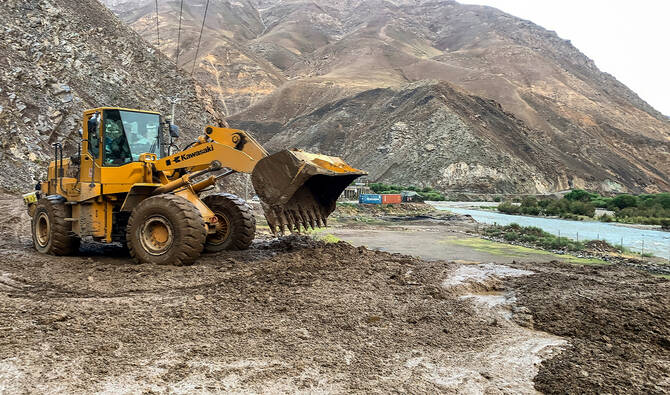
A bulldozer cleans mud and debris from a road after the flash floods hit the Omarz area in Khenj district of Panjshir province on July 13, 2025. (AFP/File)
Short Url
Updated 02 January 2026
Follow

Flash floods triggered by heavy rains in Afghanistan kill at least 17 people

  • Afghanistan, like neighboring Pakistan and India, is highly vulnerable to extreme weather events, particularly flash floods following seasonal rains
  • Decades of conflict, poor infrastructure, deforestation, and the intensifying effects of climate change have amplified the impact of such disasters

KABUL: The season’s first heavy rains and snowfall ended a prolonged dry spell but triggered flash floods in several areas of Afghanistan, killing at least 17 people and injuring 11 others, a spokesman for Afghanistan’s national disaster management authority said Thursday.

The dead included five members of a family in a property where the roof collapsed on Thursday in Kabkan, a district in Herat province, according to Mohammad Yousaf Saeedi, spokesman for the Herat governor. Two of the victims were children.

Most of the casualties have occurred since Monday in districts hit by flooding, and the severe weather also disrupted daily life across central, northern, southern, and western regions, according to Mohammad Yousaf Hammad, a spokesman for Afghanistan’s National Disaster Management Authority.

Hammad said the floods also damaged infrastructure in the affected districts, killed livestock, and affected 1,800 families, worsening conditions in already vulnerable urban and rural communities.

Hammad said the agency has sent assessment teams to the worst-affected areas, with surveys ongoing to determine further needs.

Afghanistan, like neighboring Pakistan and India, is highly vulnerable to extreme weather events, particularly flash floods following seasonal rains.

Decades of conflict, poor infrastructure, deforestation, and the intensifying effects of climate change have amplified the impact of such disasters, especially in remote areas where many homes are made of mud and offer limited protection against sudden deluges.

The United Nations and other aid agencies this week warned that Afghanistan is expected to remain one of the world’s largest humanitarian crises in 2026. The UN and its humanitarian partners launched a $1.7 billion appeal on Tuesday to assist nearly 18 million people in urgent need in the country.


Militants kill 6 officers and a civilian in ambushes on police vehicles in northwest Pakistan

Updated 2 sec ago
Follow

Militants kill 6 officers and a civilian in ambushes on police vehicles in northwest Pakistan

  • Assailants ambushed a police vehicle and killed one officer in Kohat — When police reinforcements arrived minutes later, they launched another attack and killed five more officers and a civilian
  • No group claimed responsibility for this week’s attacks, but suspicion may fall on the Pakistani Taliban, also known as Tehrik-e-Taliban Pakistan, or the TTP
PESHAWAR, Pakistan: A pair of attacks on police vehicles by suspected militants killed at least six police officers and a civilian in northwest Pakistan on Tuesday, authorities said.
The assailants ambushed a police vehicle and killed one officer in Kohat, a district in Khyber Pakhtunkhwa province. When police reinforcements arrived minutes later, they launched another attack and killed five more officers and a civilian, police official Kamran Khan said.
Separately on Tuesday, a suicide bomber detonated explosives at a police post in Bukkur, a district in eastern Punjab province, killing two officers and wounding four others, police official Shahzad Rafiq said.
He provided no further details and only said officers were still investigating.
No group immediately claimed responsibility for the attacks, which have increased across the country in recent months.
President Asif Ali Zardari condemned the attacks in Kohat and Bukkur and offered condolences to the victims’ families.
The latest violence followed an attack on a paramilitary post in Karak on Monday, when a drone loaded with explosives wounded several officers. The attackers later ambushed two ambulances transporting the wounded, killing three officers and burning their bodies before fleeing. The driver of the second ambulance transported several wounded officers despite suffering burn injuries and authorities recovered the remains of the three officers.
No group claimed responsibility for this week’s attacks, but suspicion may fall on the Pakistani Taliban, also known as Tehrik-e-Taliban Pakistan, or the TTP. The TTP is separate from, but closely allied with, Afghanistan’s Taliban. Islamabad has accused the group of operating from inside Afghanistan, a claim the TTP and Kabul deny.
Pakistan’s military said it killed at least 70 militants on Sunday in strikes along the Afghan border, targeting hideouts of Pakistani militants blamed for recent attacks inside the country.