Iranian president offers talks as protests spread

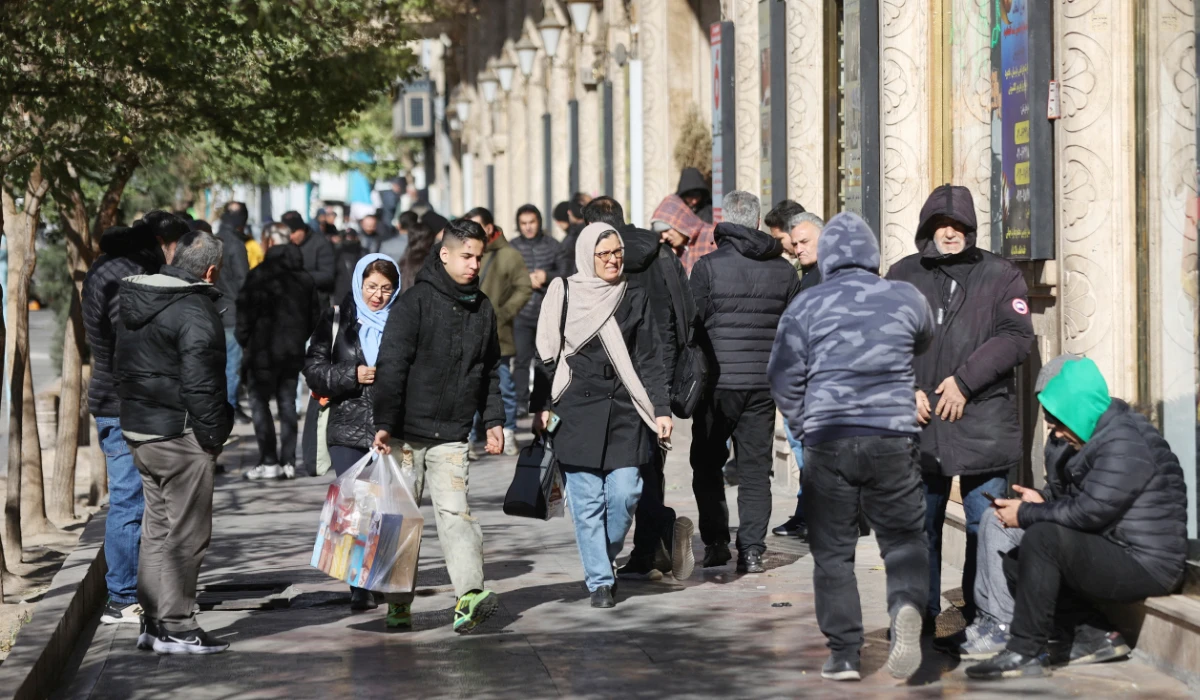
People walk past stores as the value of the Iranian Rial drops, in Tehran, Iran, December 30, 2025. (REUTERS)
Short Url
Updated 30 December 2025
Follow

Iranian president offers talks as protests spread

  • Government spokesperson Fatemeh Mohajerani said a dialogue mechanism would be set up and include talks with protest leaders

TEHRAN: Protests over Iran’s soaring cost of living spread ​to several universities on Tuesday, with students joining shopkeepers and bazaar merchants, semi-official media reported, as the government offered dialogue with demonstrators.
Iran’s rial currency has lost nearly half its value against the dollar in 2025, with inflation reaching 42.5 percent in December in a country where unrest has repeatedly flared in recent years and which is facing US sanctions and threats of Israeli strikes.

FASTFACTS

• The leadership acknowledges protests stem from economic pressure, promises monetary reforms.

• Iranian rial hits record low under the impact of Western sanctions.

President Masoud Pezeshkian said in a social media post late that he had asked the interior minister to listen to “legitimate demands” of protesters. 
Government spokesperson Fatemeh Mohajerani said a dialogue mechanism would be set up and include talks with protest leaders.
“We officially recognize the protests ... We hear their voices and we know that this originates from natural pressure arising from the pressure on people’s livelihoods,” ‌she said on Tuesday ‌in comments carried by state media.
Video of protests in Tehran showed scores of people marching along a street chanting “Rest in peace Reza Shah,” a reference to the founder of the royal dynasty ousted in the 1979 revolution. 
Footage aired on Iranian state television on Monday showed people gathered in central Tehran chanting slogans. The semi-official Fars News Agency reported that hundreds of students held protests on Tuesday at four universities in Tehran. 


Gulf countries offer support to Yemen’s legitimate government, Saudi security

Updated 31 December 2025
Follow

Gulf countries offer support to Yemen’s legitimate government, Saudi security

  • Qatar, Kuwait say their security is based on the security of Saudi Arabia and the GCC
  • Bahrain said it had confidence in the leadership of Saudi Arabia and the UAE to contain differences

LONDON: Gulf and Arab countries on Tuesday offered support to the internationally recognized government in Yemen after the UAE withdrew its forces from the country.

The statements were issued after the military coalition supporting Yemen’s government carried out airstrikes on a shipment of weapons and vehicles destined for southern separatist forces.

The shipment arrived in the port of Mukalla on board two vessels from Fujairah in the UAE.

The Emirates was asked by Rashad Al-Alimi, head of Yemen’s presidential council, to withdraw its troops from Yemen within 24 hours.

Saudi Arabia said the separatists, operating under the Southern Transitional Council and supported by the UAE, posed a direct threat to the Kingdom’s national security and regional stability by recently seizing territory in the  governorates of Hadramaut and Al-Mahra.

Qatar said it was following the developments “with keen interest.”

A foreign ministry statement said Doha fully supported the legitimate Yemeni government and stressed the importance of preserving Yemen's unity and  safeguarding the interests of the Yemeni people.

It added that the security of Saudi Arabia and the security of the member states of the Gulf Cooperation Council (GCC) “constitute an inseparable part of the security of the State of Qatar, reflecting the deep-rooted fraternal ties and shared destiny that unite the GCC states.”

The ministry commended the statements issued by Saudi Arabia and the UAE “which reflect a commitment to prioritizing the interests of the region.”

Kuwait also offered “unwavering support” for Yemen’s government and said the security of Saudi Arabia and GCC is the basis of its own national security.

Its foreign ministry praised the “responsible approach” taken by both Saudi Arabia and the UAE.

Bahrain, the current GCC chair, said it had confidence in the leadership of Saudi Arabia and the UAE “and their ability to contain any differences in viewpoints within the framework of a unified Gulf.”

The foreign ministry statement offered “unequivocal” support toward regional and international initiatives and efforts aimed at reaching a comprehensive and lasting political solution in Yemen.

Egypt said it had full confidence in Saudi Arabia and the UAE “to handle the current developments in Yemen with wisdom.”

Cairo will continue efforts toward a comprehensive political settlement for Yemen, the statement said.