

Review: ‘Sorry, Baby’ by Eva Victor

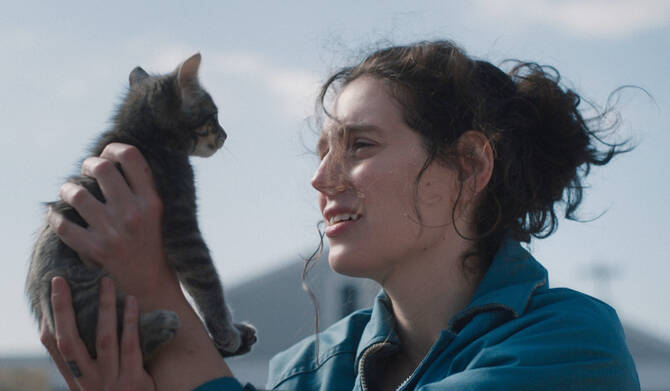
Eva Victor appears in Sorry, Baby by Eva Victor, an official selection of the 2025 Sundance Film Festival. (Supplied)
Short Url
Updated 27 December 2025
Follow

Review: ‘Sorry, Baby’ by Eva Victor

  • Victor makes a deliberate narrative choice; we never witness the violence of what happens to her character

There is a bravery in “Sorry, Baby” that comes not from what the film shows, but from what it withholds. 

Written, directed by, and starring Eva Victor, it is one of the most talked-about indie films of the year, winning the Waldo Salt Screenwriting Award at Sundance and gathering momentum with nominations, including nods at the Golden Globes and Gotham Awards. 

The film is both incisive and tender in its exploration of trauma, friendship, and the long, winding road toward healing. It follows Agnes, a young professor of literature trying to pick up the pieces after a disturbing incident in grad school. 

Victor makes a deliberate narrative choice; we never witness the violence of what happens to her character. The story centers on Agnes’ perspective in her own words, even as she struggles to name it at various points in the film. 

There is a generosity to Victor’s storytelling and a refusal to reduce the narrative to trauma alone. Instead we witness the breadth of human experience, from heartbreak and loneliness to joy and the sustaining power of friendship. These themes are supported by dialogue and camerawork that incorporates silences and stillness as much as the power of words and movement. 

The film captures the messy, beautiful ways people care for one another. Supporting performances — particularly by “Mickey 17” actor Naomi Ackie who plays the best friend Lydia — and encounters with strangers and a kitten, reinforce the story’s celebration of solidarity and community. 

“Sorry, Baby” reminds us that human resilience is rarely entirely solitary; it is nurtured through acts of care, intimacy and tenderness.

A pivotal scene between Agnes and her friend’s newborn inspires the film’s title. A single, reassuring line gently speaks a pure and simple truth: “I know you’re scared … but you’re OK.” 

It is a reminder that in the end, no matter how dark life gets, it goes on, and so does the human capacity to love.


Mini op-ed: We need a ‘potluck’ culture of reading

Updated 10 March 2026
Follow

Mini op-ed: We need a ‘potluck’ culture of reading

DUBAI: The number of times we hear, “My kids don’t read,” “I don’t have the time,” or “Do people even read anymore?” is alarming.

With newspapers declared dead and YouTube summaries or ChatGPT reviews becoming the main course of words, I often wonder: have those asking these questions considered the role they play?

Each of us — school representatives, librarians, parents, educators, children, and even occasional readers — must ask whether we are helping create a culture where reaching for a book feels as natural as reaching for a smartphone.

Even the smallest effort counts. I think of a reading culture as a potluck where everyone brings something small, and together it becomes a wholesome meal. If you do not know where to begin, look around.

Purva Grover is an author, poet, playwright, stage director, TEDx speaker, and creative entrepreneur. (Supplied)

The UAE is rich in public libraries including in Sharjah and Dubai, such as the Mohammed Bin Rashid Library, which is proof that access is not the issue. 

Meanwhile, Saudi Arabia is embedding reading into its national identity under Vision 2030 through digital libraries, major book fairs, and daily school reading.

Not a reader? Events such as the Emirates Airline Festival of Literature or the Sharjah International Book Fair offer easy entry points for conversation, community and curiosity.

They are built on cultural blocks that subtly encourage even non-readers into reading spaces. You could even start a reading club. I run one in Dubai called The Reading Village and have seen its quiet magic.

Culture is built by saying yes. And no to pirated PDFs on WhatsApp, as well as unchecked screen habits.

Tiny habits can help build an environment where reading becomes as much a part of our lives as scrolling on Netflix to decide what to binge-watch next.

Purva Grover is an author, poet, playwright, stage director, TEDx speaker, and creative entrepreneur. She is the founder of The Reading Village, a Dubai-based community.