

Malaysia’s Najib to face verdict in mega 1MDB graft trial

Short Url
Updated 26 December 2025
Follow

Malaysia’s Najib to face verdict in mega 1MDB graft trial

  • If found guilty, the man once seen as political royalty faces years more behind bars, already serving a six-year jail term after a conviction in a separate case relating to the 1MDB fund

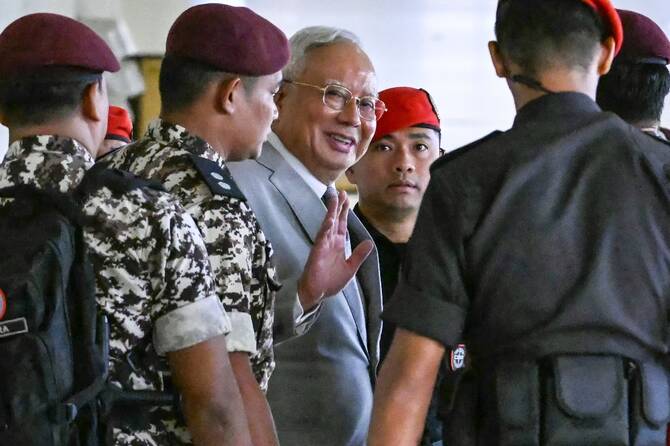
PUTRAJAYA: Former prime minister Najib Razak faces judgment on Friday for his alleged involvement in Malaysia’s 1MDB mega-graft scandal, with a guilty verdict likely to add years to a sentence already being served.
The 72-year-old stands accused of four counts of abuse of power and 21 counts of money laundering linked to the plunder of hundreds of millions of dollars from the Southeast Asian nation’s 1MDB sovereign wealth fund, sparking probes in several countries.
If found guilty, the man once seen as political royalty faces years more behind bars, already serving a six-year jail term after a conviction in a separate case relating to the 1MDB fund.
Friday’s hearing opened around 9:00 am (0100 GMT) before the Kuala Lumpur High Court, sitting in the country’s administrative capital of Putrajaya.
Presiding judge Collin Lawrence Sequerah started reading a lengthy verdict, before breaking for Friday afternoon prayers three hours later, with the hearing to resume at 3:00 pm.
It was not known whether sentencing would immediately follow a guilty verdict, but if acquitted, Najib will return to Kajang Prison outside Kuala Lumpur to continue serving his prior sentence.

- ‘Unmeritorious’ -

During the morning’s reading, Judge Sequerah slapped down several of the defense’s arguments, including that Najib was duped by his close associate, the shadowy businessman Low Taek Jho, better known as Jho Low.
“The evidence clearly points to the fact that this was no coincidence but was evident of a relationship in which Jho Low operated as a proxy or agent of the accused (Najib) with regard to the running of the affairs of 1MDB,” Sequerah said.
The defense’s argument that Najib was “misled and duped by management and by Jho Low is unmeritorious,” the judge said.
Low, who is currently on the run, is seen as the mastermind behind the scheme to plunder the country’s investment vehicle and spend the proceeds on everything from high-end real estate to pricey art, including a Monet and a Van Gogh.
Sequerah also dismissed arguments that money flowing into Najib’s accounts was “donations” from Middle East funders, calling it a “tale that surpassed even those from the Arabian Nights.”
The verdict will continue Friday afternoon in the marathon trial, seen as the main case in the 1MDB affair and which involves some 2.28 billion ringgit ($563 million).
Prosecutors say Najib abused his position as prime minister, finance minister and 1MDB advisory board chairman to move large amounts of money from the fund to his personal accounts more than a decade ago.
The prosecution presented bank records, testimony from over 50 witnesses and documentary evidence.
Najib “paints himself as a victim of rogue subordinates, when in truth, he was the single most powerful decision-maker,” deputy public prosecutor Ahmad Akram Gharib told the court during closing arguments.
“The accused wielded absolute financial, executive and political control,” he said.

- ‘No fair trial’ -

Najib’s lawyers have previously said the politician was unaware that 1MDB’s management was working hand in glove with Low to suck out large amounts of money from the fund, ostensibly established to foster economic growth in Malaysia.
Najib’s lawyer, Muhammad Shafee Abdullah, last week told journalists his client “never got a fair trial.”
He again blamed Low for the scandal, which sparked probes internationally, from neighboring Singapore to Europe and the United States, and rocked Malaysia’s image abroad.
Najib has issued an apology for the 1MDB scandal happening during his tenure, but maintains he knew nothing about illegal transfers from the now-defunct state fund.
His legal battle was dealt a blow on Monday after he lost a bid to serve the remainder of his current jail term at home.
Each count of abuse of power is punishable by up to 20 years in jail and a fine of up to five times the amount of the bribe.


Backlash as Australia kills dingoes after backpacker death

Updated 58 min 43 sec ago
Follow

Backlash as Australia kills dingoes after backpacker death

  • The euthanization program has stirred debate about how to manage the local population of dingoes
  • Wildlife experts said killing the animals was the wrong response and may threaten the island’s dingo population

SYDNEY: Australian authorities have sparked a backlash by killing a group of dingoes linked to the death of a young Canadian woman on an island in the country’s east.
The Queensland government said six animals were put down after 19-year-old backpacker Piper James’s body was found on January 19 at a beach on the World Heritage-listed island of K’gari.
The euthanization program has stirred debate about how to manage the local population of dingoes, a sandy-colored canine believed to have first arrived in Australia 4,000 to 5,000 years ago.
An autopsy conducted on James’ body found evidence “consistent with drowning” but also detected injuries corresponding to dingo bites.
“Pre-mortem dingo bite marks are not likely to have caused immediate death,” said a spokesperson for the Coroners Court of Queensland.
The coroner’s investigation into the cause of death was expected to take several weeks.
In response, the Queensland government said a pack of 10 dingoes involved would be euthanized after rangers had observed some “aggressive behavior.”
Six of the dingoes had already been euthanized, the state’s environment minister, Andrew Powell, told reporters Sunday.
“Obviously, the operation will continue,” he said.
The traditional owners of K’gari, the Butchulla people, said the state’s failure to consult with them before euthanizing the dingoes — or wongari in their language — was “unexpected and disappointing.”
“Once again, it feels as though economic priorities are being placed above the voices of the people and traditional owners, which is frustrating and difficult to accept,” the Butchulla Aboriginal Corporation said in a statement to Australian media this week.
‘You are food’
Wildlife experts said killing the animals was the wrong response and may threaten the island’s dingo population, estimated at just 70-200 animals.
Given their small numbers, killing a pack of 10 animals would harm the population’s genetic diversity, said Mathew Crowther, professor of quantitative conservation biology at the University of Sydney.
“There’s no moral from the dingoes’ point of view. They’re just being wild animals, doing wild things,” Crowther said.
Dingoes tend to lose their fear of people as they interact with tourists, some of whom defy advice against feeding the animals.
“That’s the worst thing you can do to a wild animal,” Crowther said.
“They just relate humans to food, and if you don’t give them food, well, you are food — that’s basically how it is.”
Dingoes are wild, predatory animals and need to be treated with respect, said Bill Bateman, associate professor in the school of molecular and life sciences at Curtin University.
The canines are more likely to attack children or people who are alone, and may be triggered when people turn their backs or run, he said.
“These are important animals, and therefore we need to change the way we deal with them, otherwise we’re just going to keep reacting to these attacks and driving the population of dingoes down,” Bateman said.
Wildlife managers, rangers, Indigenous people and tourism operators need to work together so that humans and dingoes can coexist on the island, he said.
Todd James, the father of Piper, has described on social media how his family’s hearts were “shattered” by her death.
News of the dingoes’ euthanization was “heart-wrenching,” he told Australian media, adding however that he recognized it may be necessary for safety because of the pack’s behavior.